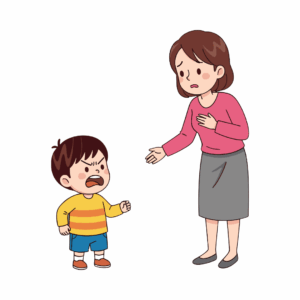
A child strikes a playmate at a crowded birthday party.
The room goes entirely quiet.
The caregiver’s heart rate spikes instantly. The face flushes with heat. The ancient, biological instinct is to grab the child and leave the room immediately, or to shout an apology to the other parents.
Instead, the caregiver takes a deep breath. The caregiver kneels down to eye level. The caregiver speaks softly and says the phrase repeated in countless online forums and modern parenting books.
“We don’t hit. Hands are not for hitting.”
The child stares blankly. The child turns. And then, the child strikes the playmate again.
This moment is devastatingly hard. It feels like a public failure. It leaves the adult feeling utterly powerless. Caregivers today are trying incredibly hard to do the right thing. They are actively attempting to break generational cycles of yelling, shaming, and punitive discipline. They are showing up with empathy. They are validating big feelings.
But the posts on social media are not translating to reality. The peace is missing. The boundaries are leaking.
When a child repeatedly ignores a gentle intervention, a quiet thought arrives in the back of the caregiver’s mind. Is this actually working? The answer many adults are arriving at is no. The research agrees that this specific application of gentle parenting is backfiring.
The problem is not the empathy. The problem is that the modern application of empathy has systematically stripped authority from the parental role. There is a profound, neurobiological difference between validating an emotion and permitting a behavior.
Gentle parenting was never designed to be passive. It requires an unshakeable, calm authority. When that authority dissolves, children are left adrift in their own neurological chaos.
Here is exactly what is happening in those moments of failure, and the psychological shift required to close the gap between endless frustration and actual behavioral change.
The Epidemic of Caregiver Burnout
Before addressing the child’s behavior, it is necessary to look honestly at the adult’s experience.
Caregivers are exhausted.
They are carrying the immense weight of trying to manage their own emotional triggers while simultaneously attempting to perfectly curate their child’s emotional landscape. In 2024, researchers published a peer-reviewed study in the journal PLOS ONE, providing the first empirical investigation into the modern gentle parenting movement.
The findings were a stark validation of what many adults already feel in their bones.
Over one-third of parents who identified as “gentle parents” reported significant feelings of parenting uncertainty, severe exhaustion, and burnout. The data suggests a direct correlation between the misinterpretation of gentle parenting and caregiver collapse.
By giving absolute deference to a child’s every mood, adults have become trapped in a cycle of endless negotiation. They attempt to facilitate autonomy by offering constant choices. They over-validate every minor frustration. They suppress their own natural irritation. The result is a home environment devoid of clear hierarchy or structure.
This burnout is completely understandable. It happens because the adult is attempting to perform an impossible task. The adult is trying to control a child’s internal emotional state while actively refusing to control the external physical environment.
When an adult believes that a successful day means the child never cried, never felt disappointed, and never heard the word “no,” they are setting a metric that guarantees failure. It is a crushing standard.
True gentle parenting does not seek to eliminate negative emotions. It seeks to provide a sturdy, safe container in which those negative emotions can be safely expressed.
The Evolution of Parenting Paradigms
To understand how this container was lost, it helps to examine the psychological frameworks that define how humans raise children.
In the 1960s, clinical and developmental psychologist Diana Baumrind revolutionized the field of child psychology. Through extensive observational studies, she identified distinct parenting styles. In the 1980s, researchers Maccoby and Martin expanded this typology into a clear, two-dimensional matrix based on two metrics: demandingness and responsiveness.
Demandingness is the level of structure, boundary-setting, and behavioral expectations an adult places on a child. Responsiveness is the level of emotional warmth, attunement, and validation the adult provides.
The intersection of these two simple metrics creates four distinct realities for a child.
| Parenting Style | Responsiveness (Warmth and Support) | Demandingness (Expectations and Limits) | Core Characteristic |
|---|---|---|---|
| Authoritarian | Low | High | Demands absolute compliance through fear and strict behavioral control. |
| Permissive | High | Low | Provides endless validation and warmth without enforcing firm boundaries. |
| Authoritative | High | High | Combines warm emotional connection with unshakeable, consistent limits. |
| Uninvolved | Low | Low | Remains emotionally detached, neglectful, and entirely disengaged. |
The traditional, authoritarian model relied heavily on restrictive behavioral control. It demanded absolute obedience. It provided zero emotional support. The phrase “because I said so” was the entire foundation of this approach. While it successfully achieved short-term behavioral compliance, it did so at a terrible cost. It sacrificed emotional safety and long-term psychological resilience.
Recognizing the emotional damage caused by authoritarianism, modern caregivers pivoted. They swung the pendulum violently in the opposite direction. They embraced the concept of gentle parenting.
In its pure, clinical definition, gentle parenting belongs firmly in the authoritative quadrant. It requires incredibly high levels of warmth. But it also requires incredibly high levels of demandingness. It is often described in psychological literature as the “tender teacher” approach.
However, something was lost in translation. As the clinical theory trickled down into social media infographics and playground advice, the demandingness vanished.
The Permissive Drift
Somewhere in the modern cultural dialogue, the word “gentle” became hopelessly confused with the word “permissive.”
Well-meaning adults began operating under the misconception that being gentle requires suppressing their own boundaries. They began to believe that setting a firm limit, or forcing a child to stop an activity, would damage the child’s autonomy. This is not authoritative care. It is textbook permissiveness.
Permissive caregivers are highly responsive. They are warm, loving, and deeply invested in the emotional lives of the children in their care. Yet, they passively accept chaotic behavior. They believe a child must be free to make choices without constant guidance. When limits are occasionally attempted, they are inconsistent. They are easily abandoned the moment a meltdown begins, simply to stop the child’s distress.
This approach feels kind in the moment. It feels respectful. But the psychological outcomes are deeply concerning.
Children raised in permissive environments consistently rank lower in overall happiness and emotional self-regulation. Because they lack steady limits, they fundamentally fail to develop impulse control. They tend to view the world as revolving entirely around their immediate desires. This leads to significant difficulties in forming peer relationships, as they struggle to share or demonstrate empathy.
Furthermore, children of permissive parents are more prone to aggressive physical behavior, academic underachievement, and long-term issues with authority.
This happens because children do not actually thrive in the absence of authority.
A child finds endless choices and boundless freedom utterly terrifying. When a child is testing a boundary, they are not fighting to conquer the adult. They are desperately searching for a wall solid enough to hold them. When they push against an adult, and the adult simply yields or negotiates, the child’s internal anxiety skyrockets.
They realize, with mounting panic, that no one is piloting the ship.
The Biology of a Meltdown
To set limits effectively, the adult must first understand the biological reality of the child’s brain during a moment of crisis. A meltdown is rarely a calculated, manipulative act of defiance. It is a profound physiological event.
The human brain processes threats and intense emotions through the limbic system. Deep within this system lies the amygdala, which functions as the brain’s primitive, ancient alarm bell. When a child experiences stress—such as being told they must leave the park, or having a toy taken away—the amygdala surges with electrical activity.
Simultaneously, another critical brain region is impacted. The prefrontal cortex is the brain’s executive control center. It is responsible for logical reasoning, impulse control, long-term planning, and flexible problem-solving. In a young child, the prefrontal cortex is highly underdeveloped. The biological processes required to build this area, such as myelination and the development of inhibitory networks, will continue actively into the person’s third decade of life.
When the amygdala detects a threat, chemical signals called catecholamines flood the child’s brain. This chemical cascade temporarily weakens the network connections within the prefrontal cortex. The prefrontal cortex literally downshifts. It goes entirely offline.
The child’s brain immediately enters a rigid, rapid-response survival mode. The options are reduced to fight, flight, freeze, or fawn.
This neurobiological reality renders purely verbal discipline completely useless during a tantrum. Language processing and executive function are simply inaccessible when the prefrontal cortex is offline. When a permissive adult kneels in front of a screaming toddler and asks, “Why are you angry? Can you use your words to tell me?”, they are asking for a biological impossibility. The child’s reasoning center is disconnected. They cannot use their words. They can only feel the piercing ring of the internal alarm.
It is vital to validate how this impacts the adult in the room.
Emotions are biologically contagious. When a child screams, the high-pitched noise hits the caregiver’s ear and instantly triggers the caregiver’s own amygdala. The adult’s heart rate accelerates. Cortisol spikes. The adult’s primitive brain registers the scream as a literal survival threat.
It is entirely normal to feel a sudden wave of rage, panic, or desperation when a child loses control. It is not a moral failing. It is biology working exactly as intended.
However, if the adult surrenders to this biological trigger—if they raise their voice, display visible panic, or frantically yield to the child’s demands to stop the crying—they inadvertently validate the child’s neurological alarm. The child’s brain registers the adult’s distress as absolute confirmation that a true survival threat exists in the room. The meltdown escalates.
The Science of Borrowed Calm
Because a young child lacks the neural architecture to regulate their own nervous system, they require an external regulatory force to survive the emotional storm. In developmental neuroscience, this critical process is known as co-regulation.
Co-regulation is not permissive coddling. It is the active, biological scaffolding of a child’s nervous system by a regulated adult.
When a child’s prefrontal cortex goes offline, the calm, anchored adult essentially lends their own functioning prefrontal cortex to the child. This transfer of calm occurs through specific, observable biological mechanisms, bypassing the logical brain entirely and speaking directly to the child’s alarmed amygdala.
The adult projects social safety cues. A soothing vocal tone, a softened eye gaze, and a predictable, slow physical rhythm signal environmental safety directly to the child’s nervous system. These cues work to manually dial down the amygdala’s alarm response.
The adult engages in dyadic synchrony. This involves moment-to-moment physical tuning. The adult might match the pacing of the child’s breathing, and then gradually slow their own breathing down, leading the child’s respiratory rate to follow. The adult manages their physical proximity, staying close enough to offer support but avoiding towering over the child, which can be perceived as threatening.
The physical presence of a calm caregiver acts as an amygdala buffer. Studies demonstrate that the mere presence of a supportive parental figure physically blocks the release of stress hormones like glucocorticoids in offspring, significantly decreasing amygdala reactivity.
The clinical approach to achieving this state requires immense discipline from the adult.
The adult must first read their own state. If the adult is dysregulated and near their own breaking point, they must take deep, calming breaths first. A dysregulated adult simply cannot regulate a dysregulated child. Next, the adult establishes safety through proximity. They get low to the ground. They soften their voice. They keep verbal language to an absolute minimum to avoid further overloading the child’s processing capacities.
Only after the physical body has been soothed, the crying has subsided, and the child’s prefrontal cortex has naturally reconnected, can the adult safely explore the story. Only then can they talk about what happened and teach alternative emotional skills.
Attempting to reason mid-meltdown is a waste of breath. The lesson must always wait until the biology is stable.
The Architecture of a Sturdy Boundary
Co-regulation stabilizes the biology. It calms the storm. But it does not address the behavioral limit. This is where the permissive model fails entirely, and where authoritative care must step in.
The adult must combine the deep empathy of co-regulation with an unyielding behavioral boundary. Clinical psychologist Dr. Becky Kennedy refers to this synthesis as “Sturdy Parenting”.
Sturdy parenting relies on two non-negotiable pillars that must exist simultaneously: profound connection and clear boundaries. It requires the adult to recognize that they are not a peer. They are a benevolent, approachable authority figure.
The adult is the pilot of the airplane. During severe turbulence, the passengers in the back do not want a pilot who comes out of the cockpit to cry with them. Nor do they want a pilot who screams at them over the intercom to stop worrying. They want a pilot who acknowledges the rough air over the speaker, validates that it feels scary, and then firmly maintains steady, confident control of the aircraft.
The most common point of failure for well-intentioned caregivers is a fundamental misunderstanding of what a boundary actually is.
In everyday language, adults routinely disguise rules, wishes, and requests as boundaries. A request asks the child to alter their behavior: “Please put the toy down so we can leave.” A rule outlines a general household expectation: “We do not throw toys inside the house.”
Neither of these is a boundary.
A true boundary does not require the child to do anything at all. A boundary is a clear communication of what the adult will do. It is an assertion of adult action designed to maintain safety and enforce the limit, entirely independent of the child’s compliance or agreement.
If an adult says, “Please turn off the television,” and the child refuses, a permissive parent will repeat the request indefinitely. They will grow increasingly resentful. They are relying entirely on the child’s cooperation to enforce the limit. An authoritarian parent will issue a punitive threat: “If you do not turn it off right now, you lose television for a week”.
A sturdy, authoritative parent understands that the child’s refusal indicates a biological inability to meet the expectation in that specific moment. The parent then executes the boundary.
“I see it is too hard for you to turn off the television right now. I am going to take the remote and turn it off for you”.
The communication is razor-sharp. The empathy is present. The limit is physically enforced. The adult retains total control of the outcome, without ever needing the child to agree with it.
The Linguistics of Leadership
This architectural shift in boundary-setting applies most critically to moments of physical aggression. When a toddler begins to hit, bite, or throw objects, the parental response must be immediate, physical, and linguistically precise.
The standard, culturally ubiquitous response to a striking child is a firm, “We don’t hit” or “Hands are not for hitting”. These phrases are the absolute staples of the modern gentle parenting movement.
They are also highly ineffective.
There are several psychological and linguistic reasons why “We don’t hit” systematically fails to stop aggressive behavior.
First, it creates third-person detachment. Stating “We don’t hit” or “Mommy doesn’t want you to hit” relies on abstract, generalized community rules. A toddler’s brain does not process abstract community guidelines efficiently, especially during a moment of distress. It removes the intimacy of the interaction. It creates a detached, passive atmosphere, referencing some vague rule floating in the sky rather than addressing the physical reality in the room.
Second, it provides the illusion of choice. By stating a general rule, the adult is implicitly asking the child to apply that rule to their current behavior. It asks a dysregulated brain, already flooded with stress chemicals, to suddenly manufacture impulse control.
Finally, it is a complete abdication of authority. Saying “Hands are not for hitting” gives up the clear boundary-setting that the child actually craves. The child is testing the environment specifically to see who is in charge. A passive statement signals that the adult is merely hoping the behavior stops, rather than ensuring it stops.
Childhood development expert Janet Lansbury, pioneer of the respectful parenting approach, advocates for a profoundly different linguistic and physical intervention. Instead of generalized rules, the adult must use direct, intimate, first-person language combined with decisive physical action.
The phrase must change from “We don’t hit” to a definitive: “I won’t let you hit me”.
This linguistic shift is transformative. It removes the burden of impulse control from the dysregulated child. It places the responsibility of safety squarely on the capable shoulders of the adult. It is a statement of absolute, benevolent authority. It establishes the reality of “you and me” in the present moment.
The Physical Application of the Limit
Words alone, even the perfectly chosen words, are entirely insufficient when dealing with a physical threat. Children learn through relationship and direct action. They require a process of “show and tell”.
When a child ignores a verbal limit, they are asking a fundamental psychological question: What are you actually going to do if I keep doing this?.
The authoritative response requires the adult to answer that question physically, but without a trace of anger. The adult must step in to physically block the strike, catch the child’s hands, or gently but firmly hold their arms to prevent the aggression from landing.
The sequence of the intervention is precise and deliberate.
First, the physical block. The adult moves swiftly to catch the striking hand in mid-air.
Second, stating the boundary. While holding the hand and maintaining calm, steady eye contact, the adult says, “I won’t let you hit me. That hurts. I see you want to hit”.
Third, acknowledging the underlying emotion. If the hitting is a reaction to a denied request, the adult names it. “You are so upset that I said no to the cookie. You really wanted another one. I see how disappointed you are”.
Fourth, the physical follow-through. If the child continues to thrash, kick, or attempt to strike with the other hand, the adult maintains the physical hold. “You still feel like hitting. I cannot let you hurt me, so I am going to hold your hands to keep us safe until your body is calm”.
This approach requires the adult to project a specific energy. Lansbury describes it as a “matter-of-fact conviction”. The adult must rise above the drama of the moment. They must perceive the toddler’s violent behavior not as a personal attack, but as a desperate expression of neurological distress.
If the adult pleads, whines, says “ouch,” or acts visibly hurt, they project weakness to the child. The child does not feel empathy in that moment; they feel terror that they are stronger than their leader. The child needs to see that the adult is completely unruffled. The adult must be vast enough to handle the child’s biggest, ugliest emotions, and physically strong enough to keep everyone in the room perfectly safe.
Applied Interventions: Moving from Theory to Reality
To fully grasp the critical difference between the punitive, permissive, and sturdy models, it is vital to examine how these paradigms play out in specific, high-stress, real-world scenarios.
These are the moments where the theory of gentle parenting is truly tested.
Scenario One: The Public Playdate Aggression
A three-year-old child is playing with a friend in a crowded living room. The friend grabs a toy truck. The child reacts instantly, striking the friend hard in the face. The other parents in the room turn and stare.
The authoritarian response prioritizes public perception over emotional regulation.
The adult’s mindset is driven by fear: “If I do not shut this down immediately, my child will become a bully, and these parents will judge me.”. The adult acts swiftly and harshly. They grab the child abruptly by the arm, raise their voice, and issue a sharp reprimand: “What is wrong with you? We do not hit!” They force the child into an immediate time-out and snatch the toy away.
The impact is immediate compliance born of fear. The child is infused with shame. Their amygdala alarm is massively amplified by the parent’s aggressive physical and vocal tone. The child does not learn what to do with the overwhelming feeling of frustration; they only learn that they are inherently bad for having it. The underlying lack of emotional regulation remains completely unresolved, guaranteeing the behavior will manifest again later, often in more secretive ways.
The permissive response prioritizes connection at the expense of safety.
The adult’s mindset is driven by a fear of causing distress: “He is only three. He does not fully understand. I do not want to shame him in public or damage our emotional bond.”. The adult approaches softly. They say, “Oh, sweetie, we don’t hit. Hands are for hugging.” They pat the child on the back and immediately attempt to distract them with a different, more exciting toy.
The impact here is chaos. The limit is completely lost. The child has successfully used violence to express frustration without encountering a single solid boundary. More dangerously, the child senses the adult’s hesitation and fear. When no one feels in charge, a toddler’s anxiety peaks. The hitting will undoubtedly continue, because the child is still waiting to find the wall.
The sturdy, authoritative response prioritizes safety first, and connection second.
The adult’s mindset is anchored in leadership: “My child is a good kid having a hard time. They currently lack the impulse control to manage this frustration. It is my job to step in and keep everyone safe.”
The adult acts decisively. They step in immediately and physically separate the children. The adult says clearly and without anger, “I won’t let you hit. I am going to move your body over here to keep your friend safe.” Once separated, the adult provides the validation. “You were so mad that he took your truck. It is okay to be mad. It is not okay to hit.” If the child attempts to hit the parent in retaliation, the parent catches the hand mid-strike. “I won’t let you hit me, either.”.
The impact is profound. The boundary is enforced instantly and without malice. The child is physically prevented from causing further harm, which secretly alleviates their own guilt and anxiety. The emotion is validated, but the behavior is forcefully stopped. The child learns that their feelings are entirely safe, but their violent actions will be confidently overridden by a capable leader.
Scenario Two: The Countertop Defiance
A strong-willed, nearly five-year-old child climbs onto the kitchen counter to reach a high cabinet. This is a known household hazard. The adult tells the child to get down immediately. The child stops, makes direct eye contact with the adult, smiles slightly, and refuses to move.
The permissive response invites an exhausting debate.
The adult repeats the request five times, the tone growing increasingly strained. “Please get down. It is dangerous up there. Remember our rules about the counter?” The child completely ignores the adult. The adult eventually sighs, gives up, or attempts to bribe the child with a snack to convince them to come down. The child learns a powerful lesson: boundaries are merely suggestions that dissolve upon the slightest resistance.
The sturdy, authoritative response recognizes the smile not as malice, but as a test of the environment’s stability.
The adult does not repeat the request endlessly. They do not debate the rules. Instead, the adult approaches the child calmly and executes the boundary. “I see you are not ready to get down. I am going to help your body down to keep you safe.” The adult reaches up and physically lifts the child off the counter.
If the child responds by thrashing, screaming “You hurt my feelings!”, or attempting to pinch the adult in retaliation, the adult does not take the bait. The adult blocks the pinch effortlessly and states the reality. “I won’t let you pinch me. You are very upset that I moved you. I will always stop you from doing something unsafe.”. The adult remains entirely unruffled, weathering the emotional storm without ever yielding the boundary.
Scenario Three: The Departure Crisis
It is time to leave a highly stimulating environment, like a park or a family gathering. The toddler flatly refuses to put on their coat. They throw themselves onto the floor, screaming, and begin kicking violently when the adult approaches.
The sturdy, authoritative response begins with deep validation before moving to action.
The adult acknowledges that the transition is genuinely painful for the child. “It is so hard to leave Grandma’s house. You are having so much fun playing.” The adult offers a micro-choice to restore a small sense of agency to the panicked brain. “Do you want to hop to the car like a bunny, or do you want me to carry you?”
If the child continues to kick and scream, refusing both options, the adult enacts the boundary. “I see it is too hard for you to walk right now. I am going to carry you to the car.” The adult bends down and picks up the child. The child thrashes wildly and attempts to strike the adult’s face.
The adult adjusts their physical grip to secure the child’s limbs safely and prevent injury to either party. “I won’t let you kick me. I’ve got you. We are going to the car.”
The adult straps the crying, dysregulated child into the car seat, remaining completely calm throughout the physical struggle. The adult does not take the kicking personally. The adult understands, through the lens of neuroscience, that the child’s prefrontal cortex is offline.
The adult sits in the front seat, takes a deep breath to regulate their own nervous system, and allows the child to cry in the back. The adult does not turn on the radio to drown it out. The adult simply projects a quiet, unshakeable presence, letting the child release the emotion while the physical boundary of the car seat holds them safe.
The Myth of the Perfect Caregiver
A vital, concluding component of this psychological framework is the stark recognition that human adults are fallible.
Caregivers will experience their own amygdala hijacks. They will lose their temper. They will shout. They will occasionally default to permissive bribing out of sheer exhaustion at the end of a long day. The pursuit of perfect gentle parenting is exactly what drives the burnout recorded in the data.
The neurological literature, however, offers profound grace. A child’s psychological development is not determined by isolated moments of parental failure. It is determined by the aggregate pattern of repair.
When a caregiver loses their unruffled state and acts out of anger, the most critical intervention occurs after the event has passed. Returning to the child once both nervous systems are fully regulated is essential.
The adult sits down and takes responsibility. “I was very frustrated earlier, and I yelled loudly. That was scary. That was not your fault. I am working on taking deep breaths when I feel mad, just like we practice.”
This moment of repair models the exact emotional regulation and accountability the child must eventually learn. It teaches the child that ruptures in a relationship can be healed, which is the cornerstone of secure attachment.
The goal of authoritative parenting is never perfection. The goal is sturdiness. It is the willingness to be the anchor in the storm, to fail, to repair, and to show up the next day ready to hold the boundary again.
The modern pivot toward gentle parenting was driven by a beautiful and entirely necessary desire: to treat children with the fundamental human respect they deserve. Empathy, validation, and emotional attunement are non-negotiable requirements for healthy neurobiological development.
However, empathy without authority is not gentle. It is chaotic.
It leaves children navigating a complex world without a map, terrified by their own power. And it leaves caregivers drowning in a sea of burnout and quiet resentment. The empirical evidence, and the neurobiological reality of the developing brain, demand a synthesis of warmth and unwavering limits.
Children do not want to be in charge. They do not possess the executive function to manage the household, direct their schedules, or contain their own explosive impulses. When an adult replaces passive, detached phrases like “We don’t hit” with the active, confident boundary of “I won’t let you hit,” they are giving the child a profound gift.
They are providing the physical and emotional containment necessary for true psychological safety. By prioritizing connection while fearlessly enforcing behavioral limits, caregivers can successfully break the cycle of authoritarian fear without falling into the trap of permissive chaos. They become the sturdy leaders their children desperately need them to be.