It happens in a flash.
You turn your back for a single second. Then you hear the scream. Your toddler has used their teeth as a weapon.
The embarrassment hits you like a physical blow. You watch other parents pull their children away. You wonder if you are failing at this whole parenting thing.
You aren’t.
Between a third and a half of all toddlers in group care get bitten. It is an entirely normal, albeit deeply unpleasant, phase of human development.
Here is the uncomfortable truth most parents avoid:
Your toddler isn’t making a calculated choice to hurt you. They are operating with severely underdeveloped neurobiology.
Their prefrontal cortex—the logical control center—is essentially offline. When they face frustration, their amygdala sounds a massive alarm. Their nervous system completely dysregulates, throwing them into fight-or-flight. The bite is simply a physical manifestation of an overloaded nervous system demanding an immediate release.
Once you understand this brain science, everything changes. You stop viewing the bite as a personal insult and gain the exact framework needed to stop it at the root.
At a Glance: The Biting Playbook
When the jaws clamp down, your brain will panic. You will want to lecture, reason, or yell. Resist it. A dysregulated toddler cannot process complex syntax or multi-step directions. Here is the exact playbook to keep your child regulated and your sanity intact.
The Silent Handoff: Execution Matters
The words you use account for only a small fraction of the solution.
A perfect script delivered with frantic, tense body language will fail completely. Your toddler’s nervous system is constantly scanning you for micro-expressions of panic. You must project total, unshakeable confidence.
Here is exactly how you execute the intervention:
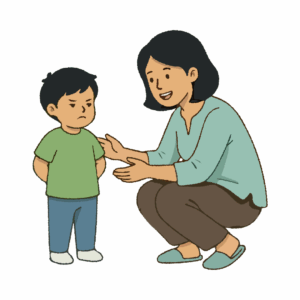
- The Body: Intervene rapidly to block the bite. Drop down to their eye level, because towering over them triggers a primitive predator-prey response. Release the tension in your jaw and keep your hands visible.
- The Tone: Utilize the “boring” response. Pitch your voice lower than normal and speak slowly. Deliver the script as if you are stating a mildly uninteresting fact about the weather. This flat delivery starves the behavior of dramatic oxygen.
- The Eyes: State the short script firmly. Maintain steady but brief eye contact. Glaring only escalates their stress. Once the script is delivered, immediately break your gaze.
What If They Keep Doing It?
They will test the limit. They are biologically programmed to push boundaries just to ensure yours is solid.
When they attempt to bite again within seconds, it is not a failure of the script. It is the expected testing phase.
If they ignore the first script, words are no longer effective. You must shift entirely to action.
Stand up, turn your body slightly away, and create a physical barrier. If you are holding them, place them safely on the floor immediately. Do not say another single word. Walk a few steps away and engage in a mundane task for thirty to sixty seconds.
This immediate removal of your presence sends a crystal-clear neurological message: aggression instantly terminates connection. After the minute passes, return and resume play without lecturing. Hold the line silently, and you prove your boundary is unshakeable.
Read: How to Stop My Toddler From Hitting (Without Yelling Back)
The Unseen Triggers
Intervening during a bite is simply damage control. The actual learning happens when your child’s nervous system is at rest.
Biting rarely occurs in a vacuum. It is almost always preceded by a specific environmental or physiological stressor.
If they bite frequently in the late afternoon, their baseline tolerance for frustration has plummeted due to fatigue. Move their bedtime earlier. If they bite in a loud, crowded room, their sensory system is overwhelmed. Leave the environment. If they bite at daycare right before lunch, they are hungry. Offer a high-protein snack earlier.
You cannot discipline a child out of exhaustion or hunger. Identify the gap between their processing capacity and their environment, and build a preventative strategy.
The Long Game
You can easily force compliance through fear, yelling, and harsh punishments.
But expecting humans at their most vulnerable stage to learn through pain and shame makes no sense. Children taught through emotional pain simply learn to stop trusting you, and eventually, they stop trusting themselves. Punishment creates anger and defiance; it fundamentally undermines your relationship.
True discipline means instruction. It means remaining their calm anchor.
When they push your limits, stop them in a firm, respectful way. With the knowledge that you will always help them handle the behaviors they cannot handle themselves, they feel inherently safe to struggle, make mistakes, and grow.
Frequently Asked Questions
Q1: How do you stop a toddler from biting in public?
Don’t change your strategy for an audience. Other parents might look, but your toddler only processes your reaction. Deliver the exact same neutral, low-energy script you use at home. If they escalate, silently pick them up and leave immediately. Removing them protects them from public shaming and cuts off the sensory overload.
Q2: Why does my toddler laugh after biting me?
It isn’t malice. A laugh is an involuntary biological release valve for a nervous system experiencing immense tension. They are overwhelmed by the sudden intensity, or they are testing the thrill of making a giant adult jump. To extinguish the laughter, eliminate the drama. Become exceptionally boring.
Q3: Should you force a toddler to say sorry after biting?
No. Forcing an apology while a toddler is still in fight-or-flight is purely performative. They are biochemically incapable of feeling genuine remorse in that moment. Model the apology yourself to the victim instead. Once your child is completely calm, invite them to help repair the connection by bringing a toy or a tissue.
Q4: What should I do if my toddler specifically targets their sibling?
Siblings are easy targets because they share close space and offer highly dramatic, high-pitched reactions. Intervene instantly. Use a strict two-word boundary, then immediately pivot your attention to comfort the hurt sibling. By starving the biter of attention, you remove the behavioral payoff.
Q5: What if my partner handles toddler biting differently?
Inconsistency breeds anxiety, which actually increases the frequency of the biting. Sit down outside the heat of the moment and look at the brain science together. When you both view the bite as a physiological stress response rather than a disciplinary rebellion, alignment becomes automatic. Agree on a single, unified protocol.