If your toddler seems to whine from morning until bedtime, you’re not alone. The constant “I want it,” “Nooo,” “Mommy, I can’t,” or drawn-out requests can wear down even the most patient parent.
Whining can be especially frustrating because your child may be perfectly capable of speaking clearly one minute and then suddenly switch to a high-pitched, drawn-out voice the next.
But toddler whining isn’t usually a sign that your child is trying to make your life miserable.
It’s often a combination of immature communication skills, strong emotions, frustration, tiredness, and a growing desire for independence.
The goal isn’t necessarily to eliminate whining overnight. It’s to help your toddler learn a more effective way to communicate while teaching them that whining isn’t the way to get what they want.
Why Do Toddlers Whine?
Understanding why whining happens can make it easier to respond without immediately becoming frustrated.
They’re still developing communication skills
Toddlers often know what they want before they have the language to explain it.
They may know:
“I want that.”
But they may not yet have the vocabulary to say:
“I’d like the blue cup because I don’t want the other one.”
When they struggle to communicate, whining can fill the gap.
They’re learning to handle frustration
Toddlers want independence, but their abilities don’t always match their ambitions.
They want to pour the juice themselves.
They want to buckle their own car seat.
They want the cookie immediately.
They want to keep playing when it’s time to leave.
When reality doesn’t cooperate, frustration comes quickly.
They’re tired, hungry, or overstimulated
Whining often increases when toddlers are running low on emotional or physical resources.
A child who has been cheerful all morning may suddenly become incredibly demanding after missing a nap or spending several hours in a busy environment.
That doesn’t mean every whiny moment should be blamed on tiredness, but patterns can be useful clues.
They’ve discovered that whining gets a response
Children learn from what happens after they behave a certain way.
If whining consistently results in extra attention, negotiation, or eventually getting what they wanted, your toddler may learn that whining is an effective strategy.
This isn’t manipulation in the adult sense.
It’s learning.
Your child is discovering:
“When I do this, something happens.”
That’s why your response matters.
They need connection
Sometimes whining is less about the request and more about wanting your attention.
A toddler may have spent hours playing independently and suddenly begin:
“Mommy! Mommy! Mommy!”
Even after you’ve answered several times.
Before assuming they’re simply being demanding, consider whether they need a few minutes of focused connection.
What to Do When Your Toddler Starts Whining
You don’t have to choose between giving in and getting angry.
There is a middle ground: stay calm, acknowledge the need, and teach a better way to communicate.
1. Stay Calm Before You Respond
This can be the hardest step.
A whining voice can trigger an immediate reaction:
“Stop whining!”
But responding with frustration often escalates the interaction.
Take a breath.
Lower your voice.
Keep your response short.
You don’t have to match your toddler’s emotional intensity.
Your calmness can help keep the situation from becoming a bigger conflict.
2. Acknowledge What Your Child Wants
You don’t have to give your child what they want just because you understand the request.
Try:
“You really want the blue cup.”
Or:
“You want to keep playing.”
Or:
“You’re asking for another snack.”
This communicates:
“I hear you.”
Then you can decide whether the answer is yes or no.
For example:
“You want another cookie. We aren’t having another cookie right now.”
Understanding the request doesn’t mean agreeing to it.
3. Teach Your Toddler How to Ask
Instead of simply saying:
“Stop whining.”
give your child a replacement.
Try:
“I want to hear you. Try that again in your regular voice.”
Or:
“You can say, ‘Mommy, can I have some water?'”
Then wait.
You may need to demonstrate the phrase.
“Say, ‘Can I have help, please?'”
You’re teaching a skill rather than merely correcting a behavior.
4. Don’t Reward Whining With a Yes
This is where consistency becomes important.
Suppose your toddler asks for a cookie.
You say no.
They whine.
You say no again.
They whine louder.
Eventually, you’re exhausted and hand over the cookie.
Your toddler learns:
Whining longer works.
That doesn’t mean you should ignore your child or become rigid about every request.
It means that when you’ve made a reasonable decision, try not to reverse it simply because the whining became louder.
You can stay empathetic:
“I know you really want it. My answer is still no.”
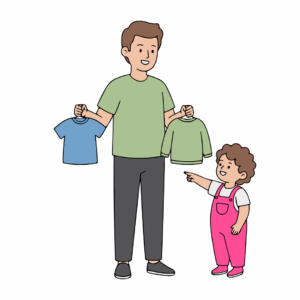
5. Give Choices When Choices Are Possible
Toddlers often want some control over their environment.
Offering limited choices can give them appropriate independence.
Instead of:
“Get dressed.”
Try:
“Do you want the dinosaur shirt or the striped shirt?”
Instead of:
“We’re having breakfast.”
Try:
“Do you want banana or toast?”
Instead of:
“Get in the car.”
Try:
“Do you want to climb in yourself or would you like me to help?”
The key is to offer choices you can genuinely accept.
Don’t ask:
“Do you want to get dressed?”
if getting dressed isn’t optional.
6. Use Fewer Words During a Whining Episode
When your toddler is already frustrated, a long explanation probably won’t help much.
You don’t need a five-minute lecture about why they can’t have something.
Try:
“I know you want it. Not today.”
Or:
“You’re upset. I’m here.”
Or:
“Try asking without whining.”
Short, calm statements are easier for a young child to process.
You can explain more later when everyone is calm.
7. Give Them Time to Try Again
If your toddler uses a whiny voice, you don’t necessarily have to answer immediately.
You can say:
“I can’t understand you when you use that voice. Try again.”
Then give them a moment.
When they try again:
“That’s much easier for me to understand. You want your cup.”
You’re reinforcing the communication you want to hear.
This is different from ignoring your child.
You’re teaching them that clear communication gets your attention.
8. Look for Patterns
If your toddler seems to whine constantly, become a detective.
When does it happen most?
Maybe whining appears:
- Right before nap time
- When you’re cooking dinner
- During transitions
- In crowded places
- After daycare
- When your child hasn’t eaten
- When you’re distracted by your phone
- When siblings are getting attention
Patterns can reveal what your child may need.
If whining happens every evening while you’re making dinner, perhaps your toddler needs a snack, a simple activity nearby, or ten minutes of connection before you start cooking.
You don’t have to prevent every instance of whining.
But understanding predictable triggers can make your days easier.
9. Prepare Your Toddler for Transitions
Some whining happens because toddlers struggle with sudden changes.
If your child is happily playing and you suddenly say:
“We’re leaving now.”
you’re more likely to get resistance.
Try giving advance notice:
“Five more minutes, then we’re going home.”
Then:
“Two more minutes.”
And finally:
“It’s time to go. You can choose one toy to bring to the car.”
The transition may still be difficult.
That’s okay.
The goal isn’t to eliminate disappointment.
It’s to give your child time to process what’s coming.
10. Give Attention to Positive Communication
If you only react strongly when your child whines, whining can become one of the easiest ways to get your attention.
Notice the moments when your toddler communicates appropriately.
“You asked so nicely.”
“I understood you right away.”
“You told me what you needed with your regular voice.”
This doesn’t require exaggerated praise.
A simple acknowledgment is enough.
You’re helping your child understand which communication style works.
What to Say Instead of “Stop Whining”
Having a few phrases ready can make difficult moments easier.
Try:
“I want to understand you. Try again.”
“Use your regular voice so I can hear you.”
“You really want that.”
“It’s okay to be disappointed.”
“You can ask me calmly.”
“I hear you. The answer is still no.”
“Would you like help asking?”
“You can be upset. I’m still not changing my answer.”
“Try telling me what you need.”
The exact words matter less than the overall message:
“Your feelings are okay. Whining isn’t how we communicate.”
What Not to Do
Don’t mock your toddler’s voice
Saying:
“Oh, listen to that baby voice!”
may make your child feel embarrassed without teaching them what to do differently.
Don’t shame them
Avoid:
“You’re being annoying.”
or:
“Nobody likes a whiny kid.”
Your child needs guidance, not a negative identity attached to their behavior.
Don’t negotiate endlessly
If every request becomes a ten-minute debate, your toddler may learn that persistence creates more opportunities to change your mind.
State the boundary clearly and move on.
Don’t expect perfect control
Toddlers are still learning.
You may teach the same lesson dozens or hundreds of times.
Progress isn’t necessarily that your child never whines again.
It’s that they gradually become better at expressing what they need.
What If Your Toddler Whines About Everything?
If it feels like every request, transition, meal, toy, and activity turns into whining, step back and look at the overall environment.
Ask yourself:
Is my toddler getting enough sleep?
Are meals and snacks reasonably predictable?
Are there too many transitions?
Is my child getting enough positive attention?
Am I giving choices where appropriate?
Am I expecting communication skills that are beyond my child’s developmental level?
Is there something stressful happening at home or in childcare?
Sometimes changing the conditions around the behavior can make a bigger difference than correcting the behavior itself.
What If You Sometimes Give In?
Don’t beat yourself up.
Every parent has moments when the whining wins.
Maybe you’re exhausted.
Maybe you’re in a grocery store.
Maybe you’re trying to get through bedtime.
One inconsistent response won’t ruin your child’s behavior.
Just return to the pattern you want:
“Yesterday I gave you the cookie after you kept asking. Today we’re going to try asking calmly.”
You don’t need to be perfect.
You need to be reasonably consistent over time.
When Whining May Need More Attention
Whining is common during toddlerhood, but pay attention if there’s a sudden and significant change in your child’s behavior or if whining comes alongside other concerning changes.
For example, consider talking with your child’s healthcare provider if you notice substantial changes in communication, behavior, sleep, eating, social interaction, or development, or if your child’s behavior is causing significant problems at home or in childcare.
You don’t have to diagnose the reason yourself.
If something feels different from your child’s usual behavior, it’s reasonable to ask for guidance.
Remember: The Goal Isn’t a Silent Toddler
It’s easy to make the goal:
“I need my child to stop whining.”
But a better goal is:
“I want my child to learn how to communicate their needs more effectively.”
That shift changes how you respond.
Instead of seeing every whiny request as defiance, you can see it as an opportunity to teach.
Instead of:
“Stop whining!”
you teach:
“Tell me what you need.”
Instead of immediately giving in, you teach:
“I hear you. The answer is still no.”
Instead of punishing disappointment, you teach:
“It’s okay to be disappointed.”
And instead of expecting your toddler to regulate every emotion independently, you provide the calm guidance they are still learning to provide for themselves.
Final Thoughts
Toddler whining can be exhausting.
You don’t have to pretend it isn’t.
But your child’s whining isn’t necessarily a sign that you’re raising a demanding or badly behaved child. Toddlers are still developing language, flexibility, patience, and emotional regulation, and whining can be one way those immature skills show up.
Your job isn’t to make every uncomfortable feeling disappear.
It’s to teach your child what to do with those feelings.
Stay calm.
Acknowledge what they want.
Set reasonable limits.
Teach them how to ask.
Give choices when appropriate.
Look for patterns.
And reinforce the moments when your child communicates clearly.
With repetition, your toddler can gradually learn an important lesson:
“My parents will listen to me. even when the answer is no, and I can tell them what I need without whining.”