Your toddler wants the blue cup.
You give them the blue cup.
They scream because they wanted the red one.
You ask them to get dressed.
They scream.
You say it’s time to leave the playground.
They scream even louder.
If your toddler seems to scream over everything, you may start wondering what you’re doing wrong.
The answer is usually much simpler.
Toddlers have enormous feelings and very limited skills for managing them. Screaming is often one of the fastest ways they know to communicate frustration, excitement, fear, exhaustion, or a strong desire for control.
That doesn’t mean you have to tolerate every behavior.
It means understanding what the screaming is communicating so you can respond without turning every difficult moment into a bigger battle.
Why Toddlers Scream So Much
Toddlers are still developing the ability to identify emotions, communicate clearly, control impulses, and cope with disappointment.
When something feels overwhelming, their emotions can take over before they have the words or self-control to explain what’s happening.
Sometimes the reason is obvious.
They’re tired.
They’re hungry.
They’re frustrated.
They don’t want to stop playing.
Other times, the trigger seems incredibly small to an adult.
But to a toddler, small disappointments can feel very big.
Screaming is not always deliberate misbehavior. Often, it is immature emotional communication.
Screaming Can Be a Form of Communication
Before toddlers have the vocabulary to say, “I’m frustrated because you changed the plan,” they may simply scream.
Their behavior might be saying:
“I don’t like this.”
“I need help.”
“I want control.”
“This is too much for me.”
“I don’t know how to handle this feeling.”
Instead of immediately asking, “How do I stop the screaming?” try asking:
“What is my child trying to communicate?”
That question can completely change how you respond.
1. Stay Calm Before You Correct
A screaming toddler can activate your own nervous system quickly.
You may feel the urge to shout:
“Stop screaming!”
But matching your child’s volume usually adds more intensity to the situation.
Take a breath.
Lower your voice.
Get physically close if your child is comfortable with that.
Then say:
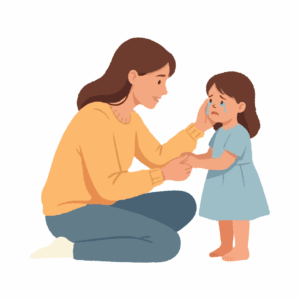
“You’re really upset. I’m here.”
Your calm presence gives your toddler something steady to follow.
2. Name the Feeling Without Giving In
You can validate your child’s emotion without changing every boundary.
If they scream because they can’t have another cookie, you might say:
“You really wanted another cookie. You’re disappointed.”
Then hold the limit:
“We’re all done with cookies.”
This teaches an important lesson: feelings are allowed, but feelings don’t automatically change the answer.
Your child can be angry with the boundary while you remain calm and loving.
3. Use Fewer Words
When a toddler is already overwhelmed, long explanations often make things worse.
They don’t need a lecture about why screaming is inappropriate.
They need simple language they can process.
Instead of:
“How many times have I told you that screaming isn’t going to get you what you want?”
Try:
“I hear you. Use your words when you’re ready.”
Then give them time.
Your calm repetition is more useful than a long explanation.
4. Teach an Alternative to Screaming
You can’t simply tell a toddler what not to do.
They also need to know what they can do instead.
Teach simple phrases such as:
“Help me.”
“I don’t like it.”
“My turn.”
“I want that.”
“I’m mad.”
Practice these phrases when your child is calm.
A toddler is much more likely to use them during frustration when they’ve already practiced them many times.
5. Give Choices When You Can
Toddlers crave independence.
When they feel controlled all day, even simple requests can become opportunities for resistance.
Small choices give them a sense of control without removing your boundaries.
Try:
“Do you want to put your pajamas on first or brush your teeth first?”
Or:
“Do you want to walk to the car or hop like a bunny?”
The destination stays the same.
Your child simply gets some control over how they get there.
6. Watch for the Common Triggers
If your toddler seems to scream over everything, look for patterns.
Screaming often increases when children are:
- Hungry
- Tired
- Overstimulated
- Sick
- Frustrated
- Facing frequent transitions
- Experiencing too many demands
You can’t prevent every tantrum, but you can reduce unnecessary triggers.
A snack before errands or a warning before leaving the playground can sometimes prevent a much bigger struggle.
7. Make Transitions More Predictable
Toddlers often struggle when they’re suddenly asked to stop doing something they enjoy.
Instead of announcing:
“We’re leaving now.”
Give a little preparation.
Try:
“Two more minutes, then we’re going home.”
Then remind them:
“One more minute, then it’s time.”
You can also turn transitions into games.
“Let’s see if we can hop all the way to the door.”
Playfulness can sometimes accomplish what repeated commands cannot.
8. Don’t Use Shame to Stop Screaming
It’s tempting to say:
“You’re embarrassing me.”
Or:
“Why are you acting like a baby?”
But shame doesn’t teach emotional regulation.
It teaches children that having difficult feelings makes them unacceptable.
Instead, separate the emotion from the behavior.
You can say:
“It’s okay to be angry. I won’t let you scream in my face.”
This communicates both acceptance and a boundary.
9. Give Them Time to Come Down
Once a toddler is fully overwhelmed, they may not be able to stop instantly.
Don’t expect one sentence to magically end the meltdown.
Stay nearby.
Keep the environment calm.
Reduce unnecessary talking.
Once their body begins settling, connection becomes easier.
You might offer:
“Do you want a hug or some space?”
Giving your child time to recover teaches them that difficult emotions eventually pass.
10. Talk About It Later
The middle of a tantrum is not the time for a major lesson.
Wait until your toddler is calm.
Then briefly revisit what happened.
You could say:
“You were really mad when we left the park. Next time, you can say, ‘I don’t want to go.'”
Keep it simple.
The goal isn’t to make your toddler feel guilty.
It’s to practice what they can do differently next time.
What Parents Should Stop Doing
When screaming becomes frequent, parents can easily fall into a cycle of repeated commands and escalating frustration.
Try to avoid:
- Yelling louder than your child
- Threatening consequences you won’t follow through on
- Giving long lectures during tantrums
- Calling your child rude, dramatic, or difficult
- Giving in every time simply to stop the noise
- Expecting adult-level emotional control
Consistency matters more than intensity.
Your toddler doesn’t need you to overpower the emotion.
They need you to help them learn how to handle it.
When Screaming Needs More Attention
Occasional screaming is common during toddlerhood.
However, if screaming is extremely frequent, unusually intense, happens across many settings, significantly interferes with daily life, or comes alongside concerns about your child’s development, communication, hearing, sleep, or behavior, it’s worth discussing with your pediatrician.
You don’t need to wait until you’re certain something is wrong.
A professional can help you understand what may be contributing to the behavior and whether additional support would be useful.
The Goal Isn’t a Silent Toddler
It’s easy to make “stop screaming” the goal.
But the deeper goal is emotional communication.
You want your toddler to gradually learn:
“I can be angry without hurting people.”
“I can ask for help.”
“I can handle disappointment.”
“My feelings are safe to have.”
Those skills take years to develop.
Your toddler won’t master them after one conversation.
They learn through repetition, modeling, boundaries, and thousands of ordinary moments with you.
Final Thoughts
Toddler screaming can test even the most patient parent.
But beneath the noise is often a child who is still learning how to communicate a very big feeling with a very small set of skills.
You don’t have to stop every scream immediately.
You don’t have to give in.
And you don’t have to become louder to be in control.
Stay calm.
Name the feeling.
Hold the boundary.
Give your child words they can use.
Then keep practicing.
One day, the scream that once lasted ten minutes may become, “Mommy, I’m really mad.”
That may seem like a small change.
Developmentally, it’s a huge one.