Two toddlers. One red truck. Four small hands.
Your child grabs the truck and holds it tight against their chest.
The other child reaches. Your child turns away.
You feel every parent on the playground watching.
Your first thought is to say, “Share!” Your second thought is to take the truck away.
Neither one teaches a turn. Both teach that bigger hands win.
Say this at the sandbox
“You are playing with the truck. Your turn will finish soon.”
“After your turn, it is their turn.”
“You can say, ‘My turn now, your turn next.'”
“I will help you wait. We will count together.”
“The truck stays here. We take turns with it.”
Keep your voice steady and your body close. Kneel down, so you are at their level.
Short words land better than a long talk about being kind.
Sharing asks more than it looks
Sharing asks a child to stop a good game, hand over a loved toy, and wait.
That is a lot to ask of someone who is still learning to wait at all.
A toddler is not being selfish when they hold on tight.
They are showing you what they care about, in the clearest way they can.
They know the toy is still there when they put it down.
By around 18 to 24 months, object permanence is established.
A child at this age does not think a toy stops existing when they stop touching it.
The hard part is not knowing the toy is still there.
The hard part is waiting while someone else enjoys it, and trusting their turn will come back.
That trust is what you are teaching, turn by turn.
Teach turns, not giving things away
A turn has a start, a middle, and an end. Make each part clear.
“Your turn starts now. You can push the truck to the hill.”
When the turn is ending, warn them. “Two more pushes, then their turn.”
Hand the toy over with them, not for them. “Now we pass it gently.”
Then help them wait. Waiting is a skill, and it needs practice too.
Stay beside them. Count, sing, or point at the truck as it moves.
“Look, the truck is coming back to you. Your turn is next.”
When their turn returns, name it. “Your turn again. See, it came back.”
That return is the lesson. A turn given is a turn that comes back.
Do this with a timer at home first, where the stakes are low and the toy is familiar.
When a child grabs or snatches
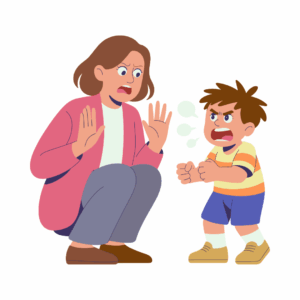
Grabbing happens fast. Your response needs to be fast too, and calm.
Step in. Hold the toy gently, so no one is pulling it.
“I will hold this while we sort it out.”
Look at both children. “You both want the truck.”
Offer a turn order. “First your turn, then your turn. I will help.”
If your child is upset, name the feeling. “You really wanted that truck.”
Do not force an apology in the moment. A rushed sorry teaches nothing.
Do not take the toy away as a punishment. That ends the lesson, not the grabbing.
Stay until the turns have started again, even if it takes a minute.
Your calm presence is what makes the next turn possible.
Practice turns at home
The playground is a hard place to learn a new skill.
Practice at home, where your child feels safe and the toys are known.
Play a simple turn game with blocks. You place one, then they place one.
Roll a ball back and forth. “My roll, your roll.”
Stir a bowl together. “Your stir, then my stir.”
Read a book and let them turn the page. Then you turn the next one.
Keep the games short and fun. End while it is still going well.
When they wait for a turn at home, say what you saw.
“You waited, and then the ball came back to you.”
That sentence links waiting to the good thing that follows it.
Bring a toy, or leave it at home
A toy from home can make the playground harder.
Your child loves it most, so sharing it feels hardest of all.
Other children will want it too, because it is new to them.
Before you leave, talk about the toy together.
“This truck is yours. If we bring it, other children may ask for a turn.”
Let them decide. Bring it and share it, or leave it safe at home.
If they bring it, keep the turn rule the same as for any toy.
If they leave it, praise the choice. “You kept your special truck safe.”
That choice is a turn skill too. It is choosing what to share and what to keep.
Not every toy has to be a sharing toy.
When another parent steps in
Sometimes another parent will step in before you do.
They may tell your child to share, or take the toy themselves.
Stay calm. Step close to your child and speak for the turn.
“We are taking turns. Your child is next after this turn.”
Keep your voice even. You are sorting a turn, not starting an argument.
If the other child is upset, you can name that too.
“Waiting is hard. Your turn is coming.”
Thank the other parent for helping, then keep the turn order clear.
Your child is watching how you handle a tense moment.
A steady adult shows them what a steady turn looks like.
Give waiting a job to do
Waiting feels endless to a toddler with nothing to do.
Give the wait a small job, so the time has a shape.
Count the pushes of the truck. One, two, three, then it is your turn.
Watch the wheels. Point at the sand the truck leaves behind.
Hold a second toy while you wait, so your hands are busy too.
A busy wait is shorter than an empty wait.
When the turn comes back, the waiting will have been worth it.
What fairness looks like at this age
Fairness to a toddler does not mean everything is split in half.
It means turns are real, and they come back around.
It means an adult notices, helps with the wait, and keeps the order clear.
Some days your child will hand a toy over with ease.
Some days they will hold on, and you will help them through it.
Both days are part of learning.
Do not label your child as the child who never shares.
A label sticks, and it follows them to the next playground.
Talk about the turn, not the child. “That turn was tricky” is truer, and kinder.
Tomorrow, at the same sandbox, offer the same clear turns, and watch what returns.