You arrive at a birthday party and your child stops in the doorway.
They press against your leg, turn their face into your coat, and will not say hello.
Another parent smiles and says, “Oh, she is shy.”
Your child hears it.
You feel the familiar mix of embarrassment and protectiveness, and you are not sure which one to listen to.
Inside, the other children are already playing.
Your child watches from the doorway for ten minutes, then asks to go home.
You wonder what to do.
Push them in and they cry.
Let them hide and they never practise.
So how do you help a shy child make friends without pushing them into the deep end?
This guide is for that doorway moment and for the months after it.
It will show you why pushing backfires, how to build friendship skills in small doses, and what to say when other adults label your child in front of them.
The Slow Warm-Up
Here is the reframe that changes everything: shyness is a temperament, not a flaw.
Call it the Slow Warm-Up.
Some children run into a room and make five friends before they take their coat off.
Other children stand at the edge and watch first.
They are not broken.
They are careful.
Their brains take longer to decide that a new person is safe, and once they decide, they are loyal, deep, and wonderful friends.
The warm-up is real and it works, but only if you let it happen at your child’s speed.
Pushing a slow warmer into the middle of the room is like pushing a cold engine to full speed.
It stalls.
What works instead is practice in small doses.
Friendship is a skill, and skills are built rung by rung, not all at once.
Call it the Practice Ladder.
It has four rungs: watch, wave, one word, one question.
Your child watches other children play, then waves, then says one word, then asks one question.
Five minutes of practice at a time, two or three times a week.
That is the whole system, and it works because it is small enough to succeed and regular enough to build.
Your child does not need to become loud.
They need to become brave in small doses, and the doses add up.
1. The First Five Minutes
The hardest five minutes are the first five minutes after you arrive.
Your child is taking in the room, the noise, the new faces, and the smell of a house that is not theirs.
Do not ask them to perform in those five minutes.
No hello on demand, no hug for the host, no joining the game before they are ready.
Instead, give them a job for their eyes.
“Let us look around first. What games can you see?”
Looking is the first rung of the ladder, and it counts as participation.
Stand near the edge of the room with them, not in the middle of it.
Let them hold your hand.
Let them watch.
After a few minutes, point out one child who looks friendly.
“See the girl with the red dress? She is building a tower. Shall we watch her for a minute?”
Watching one child is far easier than facing a whole room.
If your child wants to leave after ten minutes, do not make it a failure.
Say, “We watched for a while today. Next time we will stay a little longer.”
That sentence tells them the visit was practice, not a test.
And practice always counts, even when it is short.
2. Why Pushing Backfires
The instinct to push is strong.
“Go on, say hello. Do not be rude. Go and play with the others.”
Every one of those sentences comes from love.
Every one of them makes a shy child feel worse.
Here is why.
When you push, you tell your child that their feelings are wrong.
They feel scared, and you tell them not to be scared.
They feel unsure, and you tell them to be sure.
The child learns that their own signals cannot be trusted, and they cling harder next time.
Pushing also puts the child on stage.
Everyone is watching, the child knows it, and the pressure makes the words stick in their throat.
The harder you push, the quieter they get.
Replace the push with an invitation.
“Would you like to watch the game with me, or would you like to play with the blocks over there?”
An invitation gives a choice.
A choice gives control.
And control is what a shy child is actually asking for.
Here is a distinction that helps: shy is not the same as rude.
A rude child ignores people on purpose.
A shy child wants to connect and does not know how yet.
Adults often mistake one for the other, and the child pays the price.
When someone says your child is rude, you can answer for them.
“She is warming up. She will say hello when she is ready.”
That sentence protects your child and teaches the adult at the same time.
3. The Practice Ladder
The Practice Ladder is the heart of this guide, and it is simple enough to start today.
Four rungs, five minutes at a time, two or three times a week.
Rung one is watch.
Your child watches other children play, from a comfortable distance, with you beside them.
No talking required.
Watching is the rung most parents skip, and it is the most important one.
Rung two is wave.
A small wave at a child they know, or at a neighbour, or at the person at the shop till.
A wave is a greeting with no words attached, and that makes it safe.
Rung three is one word.
“Hello.” “Yes.” “Mine.”
One word, said once, to one person.
Celebrate it like a victory, because it is one.
Rung four is one question.
“What are you building?” “Can I play too?” “What is your name?”
One question, to one child, in one moment.
Move up a rung only when the current one feels easy.
If waving is still hard, stay on waving for another week.
There is no deadline on the ladder.
The ladder works because it is small, regular, and always winnable.
Five minutes of practice, three times a week, adds up to real courage in a few months.
For more on building confidence one small step at a time, see What to Say When Your Child Yells I Can’t Do It.
4. Words to Give Your Child
A shy child often knows what they want to do and has no words for it.
So give them the words, in advance, and practise them at home.
Start with joining play.
Most children join by standing near a game and hoping someone notices.
That rarely works.
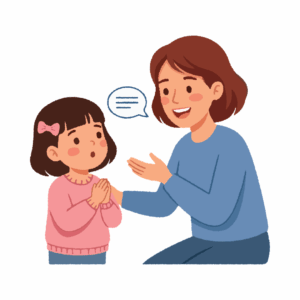
Teach your child one sentence instead: “Can I play too?”
Practise it at the kitchen table.
You build a tower, your child says, “Can I play too?” and you say, “Yes, you can put the red brick on top.”
Five minutes of practice, and the sentence is in their pocket for the next party.
Then teach them the follow-up question: “What are you building?”
Questions are easier than statements, because they give the other child something to answer.
A child who asks a question is already in the conversation.
Also teach them the exit line, for when play gets too much.
“I am going to get a drink of water.”
That sentence lets them step away without a scene, and stepping away is a skill too.
Do not give them ten scripts.
Give them three: one to join, one to ask, one to leave.
Three sentences, practised at home, carried into the world.
That is enough.
5. The One to One Playdate
Group play is the hardest place for a shy child to practise.
Too many children, too much noise, too many rules to learn at once.
So practise in the easiest place instead: one child, one hour, your house.
Pick one kind child, not the loudest or the most popular, just one who is gentle.
Invite them for a short playdate, an hour at most, doing something simple.
Building blocks, drawing, a puzzle, baking biscuits.
Something with a clear activity, so the children have something to do together instead of having to invent conversation.
Stay nearby but do not hover.
Be in the next room, close enough to help and far enough to let them manage.
If it goes well, do it again next week with the same child.
Repetition builds comfort faster than variety.
The same child, the same house, the same game, three weeks in a row.
By the third week, your child will run to the door when they hear the bell.
That is the ladder working.
One steady friendship is worth more than ten party invitations.
The guide to choosing the right friends has more on picking playmates with care.
And for the bigger picture of raising a child who bounces back, see How to Raise Resilient Children.
6. The One Job
Here is the one small tool for the whole guide: the One Job.
At any gathering, give your child one small job to do.
Hand out the cups.
Hold the door for grandma.
Carry the napkins to the table.
One job, one task, one clear role.
The One Job works because it gives your child a reason to move through the room without having to perform.
They are not the shy child standing in the corner.
They are the child with a job to do.
People talk to them because of the job, not because they are being tested.
“Thank you for the cup” is a conversation that starts itself.
And every small interaction is a rung on the ladder.
Choose the job before you arrive.
Tell your child in the car: “When we get there, your job is to hand out the cups.”
One job, agreed in advance, in a calm voice.
One job is all it takes to change the whole evening.
Afterwards, notice it out loud.
“You handed out all the cups and said thank you to everyone. That was brave.”
That sentence tells your child what courage looks like in real life.
Not a big speech.
Just a small job, done well.
What Not to Do, Even When You Mean Well
The most common mistake is labelling your child in front of them.
“She is shy.” “He does not talk to strangers.” “She is just like that.”
Every label becomes a story your child tells about themselves.
A child who hears “I am shy” fifty times starts to believe it is who they are, not how they feel.
Replace the label with a description of the moment.
“She is warming up.” “He needs a few minutes.” “She is watching first.”
Those sentences describe a feeling, not an identity.
Feelings change.
Identities feel permanent.
Another mistake is comparing your child to a louder sibling or cousin.
“Why can you not be more like your brother? He talks to everyone.”
Comparison teaches a shy child that their temperament is a problem to fix.
It is not.
It is a way of being in the world, and it has its own strengths.
Quiet children notice more, listen better, and choose their friends with care.
Now the objection every parent raises: but will my child not fall behind socially?
Will they not end up lonely if I do not push them?
Here is the truth underneath the worry.
Shy children do not fall behind when they get small, regular practice.
They fall behind when they are pushed so hard that they stop trying.
Slow and steady practice builds real friendship skills.
Pushing builds avoidance.
One more boundary to name plainly: if your child cannot speak at all outside the home, or avoids all contact for months, or is distressed every day about seeing other people, talk to your doctor.
Most shyness softens with practice.
Distress that does not soften deserves a professional answer.
In the Moment: The Doorway Sequence
When you arrive somewhere new, hold this sequence in mind.
Four steps, nothing new, just the pieces above in the order you will need them.
Step one: arrive early, before the room fills up.
A half-empty room is far easier than a full one.
Step two: look first.
“Let us look around. What games can you see?”
Step three: give them the One Job.
“Your job is to hand out the cups.”
Step four: stay close and wait.
Let them watch, wave, and warm up at their own speed.
Four steps: early, look, job, wait.
Say the four steps to yourself before you walk in: early, look, job, wait.
And if the first visit is short, call it a win.
Ten minutes of watching is still practice, and practice is what builds courage.
Come back next week and do it again.
You can hold them in your head even when another parent is watching.
A Calm Place to End
Your child is not behind.
They are warming up, and warming up takes as long as it takes.
The world needs quiet children.
It needs the child who watches first, who listens carefully, who chooses one true friend over ten loud ones.
Try one thing tonight.
Practise one rung of the ladder at home.
One wave, one word, or one question, in the kitchen, with no audience.
Then arrange one short playdate this week, one child, one hour, your house.
That is the whole plan.
Watch, wave, one word, one question.
Small doses, regular practice, and a parent who believes in them.
It starts with one wave, one word, one question.
For more on building a stronger bond through everyday questions, see 10 Questions to Ask Your Kids to Build a Stronger Bond.
Your shy child is not a problem to fix.
They are a person to know, slowly, and on their own terms.