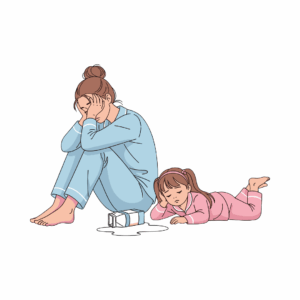
It is bedtime, and you have just said the words you say every night.
“No more stories. Lights out.”
Your child groans, and then your partner appears in the doorway and says, with a smile, “One more won’t hurt.”
Your child looks from you to your partner, and then back to you, and you can see the calculation happening in real time.
One parent says no.
The other parent says yes.
Which one wins?
You feel undermined.
Your partner feels overruled.
The child gets the extra story, and you both lie awake afterwards, replaying it, each of you sure the other one is the problem.
It is not really about the story.
It was never about the story.
It is about two people who love the same child and disagree about how to raise them, and who have never had a proper conversation about it, because every conversation about it turns into the same argument.
So here is the question this guide answers.
How do two parents who disagree raise one child together, without the child getting caught in the middle?
The Same Team Rule
Here is the reframe, and it has a name: the same team rule.
Your child does not need two perfect parents.
They need two parents who back each other up.
Disagreement between parents is normal.
Every couple disagrees about something, bedtime, sugar, screens, shouting, chores, and the damage does not come from the disagreement itself.
It comes from the child watching you fight about it, or learning to play one of you against the other.
Children test the gap between their parents the way water finds a crack.
If the gap is wide, and if the child can widen it by pushing, they will push, not because they are manipulative, but because they are small and the world feels safer when someone is clearly in charge.
Two parents pulling in different directions feels like nobody is in charge.
Two parents pulling in the same direction, even imperfectly, feels like safety.
That is the thesis.
Not agreement on everything.
Agreement on the things that matter, and a plan for the rest.
A united front is not pretending you agree when you do not.
It is disagreeing in private and backing each other up in front of the child.
That distinction is the whole guide, and once you see it, the daily friction starts to make sense in a new way.
You are not trying to become the same parent.
You are trying to become the same team.
1. Name the Real Difference
Most parenting disagreements are not what they look like.
One parent looks strict and the other looks soft, and each of them thinks the other has gone too far.
Look underneath, and the picture is usually different.
It is two fears, facing opposite directions.
One parent is afraid of a child out of control, so they hold the line harder.
The other is afraid of a child who feels controlled, so they soften the line.
Both fears are reasonable.
Both parents are trying to protect the same child.
Try saying that out loud, not in the middle of a bedtime argument, but at a calm moment.
“I think we are both scared, just of different things.”
Ask each other one question.
“What are you most afraid will happen if we do it my way?”
The strict parent is often afraid of chaos, of a child who cannot cope with limits.
The soft parent is often afraid of distance, of a child who stops coming to them.
Once you can name both fears, you can build a rule that respects both of them, instead of a rule that defeats one of you.
There is no single right style, and the guide to common parenting styles is a useful map of what each of you brings.
2. The Child Is Watching the Disagreement, Not the Rule
When you and your partner disagree in front of your child, your child is not learning about bedtime or sugar or screens.
They are learning something else entirely.
They are learning that rules are negotiable if you push the right parent.
They are learning that the adults are not sure, and when adults are not sure, a child feels less safe.
Staying calm yourself is half the work, and the guide to co-regulation with kids explains how to steady yourself first.
So the most useful change you can make is not a new rule.
It is a new habit: one answer, given together, even when you have not yet agreed.
Try this line.
“Mum and I will talk about it and let you know.”
Then go and have the argument, in private, where it belongs.
If your partner has already given an answer you disagree with, do not correct them in front of the child.
Let it stand for now, and raise it later.
“I backed you up in front of her. I want to talk about the bedtime rule tonight.”
That sentence protects the child from the disagreement and protects your partner from public correction, and both of those things matter.
Children feel safer when the adults look like a team, even a team that is still working things out.
3. Agree on the Three Non-Negotiables
You do not need to agree on everything.
Trying to agree on everything is what makes these conversations impossible, because there are a hundred small decisions a day and no couple agrees on all of them.
You need to agree on three things.
Each of you names three non-negotiables, the rules that matter most to you, the ones you are not willing to bend on.
Everything else is flexible.
One parent might name safety, honesty, and kindness.
The other might name sleep, respect, and no shouting.
Write them down, all six, on a piece of paper, and put it on the fridge.
That paper is your shared ground.
When a disagreement comes up, check it against the paper.
If it touches one of the six, you talk about it properly, in private, and you hold the line together.
If it does not touch one of the six, the parent who is there decides, and the other one backs them up.
That is the deal, and it works because it is small.
Six rules, not sixty.
Review the paper once a month.
Rules that mattered when your child was two may not matter when they are five, and a list that never changes becomes a museum piece.
4. The Park-It Word
Even with three non-negotiables on the fridge, disagreements will still happen in front of your child.
You need a way to stop them quickly, without a scene.
Here is a small tool with a name: the park-it word.
Pick a word together, any word, something neutral that neither of you would say in an argument.
“Parking lot” works well.
The rule is simple.
Either parent can say the word at any moment, and when they do, the disagreement stops, immediately, with no last word and no eye roll.
It is parked until later.
Try it in the bedtime scene.
You say no more stories.
Your partner says one more won’t hurt.
You say, “Parking lot.”
Your partner nods, and the extra story happens or it does not, but the argument does not happen in front of your child.
When your child is asleep, you unpark it.
“I said parking lot because I felt overruled. Can we talk about the bedtime rule?”
The park-it word only works if both of you use it and both of you respect it.
If one parent says it and the other keeps arguing, the tool breaks, so agree on that first.
The word is a promise: we will talk about this, just not here, and not now.
5. Back Each Other Up, Then Debrief
Here is the hardest part of the same team rule, and the part that makes it real.
When your partner makes a parenting call in front of your child, and you disagree with it, back them up anyway.
Not forever.
Just in the moment.
Then debrief in private, later, when your child cannot hear.
It is choosing the child over the argument, for ten minutes, and then having the real conversation where it belongs.
Try this script for the debrief.
“I backed you up in front of her. I want to talk about what happened, because I saw it differently.”
That opening does two things.
It tells your partner you were on their team in public, and it tells them you have something real to say in private.
Then say what you saw, not what they did wrong.
“When you gave her the extra story after I said no, I felt like my word did not count.”
If your partner does the same for you, the debrief becomes a habit, and the habit becomes the place where your parenting actually gets decided.
Not in front of your child.
In private, calmly, as a team.
That is where the united front is built, one quiet conversation at a time.
6. Let Your Child See You Change Your Mind
There is one more piece, and it surprises most parents.
Let your child see you change your mind.
Not all the time, and not on the non-negotiables.
But sometimes, in front of your child, let them watch you listen to your partner and say, “Your dad was right, I changed my mind.”
That sentence teaches your child something no rule can teach.
It teaches them that changing your mind is strength, not weakness.
It teaches them that adults listen to each other.
It teaches them that being wrong is not shameful, and that a family can disagree and still be safe.
Children who never see an adult change their mind grow up believing that admitting a mistake is dangerous.
So when your partner makes a good point, say so, out loud, where your child can hear it.
“You know what, your mum is right. We will do it her way tonight.”
Your child will notice.
They will also notice the opposite, a parent who never, ever backs down, and they will learn from that too.
Make sure the lesson they learn is the one you want them to learn.
A team that can change its mind together is a team a child can trust.
And a child who trusts their team does not need to split it.
What Not to Do, and the Objection You Are Already Thinking
Some habits feel like honesty and quietly make the problem worse.
It helps to name them, because most couples use them at least sometimes, and recognising them is not a reason for guilt.
It is a reason to handle it differently next time.
- Do not argue in front of your child. Even a small, sharp exchange teaches your child that the adults are not sure.
- Do not recruit your child. “Tell your father what you think” or “Ask your mother, she is the strict one” puts your child in the middle of an adult disagreement.
- Do not keep score. “I always back you up and you never back me up” turns parenting into a ledger, and a ledger has no room for generosity.
- Do not correct your partner in front of your child. A public correction is a public ranking, and your child will remember who won.
- Do not use the child as a messenger. “Tell Dad I said no” is not communication, it is a child carrying an adult argument.
If you have already argued in front of your child, repair it plainly, and the guide to how to apologize to your child for yelling has the words to use.
And now the objection you are already thinking, because almost every parent thinks it.
“But backing my partner means betraying what I believe.”
No, it does not.
Backing your partner up in the moment is not agreeing with them forever.
It is choosing your child over the argument for ten minutes, and then having the real conversation later, in private, where it can actually change something.
That is where you hold your ground.
Not in front of your child.
In the Moment: The Four Steps to Hold in Mind
When you and your partner disagree in front of your child, and you can feel the argument starting, hold these four steps in mind.
First, notice the gap.
You said one thing, your partner said another, and your child is watching.
Second, say the park-it word.
“Parking lot.”
One word, no last word, no eye roll.
Third, give one answer together.
“Mum and I will talk about it and let you know.”
Fourth, debrief in private.
When your child is asleep, say what you felt, not what your partner did wrong.
“I backed you up in front of her. I want to talk about the bedtime rule tonight.”
That is the whole sequence.
Notice, park it, one answer, debrief.
No new ideas, nothing to memorise, just four steps you can hold in your head while your child is watching.
Start Tonight, With Ten Minutes
You do not need a perfect agreement, a new parenting philosophy, or a weekend away to fix this.
You need ten minutes, once a week, and three questions.
Here is the system, and it has numbers you can copy: the ten minute check-in.
Same time each week, ten minutes, three questions, one decision.
What worked this week?
What did not?
What is one thing we will try next week?
That is it.
Ten minutes, three questions, one decision, and the habit of talking about parenting when you are both calm, instead of only when you are already arguing.
Start tonight, after your child is asleep.
Sit down together, set a timer for ten minutes, and ask the first question.
You will not solve everything in ten minutes.
You will solve one thing, and one thing a week is fifty-two things a year.
And your child will notice the change before you do.
Respect runs through all of this, and what respecting your child really looks like is a good companion to this guide.
That is the whole job.
Not two perfect parents.
One team.