It is 7:40 in the morning and your child is under the bed.
Not playing. Hiding.
His school shoes are by the door, his bag is packed, and his toast is going cold on the table.
You crouch down and see his face in the dark under the mattress.
“I am not going,” he says. “My tummy hurts.”
Yesterday his tummy hurt too.
And the day before that, it was his head.
By ten o’clock, on the days you give in, the pain is always gone.
He is up and playing as if the morning never happened.
You stand in the kitchen with the car keys in your hand and a question you do not know how to answer.
Do you force him into the car, or do you let him stay home?
Either choice feels wrong.
Force him, and you are dragging a crying child to a place he dreads.
Let him stay, and you are teaching him that refusing works.
Every parent in this standoff knows the same fear.
The fear that this is the start of something bigger, and that you are handling it wrong.
This guide is for that kitchen moment.
It will show you how to find out what is really happening at school, what to say in the morning, and the plan that gets him back through the gate.
Refusal Is a Message, Not a Rebellion
Here is the reframe that changes everything: your child is not refusing school to make your morning hard.
He is refusing because something at school feels too hard, and this is the only way he knows to say so.
Children do not have meetings with their parents to discuss problems.
They have behaviour. The hiding under the bed is the meeting.
The tummy ache is the agenda. Your job is not to win the morning.
Your job is to read the message inside the refusal.
Think of it as a system you can copy: the Night-Before Three.
Three things ready the night before, every school night.
Bag packed, clothes laid out, and one sentence about tomorrow.
The sentence is the important one.
“Tomorrow after school we are going to the park.”
One good thing to look past the hard part.
Then in the morning, two questions, asked the night before, not at the door.
“What is the hardest part of tomorrow?”
“What would make it a little easier?”
Two questions, one plan, and the morning stops being a surprise.
Refusal is information. Once you have the information, you can fix the thing that is actually wrong.
1. The Tummy Ache That Vanishes by Ten
Start with the morning itself, because the pattern is the clue.
The pain arrives at the same time every school day.
It is always gone by mid morning.
It never appears on Saturdays.
That pattern has a name, and it is not lying.
It is a worry body.
Here is a distinction that helps: worry pain and sick pain behave differently.
Sick pain does not check the clock.
It is there at breakfast, at lunch, and at bedtime, and it usually comes with a temperature or vomiting or something you can see.
Worry pain arrives with the school run and leaves with it.
It is real pain, in a real tummy, caused by a real worry.
Your child is not making it up.
His body is doing the talking because he does not have the words yet.
Do not argue with the pain.
Arguing about whether his tummy really hurts turns the morning into a courtroom.
Say instead, “Your tummy hurts and you do not want to go. I hear you.”
Then keep moving. Shoes on, bag on, out the door, in that order.
Calm and steady, like the pain is real and the plan is also real.
For more on the worry behind the tears, see What Your Child’s Drop-Off Tears Are Really Saying.
2. The Sunday Night Dread
Watch Sunday evening, because that is where the week is decided.
Your child is fine all weekend. Then, somewhere between dinner and bedtime on Sunday, the mood changes.
He gets quiet. He gets clingy. He asks to stay up later, or suddenly needs a drink, or remembers a homework sheet he has not done.
That is a child who can already see Monday coming.
The dread is the early warning system.
It tells you the problem is not the morning at all.
The problem is whatever is waiting for him when he gets there.
Use Sunday evening, not Monday morning, to find out what it is.
Sunday is calm. Monday is a rush.
Sit with him after dinner and ask the two questions.
“What is the hardest part of tomorrow?”
Then wait. Ten seconds of silence, no fixing, no reassuring.
Just the question and the space to answer it.
He might say the name of a child, or a subject, or a teacher.
He might say “I do not know”.
“I do not know” is an answer too.
It means the worry is big and shapeless, and your job is to help him give it a shape.
You can say, “Is it the lessons, or the other children, or the morning itself?”
Three choices are easier to answer than one open question.
3. The Friend Problem He Will Not Name
Most school refusal has a person at the centre of it.
A friend who stopped playing with him.
A child who laughs at him in the lunch line.
A group that moved on without him.
He will not tell you this directly.
He will tell you his tummy hurts.
Friendship trouble is the hardest thing to admit, because it feels like a verdict on him.
If nobody wants to play with me, something must be wrong with me.
That thought is unbearable at eight years old.
So he hides it, and the hiding looks like refusal.
Look for the small signs. He stops mentioning a friend he used to talk about every day.
He eats lunch alone, or rushes home and goes straight to his room.
He says school is “boring” when you ask, which is the word children use when they mean “lonely”.
Do not ask, “Is someone being mean to you?”
That question is too big and too frightening to answer.
Ask smaller. “Who did you sit next to at lunch today?”
“Who was in your group for the game?”
Small questions, asked on ordinary days, build the picture over a week.
You can say, “It sounds like lunchtime is the hard part. Let us think about who you could sit with.”
One friend, one seat, one plan. That is enough to start with.
4. The Work That Feels Too Hard, or Too Easy
Sometimes the problem is not a person at all.
It is the work. A child who cannot keep up sits in class feeling lost for six hours a day.
Every lesson is a reminder that everyone else understands and he does not.
Refusing to go is the only way to make the feeling stop.
Or it is the opposite. A child who finishes everything in ten minutes and then sits there, bored and restless, waiting for the day to end.
Boredom looks like refusal too.
Look at the homework, if there is any.
Is it taking twice as long as it should, with tears?
Or is it done in five minutes with a shrug?
Ask the teacher one question.
Not “how is he doing?” but “what does he do when the work gets hard?”
The answer tells you which child you have.
The one who freezes, or the one who finishes and drifts.
You can say to him, “The maths is the hard part, is it? Let us ask your teacher for the first step, just the first step.”
One step is small enough to try.
The whole worksheet is not.
For more on keeping mornings calm, see Morning Routine Without the Fight: Scripts.
5. The Teacher He Clashes With
Some refusals have a teacher at the centre.
A teacher who is strict, or loud, or who called him out in front of the class once.
One bad moment can colour a whole term.
Children remember embarrassment the way adults remember a car accident.
Vividly, and for a long time. He will not say, “My teacher embarrassed me.”
He will say, “I hate school.” Those two sentences mean the same thing, but only one of them is true.
Do not go in and accuse the teacher.
That puts your child in the middle of two adults arguing about him.
Go in with curiosity instead. “He seems to be finding your class hard at the moment. What do you see?”
Teachers usually know. They see the child who goes quiet, or the one who acts up, or the one who asks to go to the toilet five times a day.
Ask for one small change. A seat near the front, a warning before he is asked to answer, a job to do at the start of the lesson.
One change is easy for a teacher to give.
You can say to your child, “I spoke to your teacher. She is going to give you a job at the start of the day.”
That sentence tells him the adults are on his side.
On his side.
6. The Child Who Loved School Until Something Changed
Pay attention to the date the refusal started.
Not the day, the change. What was different the week before it began?
A new class, a new teacher, a friend moving away, a house move, a baby in the family, a parent working longer hours.
Children rarely refuse school for no reason.
They refuse because something in their world shifted, and school is where the shift shows.
The change might look small to you.
A different seat, a new route to school, a club that ended.
To a child, small changes are big changes.
They are the certainties he was standing on.
When one moves, the whole day wobbles.
Ask him directly, on a calm evening.
“You used to like school. What changed?”
Then wait. He might surprise you. The answer is often something you would never have guessed, and it is often fixable.
A seat by the window. A different lunchbox. A lift with a friend instead of the bus.
Small fixes for what felt like a huge problem.
For more on the worries children carry quietly, see 9 Ways Parents Can Accidentally Trigger Anxiety in Kids.
What Not to Do, Even When the Morning Is Falling Apart
The most common instinct is to bribe the morning away.
A new toy if you go today, a treat after school, a whole week of rewards for five days of attendance.
It works for a day. Then the price goes up.
By the second week you are negotiating with a child who has learned that school is something you pay him to endure.
Replace the bribe with the plan. The Night-Before Three, the two questions, one small change at school.
Another instinct is to lecture him at the door.
“You have to go. Everyone goes. You are being silly.”
Lectures at the door make the door the enemy.
He stops hearing the words and starts hearing the threat.
Now the objection every parent raises: but if I let him stay home once, will he not refuse forever?
The honest answer is this. One planned rest day, with a return plan, is not an escape hatch.
It is a pause. The difference is the plan.
“You can stay home today, and tomorrow we go in together, and I will walk you to the gate.”
A pause with a return date teaches him that hard days can be managed.
An open-ended escape teaches him that refusal works.
One more boundary to name plainly: if the refusal lasts more than two weeks, or he is missing many days, talk to his school and your doctor.
The same applies if he panics at the mention of school, or if his sleep and his appetite fall apart.
Most refusal fades once the reason is found and fixed.
Refusal that stays is a different question, and it deserves a professional answer.
In the Moment: The Morning Sequence
When the morning starts anyway, hold this sequence in mind.
Three steps, nothing new, just the pieces from this guide put in order.
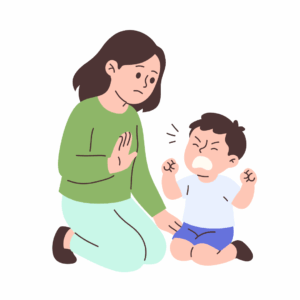
Step one: calm body, calm voice. Kneel down, make eye contact, and say, “Your tummy hurts and you do not want to go. I hear you.”
Step two: one sentence, not a negotiation.
“Shoes on, bag on, out the door.”
Step three: walk him to the gate yourself.
Hand him to his teacher, one warm sentence, and go.
“Have a good day. I will see you at three.”
Three steps: hear, move, hand over. Do not renegotiate at the door.
The plan was made last night, when everyone was calm.
The doorway is no place to rewrite the plan.
You can hold the sequence in your head even when he is crying and the clock is ticking.
The Gate Is Not the Enemy
Your child will go back to school.
Not because you won the morning, but because the thing that was wrong got found and fixed.
The tummy ache was a message.
The Sunday dread was a message.
The friend, the work, the teacher, the change, all of them were messages.
Try one thing tonight. Pack the bag, lay out the clothes, and ask the two questions.
“What is the hardest part of tomorrow?”
“What would make it a little easier?”
Then write the answer on a scrap of paper.
That is the whole plan. Three things ready, two questions asked, one small change to make.
For more on building a child who can handle hard days, see How to Raise Resilient Children.
The mornings will get easier.
Steadily, as the reason gets smaller and the plan gets stronger.
And when he walks through the gate on his own one morning, you will know exactly how it happened.
One message heard, one plan made, one morning at a time.