It is half past four.
The school bag is still by the door.
The lunchbox is still unopened.
The homework sheet is somewhere inside a crumpled folder.
You ask, calmly at first, whether homework is done.
Your child says it is boring, or that they already did it, or that they will do it later.
You ask again, a little less calmly.
Your child groans and drops their head on the table.
Within ten minutes you are sitting beside them, re-teaching fractions you last thought about years ago.
By dinner, nobody remembers the fractions.
If that scene feels familiar, you are not failing as a parent.
You are doing a job that was never yours to do alone.
Homework belongs to your child and to their teacher.
Your job is smaller than the one you have been carrying, and kinder too.
So what is really breaking down at half past four?
The Broken Chain
Think of a homework evening as a chain.
Each link has to hold for the evening to work.
A rested body, a task your child understands, a fixed time and place, a parent in the right role, and a way to stop when it falls apart.
When a chain breaks, you look for the broken link.
Most homework rows are one broken link, not a broken child.
Your child has spent hours following instructions at school, sitting still, getting along with classmates, and holding in tiredness.
By the time they get home, their patience is spent.
Then an adult they love sits down and asks for more school, straight away, with no break, no snack, and no choice about when or where.
That is not laziness.
It is a tired child protecting what little energy they have left.
So you hover, correct, and push, because watching your child struggle feels worse than taking over.
But taking over teaches your child that homework is your problem, not theirs.
The more you carry it, the less they learn to carry it themselves.
So tonight, stop asking why your child fights homework, and ask which link broke.
Link One: A Body That Is Running on Empty
Asking a child to sit still for homework straight after sitting still all day is a hard ask.
Most children need to move first.
Ten to fifteen minutes of active play can change the whole session: a run around the garden, a bike ride, dancing in the kitchen, or a walk to the park and back.
This is not a reward for homework.
It is part of the routine, in the same way a snack is part of it.
Movement first, sitting down second, every night.
For younger children, movement can sit inside the session itself: after each checklist item, ten jumps, or a run to the front door and back.
For tweens, movement may look less like play and more like a walk with headphones, a bike ride, or time shooting hoops alone.
Watch for the other kind of tiredness too.
A child who is hungry, thirsty, or overtired will not learn well, no matter how good the routine is.
A snack, a drink of water, and a toilet stop before homework starts are not delays.
They are preparation.
You can say, “Snack, drink, toilet, then we start.”
Link Two: A Task Nobody Has Explained
Sometimes the chain breaks at the task itself.
Your child stares at the sheet and does not know where to start.
So they say it is boring, and you hear defiance.
What you are really hearing is confusion.
Help your child read the task and break it into small steps, before a single answer is written.
Ask, “What is the first tiny step here?”
If the work is too hard, shorten the sitting, not the standard.
You can say, “Just the reading page, then a break.”
Once a child has started, continuing is often easier than starting.
Younger children need you close for this part: read the instructions together, break the work into tiny steps, and keep sessions short.
Tweens need something different: more independence, and more respect for their growing ability to manage time.
Let them choose the order of tasks, and check in at the start and at the end, rather than hovering throughout.
You can say, “Show me your plan for tonight, and come and find me when you are done or stuck.”
Two children can look identical at the table, and need opposite help.
One cannot do the work yet, and needs a smaller step.
The other can, but will not start, and needs a smaller start.
Telling them apart saves you from solving the wrong problem.
Link Three: An Evening With No Fixed Slot
Many families try to fit homework into the busiest part of the day, between school pickup, snacks, clubs, dinner, and baths.
When homework has no fixed slot, every evening becomes a negotiation.
Your child asks for ten more minutes of play, you agree because you are tired too, and then homework starts late, in a rush, with tempers already frayed.
A fixed slot does not make homework fun.
It removes the nightly argument about when it will happen.
Choose one homework time and keep it as steady as you can: for many families, a snack and a break first, then homework before dinner.
The best time is the one you can actually keep most nights, not the one a perfect schedule would suggest.
Write it down, tell your child, and keep it for at least two weeks.
Choose one homework place too.
It does not need to be a special desk.
A corner of the kitchen table works perfectly, the same chair and the same pencil pot, every night.
Keep the phone and the television out of that corner, including your own phone, if you can manage it.
Link Four: A Parent Doing the Teacher’s Job
This is the link most parents break without noticing.
A teacher explains new material, checks answers, and decides whether work is good enough.
A coach sets up the session, keeps the routine steady, and encourages effort.
Your child already has a teacher.
What they need at home is someone who believes they can do the work.
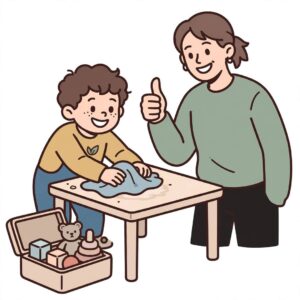
You sit nearby, doing your own quiet work, not sitting on top of them watching every pencil stroke.
You answer a question with another question when you can: “What have you tried so far?” or “Where could you look that up?”
You check that the work is done, not that every answer is perfect.
If an answer is wrong, leave it for the teacher to see.
A teacher who sees an honest mistake can teach from it, while a teacher who sees a parent’s perfect copy learns nothing about your child.
You can answer honestly: “I am helping by letting you try, and I am right here if you get stuck.”
One boundary helps more than any other: do not re-teach a whole topic at homework time.
If your child clearly does not understand the material, that is information for the teacher, not a reason for you to become the teacher at seven in the evening.
Note it, let your child attempt what they can, and use the teacher note below.
Link Five: No Way to Stop When It Falls Apart
Some nights will still fall apart, even with a good routine.
Your child may cry, shout, or shut down completely.
That is the moment to stop, not to push harder.
Pushing through tears rarely produces learning.
It produces a finished sheet, a miserable child, and a memory that makes tomorrow night harder.
A planned stop point, agreed when everyone is calm, lets you stop without it feeling like giving up.
Agree the stop rule in advance, on a calm evening.
You might say, “If homework gets too upsetting, we will stop after we have tried for a little while, and I will write a note to your teacher.”
“Stopping is not a punishment, and it is not a way out of homework every night. It is what we do when feelings get too big to learn.”
When tears start, keep your voice low and your words short: “This feels too hard right now. We are going to stop here, and I will write a note to your teacher.”
Close the book, put the pencil down, and move to something calming: a drink, a cuddle, a quiet activity, or a short walk.
Later, when everyone is calm, you can say, “The maths felt too tricky tonight. I will tell your teacher, and we will try again tomorrow.”
If tears happen most nights, or over the same subject again and again, that pattern matters, and it is worth raising with the teacher properly, not just in a nightly note.
On nights that fall apart, send a short note instead.
Dear teacher, thank you for the homework this week. My child tried the work this evening, and we stopped after a little while because they became very upset.
They completed the parts listed below, and found the rest too difficult to do on their own.
Please could you go over this part again in class?
Thank you for your help. Kind regards, followed by your name.
Then list what was done and what was not, briefly.
Use the note sparingly, and honestly.
If hard nights become the pattern, ask for a meeting and bring the notes.
The 3-2-1 Evening
Three things before the table, two rules at the table, and one stop rule for the nights it falls apart.
Before the table: snack, movement, and a drink and toilet stop, three small acts of preparation, in the same order, every night.
At the table: be a coach, not a teacher, and let the list do the reminding.
The visible checklist is the part you can see: a whiteboard, a piece of card, or a page stuck to the fridge.
Write the steps with your child, in their words, before they start.
A list might read: read the sheet, do the maths page, learn five spellings, pack the bag.
Your child ticks each step as it is done, and the list, not you, becomes the boss.
Instead of saying, “Have you done your spellings yet?” for the third time, you can say, “Check your list. What is next?”
That small change moves you from nagging to coaching in one sentence.
If the school sends more work than fits in one sitting, help your child choose the order, not the total.
You can say, “We have time for two of these before dinner. Which two will you start with?”
For younger children still building basic day patterns, the guide on small daily rhythms gives simple patterns that make homework time easier to predict.
Then the one stop rule: if tears come, stop, comfort, and write the note.
What Quietly Makes It Worse
Do not sit over your child correcting every answer as they write.
Constant correction makes a child afraid to write anything, because each sentence may be criticised before it is finished.
Let your child complete a section first, then look at it together briefly, if at all.
A few honest mistakes handed in are better than a perfect sheet your child did not produce.
Do not turn homework into a trade: “Finish your homework and you can have your tablet” makes homework the unpleasant price of something fun, and it teaches your child to rush through work to reach the reward.
Do not compare your child with a sibling or a classmate: “Your sister never had this trouble” may feel like motivation, and it lands as shame.
Compare your child only with their own progress.
Now the doubt sitting in the back of your mind: “But if I step back, will they not fall behind?”
Stepping back is not stepping away.
What you stop doing is the part that was never yours: explaining new material, fixing every answer, and carrying the worry for both of you.
Children who own their homework, even imperfectly, learn faster than children whose homework is owned by a parent.
For wording that keeps a limit kind when the evening starts to rise, the guide on how to say no and still keep the connection offers short lines you can use.
The guide on phrases that help children listen without yelling offers the same steady approach.
When Tears Start Tonight
Keep four moves in your head for the hard nights.
First, name what you see, in one short sentence: “This feels too hard right now.”
Second, stop the work, not the evening: close the book, put the pencil down.
Third, comfort first: a drink, a cuddle, a short walk, and no lecture about effort in that moment.
Fourth, write the note, and let tomorrow stay open: “The maths felt too tricky tonight. I will tell your teacher, and we will try again tomorrow.”
Four moves, all from this evening, in the order they happen.
Tomorrow, Change One Link
You do not need to become a better teacher to fix homework evenings.
You need to become a steadier coach: same time, same place, a checklist your child can see, movement before sitting down, and a stop point you both know in advance.
Start tomorrow with one change: pick the homework time and write the checklist together.
When your child gets stuck, sit nearby, ask what they have tried, and leave the wrong answers for the teacher to see.
When tears come, stop, comfort, and write the note.
Night by night, your child will learn that homework is their work, that you believe they can do it, and that home is still a safe place even when schoolwork is hard.
That lesson will last far longer than any single sheet.