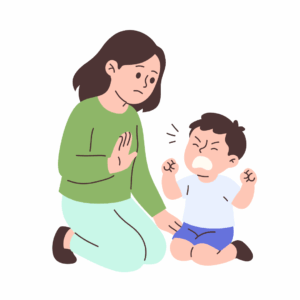
You are halfway down the supermarket aisle with a list in one hand and a tired child in the other.
Your child spots a toy, picks it up, and holds it out to you like it is already theirs.
You say no, or you say not today, and the sound rises.
Other shoppers glance over, and your face warms.
Part of you wants to buy the toy just to end the moment.
Part of you wants to lecture about how money does not grow on trees.
Neither urge helps.
Neither one makes your child understand money any better.
That aisle moment is not a failure of parenting.
It is not a sign that your child is spoiled.
It is a sign that your child has not yet had a system for money.
Children learn about money by handling it, by watching what happens when it runs out, and by hearing the same calm words every time.
A single talk about saving will not do that.
A small weekly system will.
So here is the question underneath the noise in the aisle, the one you are really asking when your child is crying next to the cereal.
How do I teach my child about money without turning every shop trip into a battle?
Practice Money, Not a Wage
Here is the idea this whole guide rests on.
Allowance is practice money.
It is a small, regular amount your child can divide, spend, save, and sometimes waste, while the stakes are still low.
It is not a wage for being a decent member of the household.
It is not a reward for good behaviour, or a prize for a good grade.
A child who spends all their Spend money on sweets on Monday and has nothing left on Friday learns something no lecture can teach.
That lesson costs very little now.
Money is invisible to children for most of the day.
You tap a card, a parcel arrives at the door, the lights stay on, and food appears in the fridge.
From a child’s seat, it can look as if wanting something is enough to make it appear.
When you say you cannot afford something, your child may hear that you do not want to buy it.
The money part has always been hidden.
The jars in this guide make that hidden part visible.
Your child sees money arrive, divides it up, spends some of it, waits for the rest, and sometimes runs out and lives with that.
Four Jars on the Kitchen Shelf
Take four clear jars, tubs, or envelopes and label them Earn, Save, Spend, and Give.
Earn is where money lands first: the allowance, the birthday money, and the money from an extra job.
Save is money set aside for something bigger that takes time, like a bicycle, a game, or a special outing.
Spend is money your child can use freely, without asking you to approve every choice, as long as the choice is safe and legal.
Give is money your child chooses to share, whether that means food for a food bank, a charity the family supports, or a small gift for someone else.
When money comes in, your child divides it straight away, before anything is spent.
Here is a split you can copy: out of every ten coins, five go to Spend, three go to Save, and two go to Give.
The Earn jar empties as it is divided, and that is the point.
It is the in tray, not a fourth pile to hoard.
Spend money can be spent at any time, once the split is done.
Save money stays in the jar until the goal is reached.
Keep the jars where your child can see them, not hidden in a cupboard.
There is no single right amount for the allowance itself, and anyone who gives you one without knowing your household is guessing.
Choose an amount you can keep every week without stress, even in a tight month, and start smaller than you think.
What the Money Is For, and What It Is Never For
This is the part most families get tangled up in, so let it be clear.
If you pay your child for making their bed, clearing their plate, or being kind to a sibling, you teach them that ordinary family life is work they should be paid for.
Basic behaviour belongs to family life, not to money.
You do not need to put a price on family life.
That does not mean your child should never earn extra money.
Extra jobs that are genuinely beyond normal family chores can be paid, and they should be agreed in advance.
Name the job, name the amount, and name when it will be paid, before the work starts.
That way your child learns what a real agreement looks like.
Schoolwork is another area to keep separate from money.
Paying for grades can turn learning into a transaction.
Praise the effort you can see, help with the habit of sitting down to work, and let grades stay a school matter.
If you want to celebrate a hard term, celebrate with time together, a favourite meal, or an outing, rather than cash for a letter on a report.
One Short Money Day Each Week
Pick one day a week for money.
Sunday evening works for many families, or Saturday morning before the shops open.
Keep it short, keep it at the same time, and keep it calm.
Fifteen minutes is enough, and five is enough for a younger child.
If it happens every week, rain or shine, it becomes as ordinary as laundry.
A money day has three parts, always in the same order.
First, hand over the allowance and divide it into the jars.
Second, check the Save jar together and count how close your child is to their goal.
You can say, “You have saved for two weeks. One more week and you will have enough. That is hard to wait for, and you are doing it.”
Third, ask one question: is there anything you want to plan for this week?
The point is that the choice is made before the shop, not in the middle of it.
Talk about your own money choices out loud, in small ways.
Children learn more from hearing you choose than from hearing you lecture.
The jars work best inside a home that already has a few steady rhythms.
If your younger children are still building those patterns, the guide on small daily rhythms offers simple patterns that make the whole day feel more predictable.
In the Aisle, Say Less
No system removes the shop moment entirely.
Your job is to stay steady, name the choice your child has, and leave the shop with your relationship intact.
When your child holds up something they want, start by noticing it rather than dismissing it.
You can say, “That looks fun. I can see why you want it.”
Then name the system, not your mood.
You can say, “That comes from your Spend jar. Do you have enough in there, or do you want to put it on your Save list?”
If your child does not have enough, say so plainly and kindly.
You can say, “You do not have enough in your Spend jar today. You can save for it, or you can choose something smaller that fits.”
If your child pushes harder, repeat the same short answer rather than inventing new reasons.
You can say, “I hear you, and the answer is still not today. We can add it to your wish list when we get home.”
That wish list earns its place.
When you get home, follow through: sit down for two minutes, write the item and its price on the list, and work out how many weeks of saving it would take.
For more on holding a limit without shutting your child down, the guide on how to say no and still keep the connection walks through the same steady approach in everyday moments.
When the Spend Jar Is Empty on Monday
Sooner or later, your child will spend the whole Spend jar on Monday and come to you on Friday with nothing left.
Here is a difference worth holding on to: running out and wasting money look alike from the outside, and they are not the same thing.
Wasting money is money spent without a choice, or money taken from the Save jar to cover a choice already made.
Running out is what happens when a child makes a real choice with their own Spend money and then lives with the empty jar.
Do not top up the Spend jar midweek.
Sit with the disappointment together, and on the next money day, ask what your child wants to try differently.
Instead of shaming the mistake, describe what happened without judgment.
You can say, “You spent the whole Spend jar on Monday, and now there is nothing left for Friday. That is a hard feeling. What would you do differently next week?”
Notice progress too, because a system that only notices mistakes will not last.
Some families reading this are counting every coin, and a guide about jars can feel out of touch.
If allowance is not possible right now, the system still works, because the system is about choices, not amounts.
A tiny amount, divided into jars, teaches the same habit as a larger one.
If you are parenting alone, the same system gives you a script you can reuse on tired evenings.
You do not have to negotiate every shop trip from scratch.
The guide on single parenting speaks honestly about carrying all of this alone.
The Mistake That Quietly Breaks the Jars
There is one mistake that undoes the whole system faster than any shop tantrum.
Do not use money as a punishment.
Keep discipline and money separate.
Do not use money as a bribe for basic behaviour either.
“If you are good in the shop, I will buy you a toy” turns the shop trip into a performance.
A calmer approach is to state the plan before you go in.
You can say, “We are buying food today, and nothing else. If you want a toy, we can add it to your list at home.”
Do not buy the item secretly later to make up for the row.
It feels kind in the moment, and it undoes the system in one move.
Now the doubt every parent raises, out loud: but will giving my child money to spend however they like not make them greedy?
They are not learning greed. They are learning that money has edges, that waiting is possible, and that giving is part of the plan from the start.
One more boundary to name plainly.
If your child takes money that is not theirs more than once, that is more than a jar problem.
The same applies if they hide spending and lie about it again and again, or if money worry keeps them awake and frightened for weeks.
Talk to your doctor, or to a trusted professional who works with children, and say what you have seen.
For wording that keeps a limit kind, including with other adults who keep overruling the system, the guide on phrases that help children listen without yelling has lines you can borrow, with a calmer tone.
Next Time You Are Standing in the Aisle
When the moment comes anyway, hold this order in mind.
Step one: get close and notice the want.
“That looks fun. I can see why you want it.”
Step two: name the jar, not your mood.
“That comes from your Spend jar. Do you have enough in there, or do you want to put it on your Save list?”
Step three: hold the answer, even if tears come.
“You do not have enough in your Spend jar today. You can save for it, or you can choose something smaller that fits.”
Step four: write it down when you get home.
Add it to the wish list, work out how many weeks it would take, and let the list do the waiting for you.
Right now, your only job is to stay steady and leave the shop with your relationship intact.
Start With the Jars You Already Own
You do not need to teach your child everything about money this week.
You need four jars, one money day, and a few steady phrases for the shop.
Your child is not behind, and you are not late.
Try one thing tonight.
Find four jars, tubs, or envelopes you already own, label them Earn, Save, Spend, and Give, and put them where your child can see them.
Then agree on your split, five to Spend, three to Save, and two to Give out of every ten, and on your money day.
That is the whole start.
There will still be tears in an aisle from time to time.
That is the system working, because your child is learning, in real life, that money is limited, that waiting is possible, and that a no from you is not a rejection of them.
Keep the jars visible, keep money day short, and keep your voice steady.
Over weeks and months, that quiet repetition will teach your child more about money than any single talk ever could.