It is twenty past eight on a Monday morning.
The classroom door is open.
The first children are already inside, bags on hooks, coats half off.
One of them stops beside your desk.
What are we doing today?
Before you can answer, another one asks the same question.
Then a third.
By the time the bell rings, you have answered it five times.
The day has not started yet.
That is the problem this printable solves.
Not with a louder voice.
With a wall.
A visual schedule for the classroom puts the whole class day where every child can see it.
First step in the morning to last step at dismissal.
One board. One arrow. Twenty children who can read the day for themselves.
The question does not go away.
It just stops needing you.
Try a class moment right now
Six moments from one school day, each with words that work.
Pick one, and it opens with the words to say and the step that follows.
Try a class moment
Tap a moment below. The words to say and the step to take appear right here.
Morning meeting
Say this: “Look at our class day. First morning meeting, then reading, then writing. What comes after writing?”
Then: point at the clock card, and let the arrow monitor move the arrow to morning meeting.
Reading time
Say this: “Reading is next. Who can find the book card on our board?”
Then: move the arrow down one step, and let the class read the next block out loud.
Lunch
Say this: “Lunch is next. What do we do after lunch?”
Then: point at the lunchbox card, and let the class name recess before you do.
Recess
Say this: “Recess is over! The arrow slides down to centers. Which block is next on our board?”
Then: let one student move the arrow, and the class walks to centers without a reminder.
Centers
Say this: “Centers are nearly finished. Look at the board. What follows centers?”
Then: point at the story card, and let the class see dismissal is the last step.
Dismissal
Say this: “Look, the arrow reached the bottom. We finished every step of our class day.”
Then: let the class fill in tomorrow’s preview card together before they go.
Pick a moment above to see the words and the next step.
What goes on the board, and what never does
The board shows steps, in order, with a picture for each.
Nothing else goes on it.
No names. No stars. No behavior marks. No good or bad.
A behavior chart counts stars across a week and ends with a reward.
This board counts nothing and rewards nothing.
It only shows the day.
The board is for the whole class, not one child.
One child does not get a different board.
When every child watches the same arrow, every child knows the same day.
That is what makes the room calm.
If a step changes, change the board before morning.
Assembly days, field trips, and cancelled specials all change the day.
Change the board with the class, so nobody is surprised.
A board that shows a different day from the real one is worse than no board at all.
The class stops trusting it, and then they stop looking at it.
The arrow is the whole trick
The board without the arrow is a poster.
The arrow makes it a schedule.
Snip the large arrow from the cards page.
Place it next to the step the class is on at this moment.
As the class shifts to the next block, slide the arrow down one step.
Everyone in the room can tell where they stand and what follows.
Hand the arrow to a student.
Pick one student a week to be the arrow monitor.
Their job is small and real: move the arrow at every transition and read the next block out loud.
A board a student moves is a board the class watches.
Rotate the job every Monday so every child gets a turn.
Read the day top to bottom at morning meeting.
Point at the special for today, and name the one thing that is different.
Then stick the arrow beside the first block and start.
If the arrow never moves, the class stops looking.
Leave the arrow in one place all day, and the class learns to stop watching it.
Move it every time, even on the easy days.
Specials, substitutes, and the days that change
Specials change every week, and the class always asks about them.
Art, music, PE, library, computers.
Fill the specials chart on Monday morning, every week.
Point at it when the class asks, and the question answers itself.
A chart that changes weekly is still a chart the class trusts.
It only has to change before morning, never during the day.
Fill in tomorrow before dismissal, every day.
The tomorrow preview card takes one minute.
Tomorrow we will, the special tomorrow is, one thing to remember.
When tomorrow stays hidden, every morning starts with worry.
A class that sees tomorrow walks in already knowing the day.
Leave the substitute sheet filled in the night before any absence.
Today’s specials, what changed today, and one thing only you would know.
Add what to do if the class gets stuck.
A supply teacher who follows the board can carry the whole day alone.
A substitute who cannot read the board spends the morning asking the class, and the class spends the morning running the room.
From the wall to the timetable to nothing
Pictures stop working at ten, but the visible week still matters.
An older class juggles eight blocks a day across five days, and a busy week drops things.
A timetable takes the week out of memory and puts it on the wall.
There it can be checked, changed, and finished with no teacher narrating.
The three versions below grow with the class.
Ages 3 to 5 get a picture board with seven steps and big cards.
Ages 6 to 9 get nine blocks with times, subject cards, and the specials chart.
Ages 10 plus get a timetable, five days and eight blocks, with a desk strip of their own.
Fade the wall slowly.
The wall is the first rung, the timetable is the second, and no wall at all is the third.
First the timetable stays on the wall but nobody reads it aloud.
Then it comes out only on changed days.
Then the timetable alone runs the week.
If the week slips, bring the full board back without fuss.
Tools stay tools, never verdicts.
A missed block is information, not failure.
Ask what made it hard, then fix next week.
Print the board on card stock.
Laminate the cards, and keep the arrow on a magnet or a clip so it moves in one second.
A board that is easy to move is a board that gets moved.
And a board that gets moved is a board the whole class can trust.
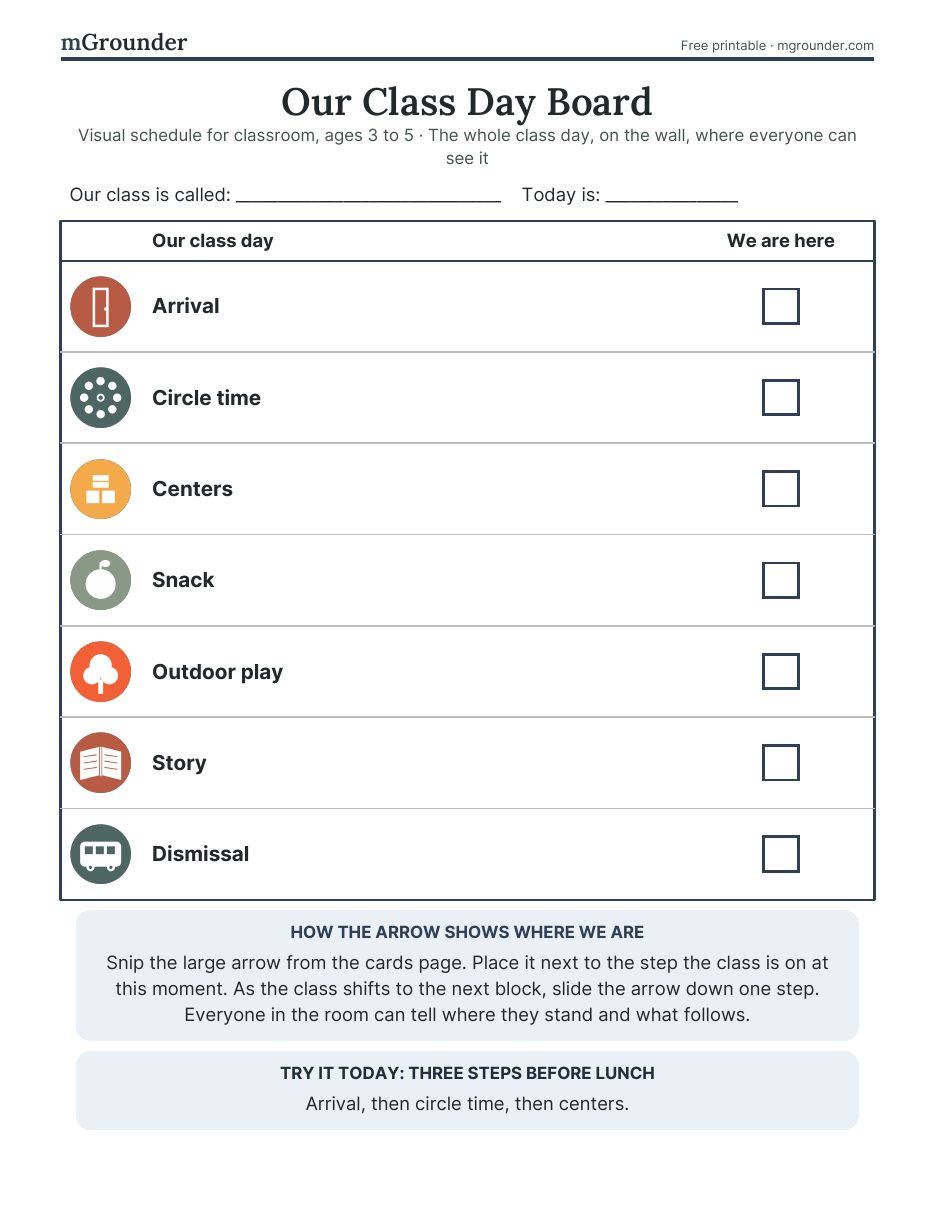
Ages 3 to 5: the class day board
Seven steps from arrival to dismissal, twelve picture cards to cut out, a big WE ARE HERE arrow, and a teacher guide for running the wall.
Download the ages 3 to 5 board (PDF, 3 pages)Free printable. No sign-up, no email.
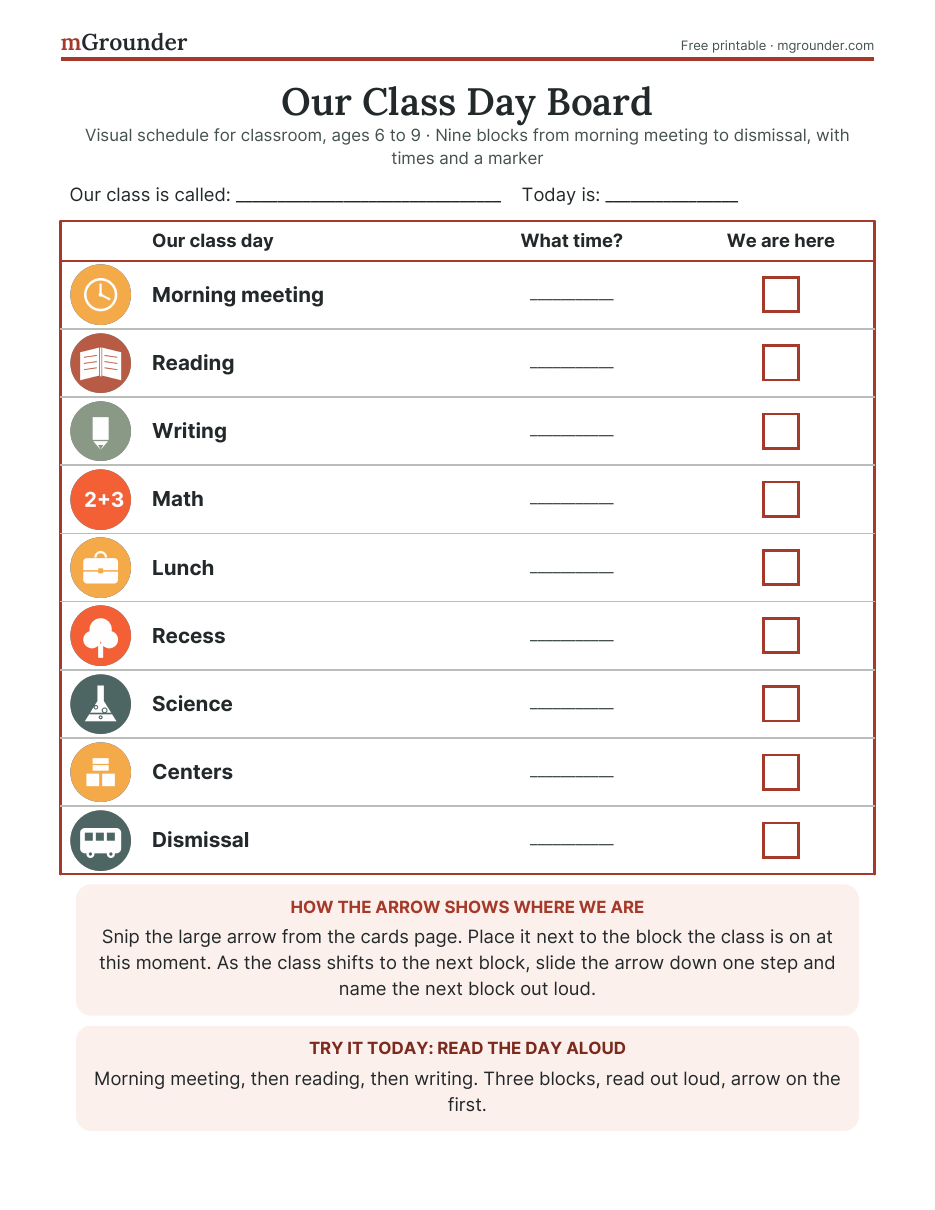
Ages 6 to 9: the class day board with times
Nine blocks with write-in times, sixteen subject cards, a specials rotation, a tomorrow preview, a substitute teacher sheet, and a teacher guide.
Download the ages 6 to 9 board (PDF, 4 pages)Free printable. No sign-up, no email.
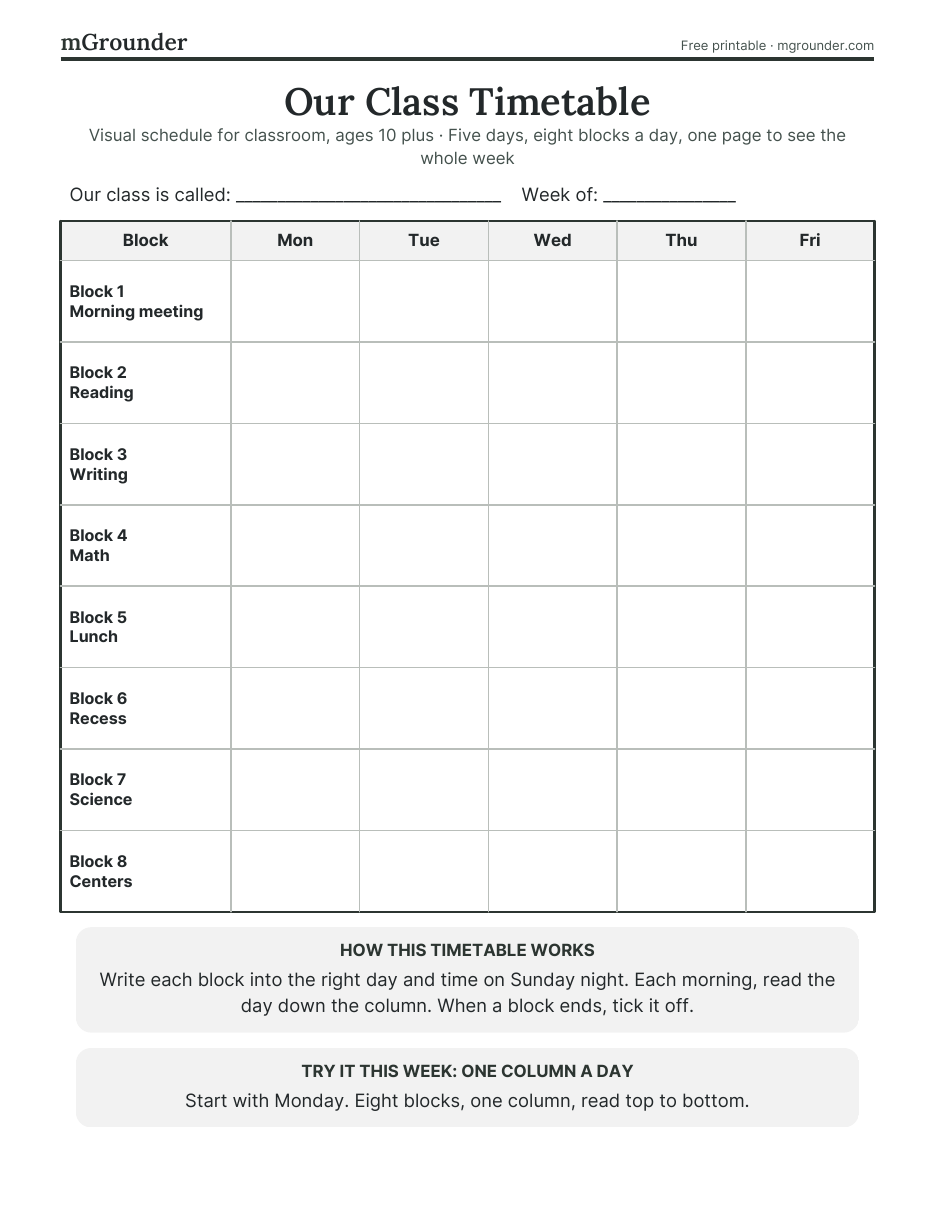
Ages 10 plus: the class timetable
Five days and eight blocks on one page, twelve subject cards, a desk mini-schedule for the week, and a teacher guide. Prints clean in black and white.
Download the ages 10 plus timetable (PDF, 3 pages)Free printable. No sign-up, no email.
Tomorrow morning, the question will come again.
What are we doing today?
This time, you will not have to answer it five times.
Point at the wall, and let the board answer.