The bathroom mirror is still fogged from the shower.
Toothpaste on the sink, pyjamas half off, hair sticking up.
Your child stands in front of the glass, and the day has not started yet.
Leaning against the mirror is one small card.
Not a poster, not a chart, not a page full of words.
One card, with one sentence on it.
Your child reads it out loud, in a sleepy voice,
And the day starts with words that belong to them.
That is the whole idea behind this kit.
An affirmation card holds a short true sentence a child can say about themselves.
Not a promise about what will happen, and not praise for something done.
A sentence about what is true right now, said in the child’s own voice.
Three decks sit below, one for each age,
Because a four year old and a twelve year old do not need the same sentences.
Print the deck that fits, cut the cards out tonight,
And stand one up by the mirror before bed.
Try a morning before you print
Six mornings that can go wrong, each with words to say and a step to take.
Open one, and its words will show underneath.
Try a morning before you print
Six mornings that can go wrong. Open one to see the words that fit it.
The card will not stand up by the mirror
Say this: “It keeps falling over. Let us fold the bottom back and try again.”
Then: fold the bottom edge back to make a stand, lean the card against the glass, and let your child be the one who sets it straight.
A hard worksheet waits in the school bag
Say this: “That worksheet is waiting, and it looks big. Which card fits a big morning?”
Then: let your child pick the try again card, say it once at the mirror, and pack the worksheet last, so the card is the last thing seen.
Your child says the card feels like a lie
Say this: “If it feels like a lie, it is the wrong card. Let us find a smaller one.”
Then: swap the big sentence for a small true one, like handling the next hour, and watch how fast a card that fits gets said.
A friend was unkind yesterday
Say this: “Yesterday hurt, and today is a new day. Which card is about friends?”
Then: hand over the friend card, say it together at the mirror, and ask after school whether the card held up.
The morning fell apart before breakfast
Say this: “No card today. The morning ran away from us, and that happens.”
Then: skip the card without a speech, stand a fresh one tomorrow, and never use a missed morning as a lecture.
Your older child calls the cards babyish
Say this: “You might be right about the little ones. The older deck is written for you, not for a little kid.”
Then: switch to the 10 plus deck, and let the plain sentences do the talking, because a card that treats an older kid as grown up gets kept.
Open a moment above, and its words will appear here.
A sentence to say, not a feeling to name
This kit holds sentences, and only sentences.
Short ones, in the child’s own voice, starting with I am or I can,
Said out loud in the morning, before the day starts.
That is a different job from every other kit in this series,
And the difference is what the card asks the child to do.
Our Feelings Faces are cut-out face cards to hold up, match, and play with.
Six cards for ages 3 to 5, a 12-card deck with a sort mat for ages 6 to 9,
And a build-a-face kit for ages 10 plus, with games that need the deck.
A face card asks a child to pick a feeling, act it, or match it.
An affirmation card asks a child to say one true sentence about themselves.
One shows a feeling on a face, and the other speaks a sentence out loud.
Our Emotion Cards for Autism are cards a child hands over to say how they feel.
Six hand-over cards for ages 3 to 5, a 12-card deck with sentence builders for ages 6 to 9,
And a talk board for ages 10 plus, for the moments when words are hard.
A hand-over card says I feel, and the grown-up answers the feeling.
No card here says I feel at all.
These cards speak of what a child can do, not how a child feels.
Our Lunchbox Notes are small messages waiting at lunchtime, slipped into a lunchbox by someone else.
Eight notes for ages 3 to 5, a week of five notes for ages 6 to 9,
And ten notes for ages 10 plus, found alone at school in the middle of an ordinary day.
A lunchbox note is a surprise from a parent, written by someone else.
An affirmation card is chosen by the child, stood up at home, and spoken aloud by the child.
One is found, and the other is spoken.
Our Valentines Cards for Kids are foldable cards to colour, fill in, and hand over in person.
The youngest get eight foldable cards, the middle get twelve joke and message cards,
And the oldest get four elegant cards, with envelopes and an exchange system in each deck.
A Valentine card leaves the house in an envelope, for someone else to keep.
An affirmation card stays by the mirror, for the child who said it to keep saying it.
One is given away, and the other is kept.
Our Gratitude Worksheet practices noticing good things, with three good things a day,
Thank-you notes, and a gratitude jar to fill over the weeks.
That kit looks back at the day and thanks someone for it.
This kit looks forward to the day ahead, and gives the child one sentence to carry into it.
Many families use several of these together, because naming a feeling, handing over a card,
Finding a note, giving a card away, and saying a true sentence are five different jobs.
But when the need is one true sentence in the morning, before the day even starts,
The cards in this post are the tool that fits.
Inside the three decks
Three decks, one per age, all built on the same morning ritual.
Draw, stand, say, ask.
The youngest deck opens with eight cards to cut out and stand up.
Brave, kind, try again, friend, help, keep going, waiting, and loved,
Each one with the moment to say it, so the child knows when the sentence fits.
Four blank cards follow, to draw on or write on,
Plus a week picker with five school days to tick.
A grown-ups guide ends the youngest deck, with the morning routine, a sample week, and three mistakes to steer clear of.
The middle deck opens with twelve cards to cut out and draw from.
Brave enough to try, another go after a mistake, a kind friend, asking for help,
Finishing what you start, noticing when someone needs a hand, pausing to think,
Pride in effort, learning hard things, listening well, saying sorry, and being enough.
A week log comes next, with seven days, one card a day,
And one card kept standing for next week.
Six blank cards come next, with four rules for a card that works.
A grown-ups guide closes the deck, including the sample week, when the habit fades, and the three mistakes to avoid.
The oldest deck prints in black and white on purpose.
It opens with twelve cards written for older kids, because older kids can tell when a card was written for a little kid.
Hard days, trying again, loyal friendship, asking for help without shame,
Effort that counts unseen, disagreeing without unkindness, learning at your own speed,
Keeping going when practice drags, owning mistakes, more than one bad day,
Choosing kind words when angry, and still growing.
Six blank cards come next, with four rules for a card that works, and a make it believable box.
The middle pages end with a fourteen day log, one card for each day of two weeks.
A grown-ups guide closes the deck, including handing it over, when a card feels false, a sample fourteen days, and when to retire a card.
Every deck prints free, for home or for class.
How to run a morning in three steps
Stand one card up the evening before, by the mirror or on the breakfast table.
Hunt for a card in the morning rush, and the card never gets read.
Say it aloud, once, before the day begins.
A sentence spoken aloud lands twice as hard, because the child hears it in their own voice.
Ask one question after school, then set the card aside.
One question is enough: did your card come true today?
That is the method, all of it.
Draw, stand, say, ask.
When a card feels too big, shrink it, do not force it.
A sentence that fits this morning is one a child will say, and one that does not fit gets left alone.
Smaller and true beats bigger and grand, every time.
When a card stalls, let the child pick a different one.
A card the child picked is a card the child will say.
When the morning falls apart, skip the card without a speech.
No card today, fresh card tomorrow, and nothing more said about it.
Writing a card the child cannot believe is the first mistake.
If a child laughs at a card, blame the card, not the child.
Turning a card into a bribe or a punishment is the second mistake.
A card taken away for bad behaviour teaches a child that kind self talk is earned, and it is not.
Pressing a card on a bad morning is the third mistake.
Skip it, and stand a new card tomorrow.
Hiding a real problem behind cards is the fourth mistake.
A child who is struggling at school needs a grown-up’s help, not just words on a card.
Marking the log is the fifth mistake.
Blank days in a log only mean the log waited for a kinder day, and that is all right.
Print the cards at full size on plain paper,
And on card stock if they will be stood up every morning.
The oldest deck is designed for black and white printing,
So printing a class set costs next to nothing.
Cut the cards with scissors, not by tearing,
Because a clean edge stands better and lasts longer.
Fold the bottom back to make a stand,
And lean the card against the mirror if it will not stand alone.
Keep the set in an envelope by the mirror,
And let the child pick one card each morning.
Keep a spare set in a drawer for the day a teacher, a counsellor, or a grandparent asks for one.
Keep finished logs in a binder, because a binder of true sentences is something a child can look back on with pride.
When the words will not come at all,
the Feelings Chart gives your child a word to point at first.
The Emotions Chart sits beside it, matching each feeling with a helper worth trying.
When the morning ends in raised voices,
the What to Say Instead of Yelling post offers a calmer line for that moment.
When a little one cries over a card that fell down,
the Toddler Says “I Don’t Love You” post holds words for the tears after.
Most cards get picked for tomorrow in the hour after school,
When the bags land by the door and the day spills out.
Answers before you print
Which deck should I print?
Choose by age: the 3 to 5 deck, the 6 to 9 deck, or the 10 plus deck.
Go by reading level, not just by birthday,
And move up a deck when the sentences feel too young.
My child already names feelings. Why add cards?
Naming a feeling and saying a true sentence are two different habits.
A feeling card says what is happening inside.
An affirmation card says what the child can do about the day ahead.
One names, and the other speaks.
What if my child says the card is not true?
Shrink it.
A big sentence becomes a small one, and a small true one gets said.
If a card never fits, retire it, and write a smaller one in its place.
My child already gets lunchbox notes. Why add cards?
A lunchbox note comes from someone else, tucked away for the child to discover at school.
An affirmation card is chosen by the child, stood up at home, and spoken aloud by the child.
One arrives as a surprise from a parent, and the other comes as a sentence from the child.
What if my child will not say the card out loud?
Let them read it in a whisper, or in a silly voice.
A silly reading is still a reading, and the sentence still lands.
Never force a reading, and never make a card into a test.
Do these work at school too?
Yes.
They are free for home and class, and the card of the day routine in the guides was built for classrooms.
Never mark them, never make a child read one aloud, and keep private cards private.
Do I pay anything for this?
No.
It is free from start to finish, with no account and no email gate.
It costs nothing for home or class, and you can print as many copies as you like.
When should I retire a card?
Retire a card the week it stops fitting, and say so out loud.
Retiring a card is not quitting.
It is choosing a sentence that still fits.
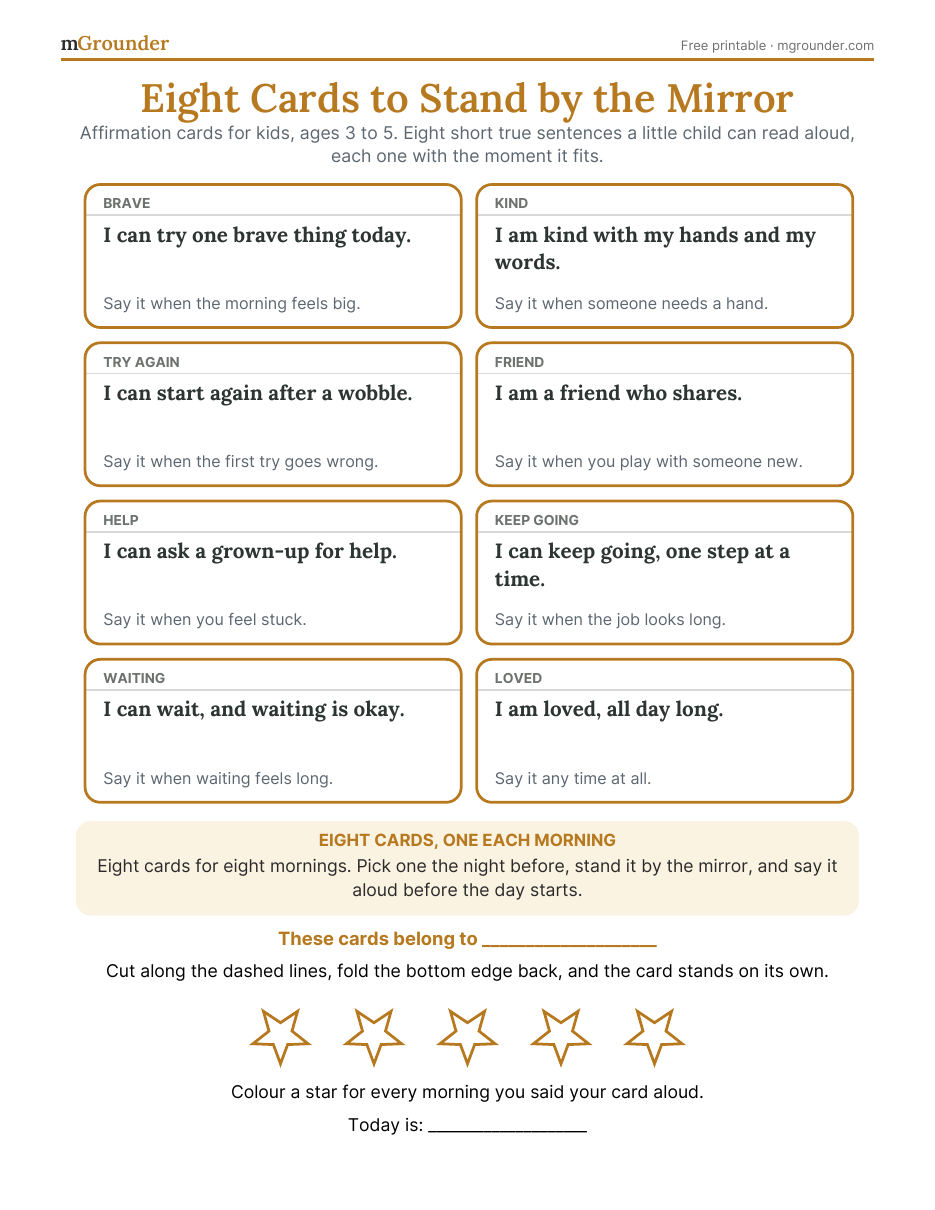
Ages 3 to 5: eight cards to stand by the mirror, and a week to tick off
Eight cards to cut out and stand up, four blank cards to draw on,
A week picker with five school days, and a grown-ups guide.
Download the ages 3 to 5 affirmation cards (PDF, 3 pages)Cut them out tonight, and stand one up by the mirror before bed.
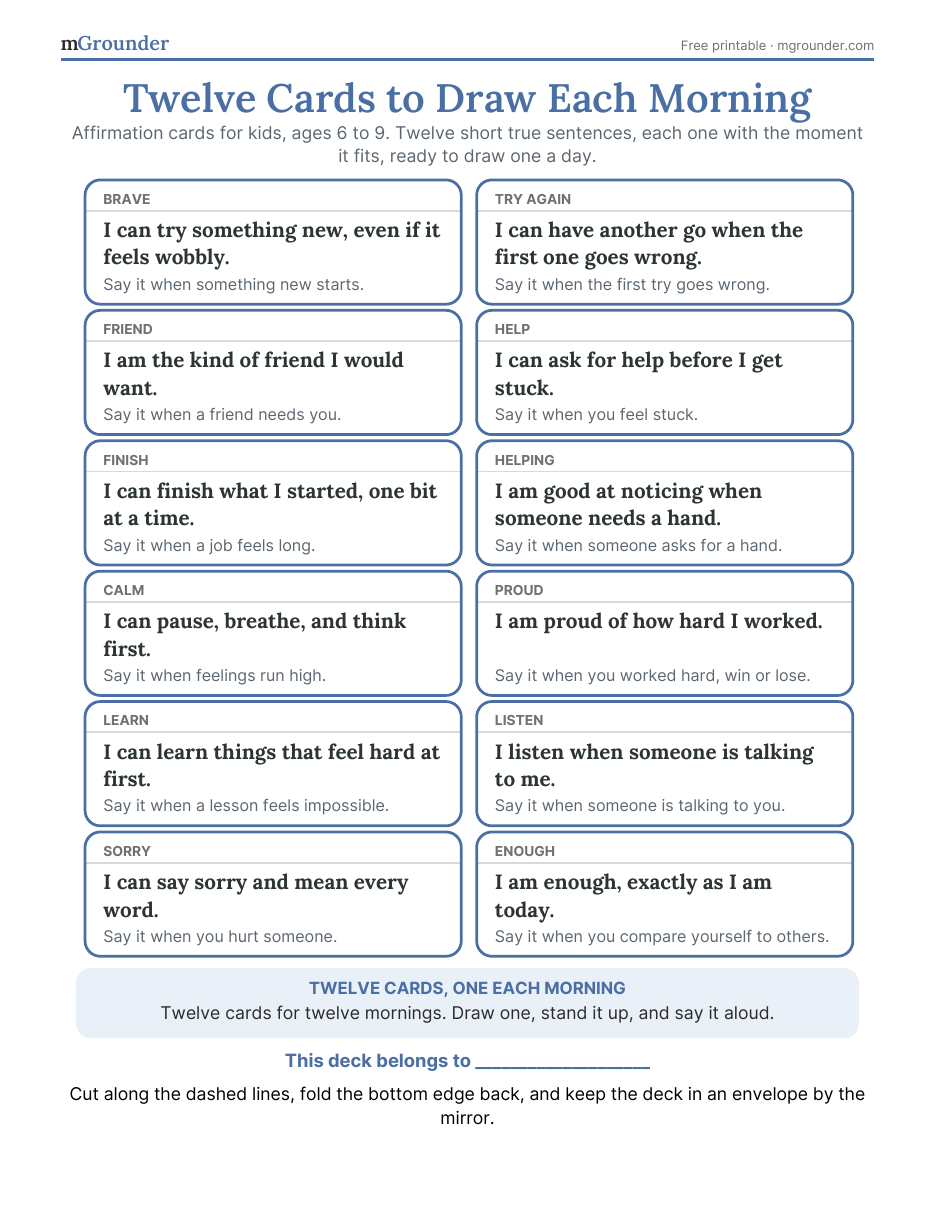
Ages 6 to 9: twelve cards to draw, a week log, and six blanks
Twelve cards to draw from, a seven day week log,
Six blank cards, four rules, and a grown-ups guide.
Download the ages 6 to 9 affirmation cards (PDF, 4 pages)Keep the deck in an envelope by the mirror, and draw one each morning.
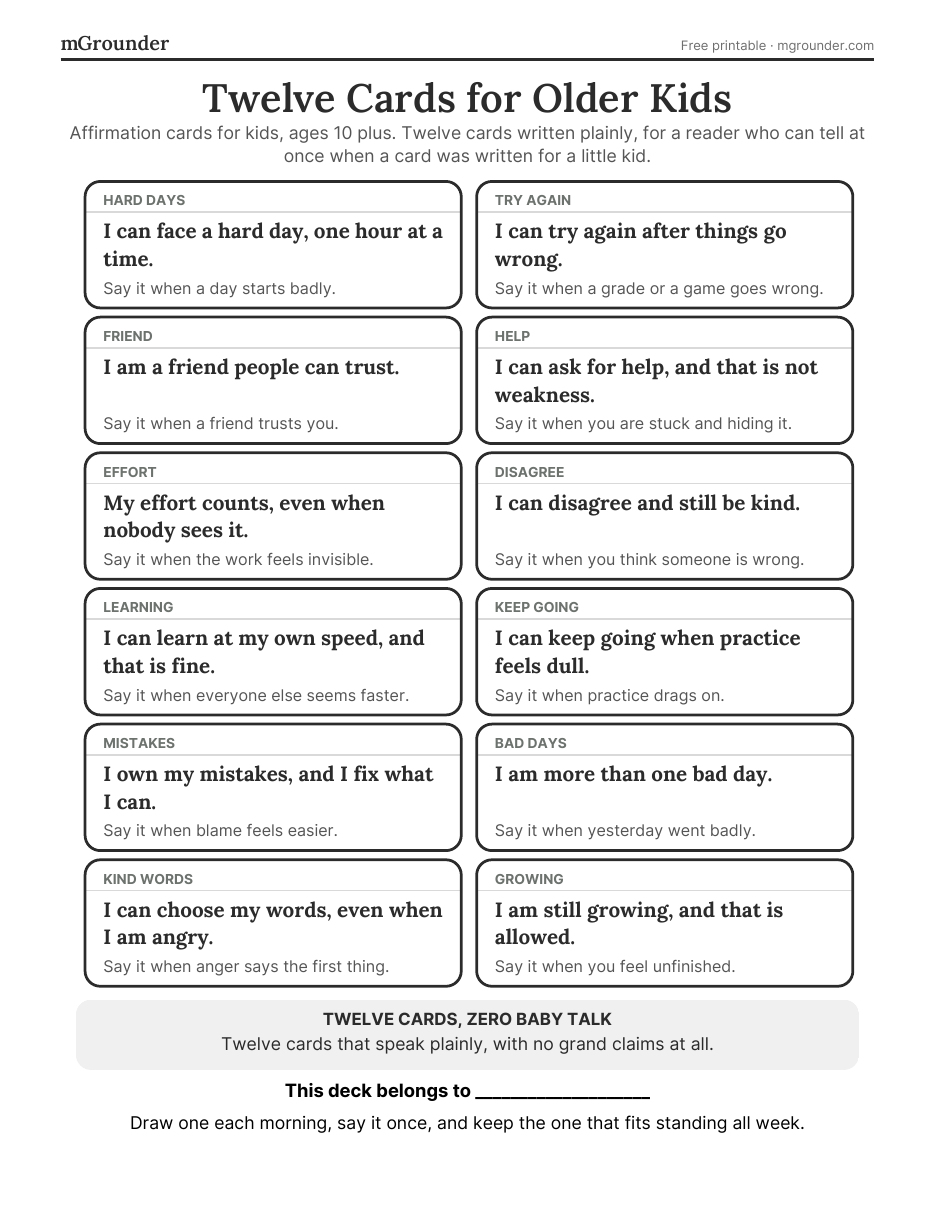
Ages 10 plus: twelve cards for older kids, in black and white
Twelve cards that sound grown up, six blank cards,
A fourteen day log, and a grown-ups guide, all in black and white.
Download the ages 10 plus affirmation cards (PDF, 4 pages)A black and white class set stays cheap.
Cut the deck out tonight, and put it in an envelope by the mirror.
Tomorrow morning, your child draws one card, stands it up, and says it aloud.
By next week, seven mornings will hold seven true sentences.
A deck of true sentences, one morning at a time.