The teacher smiles at the gate and says it was a lovely day.
Your child smiles back, walks to the car, and holds it together all the way home.
Then a shoe feels wrong.
The snack is the wrong flavour.
A younger sibling looks at them for half a second too long.
Tears. Shouting. A bag thrown on the floor.
The child who was polite for six hours suddenly cannot cope with anything at all, and you are standing in the hallway wondering what just happened.
Did something go wrong at school that nobody told you about, or does your child save the worst of themselves for you?
Here is the question underneath both of those.
It is the one parents ask quietly after the shouting has stopped, standing in the hallway with a bag on the floor and a child in tears.
If home is safe, why does home feel like the place where everything falls apart?
The Depleted Battery
Think of your child’s ability to stay calm, polite, patient and focused as a battery.
Every part of the school day uses a little charge.
Sitting still when they want to move uses charge.
Waiting for a turn uses charge.
Listening when they are bored uses charge.
Being kind to a classmate they find irritating uses charge.
Following rules they did not choose uses charge.
Eating lunch in a noisy hall, coping with a change of teacher, losing a game without crying, and asking for help when they feel embarrassed all use charge.
By three o’clock, the battery is low.
It means self control is a limited resource on any given day, especially for a child whose brain is still learning how to manage it.
Hunger and tiredness drain the battery faster still.
A child who is hungry, tired and socially drained does not need a lesson in gratitude when they walk through the door.
They need fuel, rest and a pause, in that order.
Call the pattern what it is.
Your child holds themselves together all day at school, and then falls apart at home, where it finally feels safe to do so.
Home is not causing the meltdown.
Home is where your child can finally stop holding it in.
1. The Shoe That Was Never About the Shoe
Watch the trigger closely next time, because it will look too small for the reaction.
A strap pinches.
A biscuit breaks.
A sibling hums the wrong tune.
Your child erupts, and a reasonable voice in your head says this cannot be about a shoe.
It is not.
When the reaction is bigger than the trigger, the trigger is rarely the whole cause.
The whole day is the cause.
The shoe is simply the last thing the battery had to carry.
That mismatch tells you this is a meltdown, not a tantrum.
A tantrum has a goal.
A child wants the biscuit, or wants to stay at the park, and the crying is a push to get it.
A meltdown has no goal.
Your child is overwhelmed, out of charge, and unable to stop, even when you offer the very thing they seemed to want.
They are spent.
Take the small trigger seriously, because to a depleted child it genuinely feels large.
Kneel down, loosen the strap, and say, “That shoe is really annoying you. Let us take it off and sit for a minute.”
Some children get clingy, and some get silly and wild, then tip into tears.
The shape changes, but the timing does not.
It starts soon after school ends, and it often fades after rest, food and quiet connection.
2. Food Before Words
The landing strip starts in the kitchen, not in a conversation.
Offer food within the first few minutes of arrival, before you ask anything else.
Keep it simple and ready: a banana, crackers and cheese, yoghurt, a sandwich, or whatever your child will reliably eat.
The point is fuel, not nutrition perfection.
A child who is hungry cannot regulate emotions well, and a snack removes one drain on the battery quickly.
Do not turn the snack into a decision that needs energy.
“What do you want?” is another question for a tired child.
Offer a choice between two ready options instead.
“Apple slices or crackers?”
Let your child eat somewhere comfortable, not necessarily at the table.
A cushion on the floor, the garden step, or the sofa may suit a tired child better than a formal seat.
If your child refuses food, do not force it.
Leave a snack within reach and move on.
What matters is that food is available early, without pressure, and that the first thing your child meets at home is care, not a demand.
Think of the whole first half hour as a landing strip.
A plane does not go straight from full speed to parked.
It slows down gradually, and so does a child.
Your job in these thirty minutes is to slow things down, not to fix the day, review it, or prepare for tomorrow.
3. Let the Body Move First
After a day of sitting still, a child’s body needs to move.
Movement does not have to be sport, and it does not have to be long.
Ten to fifteen minutes is enough for most children.
Running in the garden, kicking a ball, jumping on a trampoline, dancing in the living room, climbing at the park, or simply walking around the block with you.
A child who has run hard for ten minutes often returns calmer than a child who has been told to calm down for ten minutes.
If the weather is bad, indoor movement counts.
An obstacle course of cushions, a hallway race, or a few minutes of jumping and stretching in the bedroom all work.
For an older child, movement may look different.
A teenager may want to shoot hoops alone, go for a walk with headphones on, or lie on the floor listening to music.
Respect that.
A teenager’s decompression may look like withdrawal to a parent, but if they return steadier after twenty minutes, it is working.
The test is whether your child is calmer afterwards.
Even five minutes of unstructured time between structured activities helps the battery recover.
Recharge first, then requests.
That one line is the order for the whole afternoon.
4. Thirty Minutes With No Questions
This is the hardest part for many parents, because asking about school feels like caring.
But for thirty minutes, hold the questions.
Do not ask how the day went, what they learned, or who they played with.
Let your child choose whether to talk, and about what.
Many children answer “fine” and then explode, not because they are hiding something, but because they have no energy left for a summary.
A child who is not asked anything may volunteer, halfway through a snack, that a friend was unkind, or that a lesson was confusing.
That volunteering is more honest than any answer dragged out by questioning, because it comes when the child is ready, not when you are curious.
A child who says “nobody played with me” does not need “I am sure they will tomorrow.”
When the thirty minutes are over, you can ask one gentle, open question if you like, but keep it light.
“Anything you want to tell me about today?” is better than a list of specific questions, because it lets your child pick the part of the day that matters to them.
For ideas that invite conversation without pressure, the guide to questions to ask your child instead of how was school offers alternatives that work far better in the evening than at the school gate.
5. Sit Beside Them
Reconnection is a short, warm moment that tells your child you are glad they are home, without asking them to perform.
It might be sitting beside them while they draw, reading a page of a book together, making a drink side by side, or simply being in the same room without talking.
The activity matters less than the message.
You are here, you are not in a hurry, and your child does not have to earn your attention by being cheerful.
Beside, not across.
Across a table feels like an interview.
Beside them on a sofa feels like company.
Once reconnection has happened, you can gently move toward the evening’s tasks.
The transition works better with a warning than a sudden switch.
Use the five minute warning, the one small tool in this guide.
Say it once, calmly, and then keep your word.
“In five minutes, we will start homework. You can finish this drawing first.”
A child who has been warned can prepare.
If homework still causes a collapse after a proper landing strip, that is a separate conversation, worth having with the teacher, rather than a reason to abandon the routine.
A child who can do homework calmly after rest, but not straight after school, has shown you exactly what they need.
Believe them.
Connection first, then correction.
A child with a little charge back can hear a boundary.
A child with none left can only hear a threat.
6. The Words That Shorten a Meltdown
Even with a good landing strip, meltdowns will still happen, especially in the first weeks while the routine is new.
What you say during one can either shorten it or lengthen it.
Start with the simplest sentence you own.
“You had a long day, and you are tired. I am here.”
Next, give the feeling permission.
“You can cry here. I will wait with you.”
Then, when the peak has passed, hand a little control back.
“When you are ready, tell me what you need.”
There are sentences to leave out, and they are the ones most of us reach for first.
Do not say, “You were fine at school, so why are you acting like this now?”
Do not say, “Stop crying over nothing.”
To a tired child, it is not nothing.
Do not say, “If you carry on like this, there will be no screen time.”
You can hold a boundary and be kind at the same time.
“I will not let you hit. I am going to stay nearby until your body feels calmer.”
Short, steady phrases like these are also gathered in phrases that help kids build self-regulation, which is useful to read when you are calm, so the words are ready when you are not.
The shape changes as children grow: a younger child may cry or fall asleep on the sofa, and a teenager may close a bedroom door and need a quiet half hour.
Same battery.
Same landing strip.
Different shape.
What Not to Do When You Are Tired Too
Most parents, on seeing a child fall apart after school, do one of three things, all with good intentions.
They ask questions, they correct the behaviour, or they start the evening routine straight away.
Correction in the peak of a meltdown does the same damage in a different way.
“Do not speak to me like that. Take your shoes off properly. Stop crying over nothing.”
A child who has just lost control does not need to be told they have lost control. They know.
Now the objection every parent raises, usually in the same breath as the relief: but will this not spoil them?
You are not removing the demands of the evening.
You are moving them thirty minutes later, to a moment when your child has something left to meet them with.
One boundary to name plainly.
Most collapses improve noticeably within two to three weeks of a consistent landing strip.
If meltdowns last for hours most evenings, talk to your child’s teacher first.
The same applies if your child is distressed about going to school in the morning, or if teachers report difficulties at school too.
If sleep, appetite or interest in play has changed markedly over several weeks, talk to your child’s doctor as well.
Asking for support is not a sign that the landing strip failed.
The routine is for an ordinary, tiring school day.
For a fuller picture of what helps when a child is overwhelmed in general, the guide on helping a dysregulated child explains the same calm, step by step approach in a wider context.
In the Moment: Four Steps on the Landing Strip
When it happens anyway, keep the landing strip in mind.
Four moves, all from this guide, in afternoon order.
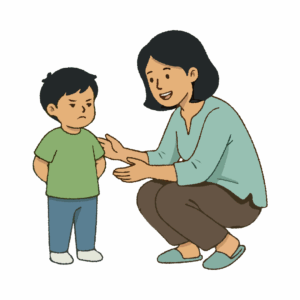
Step one: drop to their level.
Crouch down, meet their eyes, and say, “I am here. We will get through this together.”
Step two: name the day, not the shoe.
“You had a long day, and you are tired.”
Step three: offer food, movement or quiet, not a lecture.
“Let us take the shoe off, have a snack, and sit for a minute.”
Step four: wait, then warn.
Once your child is calm, give the five minute warning before the next thing begins.
Teach nothing in the middle of it. Save the lesson for tomorrow, when everyone is rested.
Right now, your only job is to get your child calm and get through the landing strip together.
Tonight, Start With the Snack
Your child is not falling apart because school is bad, or because you are doing something wrong, or because they have a difficult character.
They are falling apart because a full school day asks a great deal of a young person, and home is the first place where they can stop asking so much of themselves.
Try one thing tonight.
Have the snack ready when they walk in, and notice what happens in the ten minutes after that.
You may find that the child who seemed impossible at half past three is, by dinner, the child you recognise again: chatty, funny, and ready to tell you about their day, in their own time, and in their own words.
Pack bags the night before, keep breakfast seated for five minutes, and leave a few minutes early.
If mornings in your house currently involve a daily argument, the guide to a morning routine without the fight offers scripts that pair naturally with the landing strip in this guide.
It is a small routine, but it changes the whole afternoon, because it treats tiredness as tiredness, not as bad behaviour.