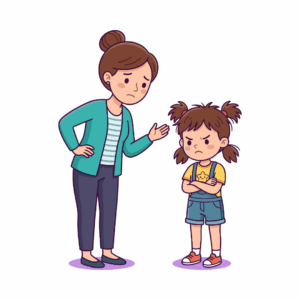
“You always take his side.”
Your daughter says it from the back seat, loud enough for the whole car to hear, and your son answers before you can draw breath.
“No, she always takes your side.”
You are at a red light. One child has kicked a bag. The other has folded his arms so hard his shoulders have gone up to his ears.
It started over nothing you saw. A look. A breath. A seat.
And now you are the judge, the jury, and the person both of them are angry with, all at once.
You did not plan to spend your evening like this.
You planned dinner, homework, a bedtime that started on time.
Instead you are weighing evidence you never saw, about a toy you did not watch anyone touch, while the traffic light turns green.
How do you stop being the referee without letting the house fall apart?
They Are Fighting for a Place, Not a Toy
Call it the attention contest.
Most fights between your children are not about the red car, the last biscuit, or who sat in the front seat yesterday.
They are about a question your children keep asking in different ways: am I as important as my brother or sister?
A younger child grabs because grabbing is faster than waiting, and because the older child’s reaction proves the toy matters.
An older child guards a game because the game is one of the few places where they feel in charge.
When one child gets a later bedtime, a bigger portion, or the turn to choose the film, the other child reads it as a ranking, not a practical decision.
Children also fight because fighting works.
If shouting brings you running, if tears change your decision, if the loudest child gets the item just so the house goes quiet, both children have learned a lesson you never meant to teach.
The child who shouts has learned that volume wins.
The child who gives in has learned that peace costs them what they wanted.
Rivalry grows in the gap between those needs and the attention available on a normal, tired day.
Your job is to narrow that gap, not to close it perfectly, and to coach, never to referee.
A referee decides who started it. A coach helps both children decide what happens next.
1. The Back Seat Knows First
The car concentrates every ingredient of sibling rivalry.
Your children are strapped in, close together, bored, tired, and unable to walk away.
You are driving, so you cannot mediate properly, and every raised voice competes with the road for your attention.
If the same seat causes the same fight every day, rotate the seating on a visible schedule, or assign seats for the week and change them on Monday.
A child who knows their turn for the window seat is coming will argue less about missing it today.
Give the journey a job.
An audiobook both children chose, a game where they take turns naming animals, or a rule that each child picks one song, gives restless minds something to do besides provoking each other.
When a fight starts, keep your response short and safety first.
“I cannot drive safely while you are shouting. I need quiet voices until we stop.”
If the shouting continues and it is safe to pull over, pull over, sit quietly until the noise settles, then drive on.
Deal with the dispute after you arrive.
“We will sort this out after we get home. Right now, everyone needs a quiet body in the car.”
Then keep that promise, when you can look at both children and give them your full attention.
2. Dinner Turns Into a Courtroom
Dinner table fights rarely start at dinner.
They start with hunger, tiredness, and a whole day of small frustrations that have had nowhere to go.
One child copies another. One complains about the food. One announces that the other got more.
Separate the jobs at the table.
Let one child pour the water and the other hand out the plates, and swap the jobs tomorrow.
Watch for the fairness trap at mealtimes.
Serving exactly equal portions feels fair to an adult, but a hungry ten year old and a picky five year old do not need the same plate.
If equal portions are causing daily arguments, serve by appetite instead and say so plainly.
“You get what your body needs tonight, and so does your brother. Different does not mean unfair.”
When teasing starts at the table, name it directly and briefly.
“Teasing about food is not allowed at this table. You can talk about your own plate.”
If the same complaint returns every night, change the seating or the serving order for a week and see what shifts.
If one child regularly provokes the other at dinner, look at what happens just before the meal.
Ten minutes outside before dinner can change the whole meal.
3. Bedtime Is the Last Tug of the Day
Bedtime fights have a particular sting because you are tired too, and because the argument delays the only quiet part of your day.
Give each child a small, separate bedtime moment, even if it is only five minutes.
A story for one child and a short chat for the other, in that order one night and reversed the next, tells each child they have their own time with you that nobody else can take.
When a dispute erupts at bedtime, keep the intervention brief and boring.
“It is bedtime. Everyone in their own bed. We will talk about the game in the morning.”
A long bedtime negotiation rewards the stalling, because it extends the evening.
If one child is afraid of the dark and the other teases them for it, treat the teasing as its own issue.
“Being scared is not something to laugh at in this house. If your brother is scared, you can ignore it or you can be kind. Laughing at him is not an option.”
That protection lands better when children already have words for the feelings underneath the fight.
The phrases that help kids build self-regulation are worth learning calmly.
The short lines to use instead of yelling work best when practised before bedtime, not during it.
4. “You Always Take His Side”
Those five words hurt because they accuse you of the one thing you are trying hardest not to do.
Your first instinct may be to deny it: “That is not true. I love you both the same.”
Denial rarely works, because your child is not asking for a statement about your love.
They are telling you about a moment when they felt less important.
Start by believing the feeling, even if you disagree with the charge.
“It sounds like you felt I was on his side just now, and that must have felt awful.”
Then look at the specific moment, not the general accusation.
Ask, “What happened just now that made it feel unfair?”
A specific problem has a specific fix. A general accusation has none.
Children notice when one sibling gets more of your time because of homework, a medical appointment, or a difficult week.
Pretending everything is equal when it plainly is not teaches children not to trust your answers.
Name the reason instead: “Your sister needed extra help with reading this week, so I spent more time with her. That does not mean I love you less.”
For a broader look at staying close without keeping score, the guide on how to become a parent your kids enjoy being around sits well beside this section.
5. Then a Baby Arrives and Everything Shifts
Most sibling rivalry does not start with a fight.
Preparation works best when it is honest and concrete.
Instead of only saying a baby is a gift, talk about what will actually change.
“The baby will cry a lot, and I will need to feed them many times a day. You will still have your story at bedtime, and your swimming lesson will stay the same.”
Give the older child a real role, not a pretend one.
A child who can fetch a nappy, choose the baby’s outfit, or sing a song while you change the baby feels useful rather than replaced.
A child who is only told to be gentle and quiet feels like an obstacle.
Protect one thing that stays only theirs.
It might be a special toy the baby will not touch, a weekly outing with you, or a bedtime story that belongs to them alone.
Expect regression, and do not punish it.
An older child who starts wetting the bed again, or wanting to be carried, may be testing whether baby behaviour brings baby attention.
“You want to be little tonight. I can hold you like a baby for five minutes, and then we will read your big kid book.”
When visitors crowd around the baby, narrate the older child’s importance where others can hear it: “She has been such a careful big brother this week.”
6. The Quiet One Is Not Always the Fine One
Here is a distinction that changes how you watch a fight: quiet is not the same as content.
One child shouts. The other goes silent, hands over the toy, and walks away.
So watch the child who yields, not only the child who grabs.
Check in privately, later, when the room is calm: “I noticed your sister did most of the talking. What did you actually want?”
Then teach them a line they can use in the moment, and back them up when they use it: “I want a turn too.”
Fairness sometimes means giving the quieter voice extra room, not giving both voices identical time.
When one child is bossy in a way that takes over every interaction, not only during arguments, look closer at the pattern.
The strategies in how to deal with a bossy child can help you separate a leadership strength from a habit of controlling others.
For the shared toy itself, use one small tool and use it the same way every time.
Call it the Timer Turn: a visible timer, five minutes each, and the turn changes when it rings, even if the child giving up the toy protests.
If neither child can agree on a fair way to share it, the item rests on the shelf until tomorrow, and you try again then.
What Makes It Worse, Even When You Mean Well
Some responses feel effective in the moment and quietly make rivalry worse over weeks.
Do not ask who started it. The question turns you into a judge, rewards the better storyteller, and punishes the child who is too upset to explain themselves clearly.
Do not force an apology. A child made to say sorry before they understand what hurt the other person learns that sorry is a password for ending trouble, not a repair.
Do not compare children, even favourably. “Why can you not be tidy like your sister?” tells one child they are failing and tells the other that their value lies in being better than their sibling.
Do not solve every dispute yourself. Quick adult solutions keep the peace today and keep children dependent tomorrow. A short, messy negotiation between siblings is better practice than a perfect verdict from you.
Now the objection every parent raises at this point: but will they not just fight more if I stop deciding?
Here is the plain truth of it. At first, yes, the fights may look messier, because your children are practising a skill they have never had to use.
One boundary to name plainly: if fights are frequent and intense and leave one child frightened, or if a child is regularly hurting a sibling on purpose, that is beyond ordinary rivalry.
Talk to your child’s doctor or school counsellor, not as a punishment, but as a way to get support for a pattern that home strategies alone are not shifting. Asking for help is not admitting failure.
When It Starts Again Tonight
Picture it happening again, because it will, and hold four moves in your head.
Open with the line that sets the whole tone: “I hear two upset voices. I am going to help you sort this out, not pick a winner.”
Or, when hands are already moving: “Pause. No hands, no grabbing. Tell me what you each wanted, one at a time.”
Step one, stop the harm. If a child is hitting or throwing, step in calmly: “I am going to keep both of you safe. Hands stay off each other while we sort this out.”
Step two, name what each child wants: “You wanted the red car, and you wanted to finish your race without being interrupted.”
Step three, hand the problem back with a limit: “You both sound angry, and that makes sense if you both wanted the same thing. Let us figure out a fair turn.”
For older children, say: “I am not going to decide this one. You two know what fair would look like. What is your plan?”
Step four, hold the outcome. If they agreed on a timer and the timer rings, the turn changes. If neither child can agree, the item rests.
Start With the Next Fight, Not a Perfect Week
You will still hear shouting from the back seat.
You will still referee a dinner table dispute on a night when you have nothing left.
That does not mean the method has failed.
It means your children are still learning, and so are you.
The change to watch for is quieter than silence.
It is a child who pauses before grabbing, a sibling who offers a timer instead of a shout, a child who says “that is not fair” and then waits to hear your answer instead of escalating.
Those small moments are the method working.
They mean your children are starting to believe that fairness is something they can build together, not something they have to win from you.
Try one thing tonight.
At the next fight, do not ask who started it. Ask what each child wanted, hand the problem back, and notice what happens.
One fair moment, held calmly, is enough to start with.
Your children do not need a perfect referee.
They need a coach who stays on their side, even in the middle of a fight.