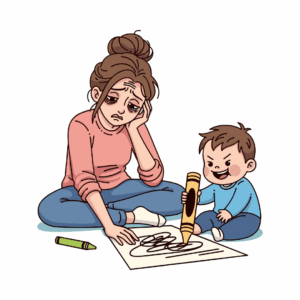
It is 6 in the evening. The toys are everywhere. You have asked three times, and your voice is already climbing before you decide to raise it.
Then it comes out. Loud. Sharp. Louder than you meant.
Silence follows. Your toddler freezes, eyes wide, bottom lip trembling.
You know that silence. It sits in your chest all the way to bedtime.
You did not plan to yell. Nobody plans to yell. It happens in the gap between the third request and the fourth, when patience runs out mid-sentence.
This is about what goes in that gap instead. Ten phrases, each one for a real moment, each one sayable with a tired voice and a full heart.
Say this instead, right now
The swap is small. Get low, get close, and say it quietly.
A low voice lands harder than a loud one, because it breaks the pattern your child expects.
When they will not listen, and you have asked three times.
“I need you to hear me. Come close so I can say this quietly.”
“I asked three times. Now I am going to help your body do it.”
“Show me you heard me. What did I just ask?”
That last one tells you something useful. Many toddlers genuinely did not process the instruction.
If they cannot repeat it, they need you to repeat it, not to raise your voice.
When it is dangerous, and fear is doing the shouting.
They ran toward the street. They threw the remote at the television. Your body floods with fear, and fear comes out as a scream.
“Stop. That is dangerous. I am moving you somewhere safe.”
“That is not safe. I will not let you do that.”
Short, firm, and then action. Name the danger once, then move.
A frightened two-year-old needs a calm adult in charge, not a louder one.
When they are melting down and you feel yourself snapping.
The screaming has gone on for ten minutes. Your jaw is clenched. You are one spilled cup away from losing it.
“I am feeling really frustrated. I am going to take a breath before I talk.”
“This is hard for both of us. I am right here.”
Saying your own feeling out loud buys you seconds.
It also shows your child what calming down looks like, which is the skill they do not have yet.
When you need thirty seconds to reset.
Sometimes the wisest thing you can say is the thing that pauses everything.
“I need a minute. I love you, and I will be right back.”
“Pause. We are both upset. Let us start this over.”
A parent who steps away and returns calm teaches more than one who stays and explodes.
Why the yell feels like it works
Yelling feels like it works because it gets an instant reaction. Your toddler freezes. The noise stops.
For three seconds, you have their complete attention.
But the behavior returns tomorrow, and the day after. A frightened child stops out of fear, not understanding.
Fear does not teach. It only pauses.
There is a second cost, and it stings more. Toddlers learn how to handle big feelings by copying you.
Every time volume solves frustration, you show them that volume is how big feelings get handled.
The child yelled at for hitting learns exactly that lesson. Then they use it on the next person who frustrates them.
None of this means you have damaged your child. A yell here and there in an otherwise warm home does not define their childhood.
But if yelling is your only tool, the pattern is worth changing.
Your body pays for it too. Every yell spikes your stress, then replaces it with guilt, which lowers your threshold for the next yell.
It is a loop. The phrases above are how you step out of it, one moment at a time.
Catch it before it comes out
Phrases alone are not enough. You need a way to catch the yell before it forms, and your body gives you one.
It always warns you first.
Tight chest. Clenched jaw. Heat in your face. Fists balling up.
Spend one day just noticing. The moment you can name the warning sign, you gain the two seconds you need to choose a phrase instead.
When the warning comes, drop your voice on purpose. Lower it. Slow it down.
A low, slow voice startles a toddler more than shouting, because it breaks the pattern they expect.
Then get low and get close. Move to their eye level before you speak.
Yelling happens from above, from across the room. Closing the distance turns confrontation into connection.
Say one phrase, then stop talking. Every extra sentence is another chance for frustration to leak through.
One calm phrase, then silence, beats a whole paragraph.
If the phrase does not work, do not say it louder. Act instead. Pick them up. Remove the object. Start the routine.
Toddlers learn from what happens, not from what is said repeatedly.
Mornings are where most yells happen, because the clock is loud and everyone is half awake.
After the moment passes, ask one question: what was I feeling before my toddler did anything?
Most yells are not about the spilled milk. They are about the sleepless night, the work email, the third boundary test in an hour.
Naming the real trigger keeps tomorrow’s yell from borrowing today’s stress.
When the yell already escaped
It will happen again, even with ten good phrases in your pocket. The repair is what makes the difference.
Go back when everyone is calm. Get low. Own it plainly, without a lecture attached.
“I yelled, and that was not fair. I am sorry. I love you, and I am here.”
That is the whole repair. No explanation of why you were stressed. No “but you were not listening” on the end of it.
The apology is the lesson.
Children do not keep score the way we do. What they remember is the overall pattern.
Every calm moment shifts it, and every honest repair shifts it further.
The goal is not a perfect record. It is a changing ratio.
The traps that sound calm but are not
Some replacements for yelling sound calm and cause the same damage. Watch for these.
Do not whisper-threaten. Hissing “you wait until your father gets home” through clenched teeth is yelling with the volume turned down.
Your toddler reads your tension, not your decibel level.
Do not go cold. The silent treatment punishes a toddler who cannot decode what the silence means.
To them it feels like abandonment, not a lesson.
Do not label them in the moment. “You are being bad” or “you never listen” sticks to a toddler’s forming self-image.
Name what they did, not who they are.
Do not bring up yesterday. “This is just like what you did at the store” turns a small moment into a trial.
Address what is happening now.
Do not apologize mid-boundary. “I am sorry, but you have to” confuses your toddler about whether the limit is real.
Hold it warmly. Repair your tone later.
Do not expect the phrases to work instantly. The first week your toddler may stare blankly when you speak quietly instead of yelling.
You are rewiring both of your reflexes, and rewiring takes repetition, not perfection.
You will still yell sometimes. That does not erase the ten times you did not. Every calm phrase is a rep, and reps build the parent you want to be.
Start with the one phrase that fits your hardest moment of the day. Use it until it is yours.