It is 9:40 on a Tuesday. The red rain boots are by the door, one tipped over.
Your bag is packed. Water bottle, banana, spare socks. The park is ten minutes away.
“Park?” you say.
“No.”
No. No. No.
Today the word is no, and it lands before you finish the sentence.
You hold up the rain boots.
No.
You offer the banana.
No.
No works.
For a small child with almost no say in the day, that is a powerful word.
The Word That Stops the Room
Think about your toddler’s morning so far.
Someone else picked the clothes. Someone else poured the milk. Someone else said it was time to brush teeth.
No does not need a reason. It does not need a plan.
Sometimes it means I want to choose. Sometimes it means nothing at all.
It is simply the word that worked last time, so it comes out again.
That is why arguing with it goes nowhere.
You are arguing with a word. Your child is holding on to a feeling.
Pause before you push back. Look at the face, not just the word.
Tired eyes? A thumb in the mouth? A body turned toward the sofa?
The no might be a signal. It might be asking for a slower start.
Stop Asking What You Cannot Accept
“Do you want to go to the park?” sounds like a choice.
It is not one, if you need to leave.
Your child hears a real question and gives a real answer.
Save yes or no questions for the things that are truly optional.
“Do you want a story before bed?” works when either answer is fine.
For the things that must happen, say the plan plainly.
Then put a real choice inside it.
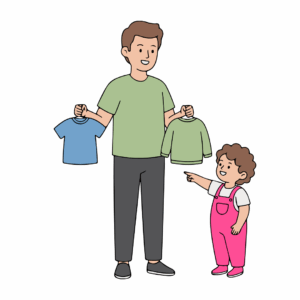
“We are going to the park now. Walk or ride in the stroller?”
“Shoes on. Red rain boots or blue sneakers?”
The boundary stays firm. The choice stays real.
Two options are enough. Three turns a doorway into a debate.
Offer only choices you can live with. If they pick the blue sneakers, the blue sneakers go on.
That is how a child learns that choosing means something.
Hand Them a Small Job
A child who says no to everything often needs a yes somewhere else.
Not praise. A job.
Let them carry the bag. Let them press the elevator button. Let them pick the snack.
“Can you be the bag carrier today? I need someone strong.”
“You press the button. I will count to three.”
With a job, your child is no longer the person being moved from room to room.
Keep the job real. A toddler can tell when a task matters.
Keep it short, too. One job is enough.
A list of jobs feels like another set of orders.
When it is done, name it plainly.
“You carried the bag all the way. Thank you.”
Make the Dull Bit Playful
Shoes, coats, car seats, hand washing. The dull bits stall first.
There is no fun in them, so no becomes the fun.
Add a little back. Not a show. Just a game.
“Can we hop like bunnies to the car?”
“Stomp like dinosaurs to the door. Big stomps.”
“The rain boots are sleepy. Wake them up with a jump.”
Play gives your child a new role to step into.
Keep the game short and let it end.
If the hopping goes on too long, the next step stalls again.
Go back to a calm, plain repeat.
“We are hopping to the car now. Then we buckle in.”
When No Means I Need a Minute
Not every no needs a fix. Some need space.
A child who has just woken up, or just stopped playing, may need a pause.
Give the pause a shape, so it does not stretch into a standoff.
“We will sit here for one minute. Then shoes on.”
One minute on the step can save a few minutes of struggle at the door.
Watch for the quiet signs. A turned back. A face hidden in your leg.
“You look like you need a minute. I will wait here with you.”
Stay close while you wait. Sit on the step beside them.
When the minute ends, move gently.
“Minute is done. Shoes on, then park.”
When No Turns Into Tears
Sometimes no is the first step toward tears.
You hold the boundary, and the feelings spill over.
Stay near. Keep your voice low. Keep your words short.
“I hear you. You did not want to leave. I am right here.”
Do not explain the plan again while your child is crying.
A crying child cannot hear a reason for leaving the house.
When the tears ease, offer the next step in one short sentence.
“Ready to walk to the car? I will hold your hand.”
A few extra minutes at home beats a forced exit that starts the park trip in tears.
Keep Your Own Word Steady
Your child is watching how you handle no, too.
If your no changes when they cry, or shout, or repeat the word, they learn it is a negotiation.
Say the plan once. Say it the same way the second time.
Then help your child do it.
“Shoes on now. I can help you, or you can do it yourself.”
If the plan truly changes, say so plainly.
“We are staying home now. The park will wait until tomorrow.”
That steadiness makes the next no easier to meet.
Lines You Can Use Today
Keep these close. They are short, plain, and easy to say when you are tired.
“We are going now. Walk or ride?”
“Red rain boots or blue sneakers? You choose.”
“Shoes on. Then we go.”
“You carry the bag. That is your job.”
“Hop to the car like a bunny.”
“You need a minute. I will wait.”
“I hear you. I am here.”
Pick one line. Use it for a week.
One steady line, used the same way each time, teaches your child what comes next.
What Progress Looks Like
This phase does not end with one good morning.
It softens, as your child finds other ways to feel strong.
Look for the small shifts. A choice made without a fight.
A shoe put on after one reminder. A no that turns into a yes after a minute on the step.
Keep the games short and the pauses kind.
Your child is finding a voice in a day they do not control.
Give that voice a place inside the plan, and no will have less work to do.
Start tomorrow at the first stuck moment. Offer one real choice, and see what happens next.