The milk pooled across the table at 7:40, and your toddler laughed.
You had already packed the bag, found one shoe, and lost the other.
The laugh did it.
Your voice came out louder than you meant it to, sharp enough to stop the room.
Your toddler froze with the spoon halfway to their mouth.
Then the crying started, and the guilt hit right behind it.
You had not planned to yell. You had planned to be calm, patient, the parent who handles a spilled bowl without raising their voice.
And here you are, kneeling in milk, wondering how the morning slipped that fast.
Before the Bowl Tipped
You woke up tired. The night had been broken by coughing, a wet sheet, a small foot in your back.
You skipped breakfast to get the bag ready.
The clock was already pushing you.
Your shirt had toothpaste on the collar.
The radio was talking, the washer was buzzing, your toddler was asking for the blue cup.
None of that was a crisis on its own.
Together, it filled every inch of room you had left.
A short fuse rarely starts with the thing that lights it.
It starts earlier, in the tired body and the rushed morning and the noise that never quite stops.
Your toddler did not create that pressure.
They just walked into it with a bowl of cereal.
That distinction matters, because it tells you where the work is.
Not in loving your child more.
In giving yourself a little more space before the next spill.
Touched Out at Bedtime
Bath water on the floor, pajamas inside out, one more story, one more drink of water.
Your toddler climbed into your lap and then off it, then back on, hands on your face, feet on your stomach.
You love the closeness and you feel crowded by it at the same time.
That is what touched out feels like.
Your skin feels tired of being touched.
Your voice gets thin. Then it gets loud.
You snap, “Get off me.”
The words hang in the bedroom.
Your toddler goes quiet in a way that makes your chest ache.
You did not mean to push them away.
You meant to ask for a minute of stillness, and it came out as a shout.
When It Happens Where Everyone Can See
The grocery store aisle, the parking lot, the playground gate.
Your toddler drops to the floor and screams for the crackers.
Heads turn, and you feel the heat rise in your face before you feel the anger.
Humiliation makes the fuse shorter.
You hear yourself say, “Get up right now,” in a voice you barely recognize.
You are not only trying to move your child.
You are trying to move the eyes off you.
The look on your toddler’s face stays with you.
The Same Spill, The Same Shout
Shoes by the door, again. Milk on the table, again.
The same request, ignored, again.
Repetition wears a groove in your temper.
You tell yourself you will handle it differently next time.
Then next time arrives at the same hour, with the same mess, and the same tired body.
The problem is that nothing around the moment changed.
Willpower alone does not fix a morning that is built to rush you.
The Pause Before the Next Word
The pause is not a lecture to yourself.
It is a small physical stop, right in the heat.
Put your feet flat on the floor.
Let your hands drop to your sides.
Unclench your jaw.
Take a breath that you can feel in your chest.
Look at your toddler’s hands, not their face, if their face makes the guilt spike.
Say nothing for that breath.
The silence is not punishment. It is space.
If you need to leave the room, say so in plain words.
“I need a minute. I will be right back.”
Step into the hallway.
Run cold water over your hands.
Let the heat drop before you speak again.
The pause will not make you calm.
It will make you less likely to say the thing you will regret.
That is enough for now.
If the yelling already happened, the pause still helps.
It stops the second shout, the one that usually follows the first.
After the Yelling Stops
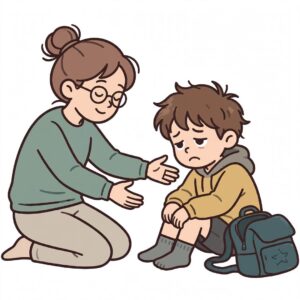
Go to your toddler, get low, and make your voice soft.
Do not rush the repair to make your own guilt go away.
Let them see your face settle first.
Then say it plainly.
“I yelled, and that was too loud. I am sorry. You did not deserve that.”
Wait. Let them answer, or not answer, in their own time.
If they cry, stay close.
If they turn away, stay near.
“I am here. We are okay.”
Do not explain the morning, the traffic, or the lost shoe.
A small child cannot carry the reasons behind your shout.
They can carry the repair.
If you snapped in public, repair there too, quietly, at their level.
No big speech on the sidewalk.
Just the same plain words, at the same low voice.
Repair does not erase the yell.
It shows your child what a grown person does after getting it wrong.
Stopping Tomorrow’s Blow-Up Before It Starts
Look at the hour, not your character.
Where does the yelling usually land?
Morning, bedtime, the car, the store.
Pick one of those hours and change one thing in it.
Set the bag out the night before.
Put the shoes by the door before bed.
Pour the cereal after the shoes are on, not before.
At bedtime, start earlier than you think you need to, so the story does not have to race the clock.
If touch feels like too much, give your toddler a job for their hands.
“Hold this towel while I dry your hair.”
In the store, keep the trip short and the list visible, so you are not deciding and soothing at the same time.
None of this is about being a better person.
It is about building a morning that does not ask you to be patient on empty.
When the fuse feels short, name it out loud to yourself.
“I am tired and rushed. I need to slow down.”
That sentence is not an excuse.
It is a warning light.
Tell another adult, if one is near.
“I am about to lose it. Can you take over for a bit?”
Asking for help in that moment is not weakness.
It is the pause, with another pair of hands.
Keep a note of the triggers, not to blame yourself, but to see the pattern.
The pattern is the thing you can change.
Back in the Kitchen
Tomorrow morning, the milk may spill again.
Your toddler may laugh again.
You may feel the same heat rise. This time, let your feet find the floor first.
Let your hands drop. Let the breath come before the voice.
Then kneel down, wipe the table, and start the morning over with your child beside you.
“Let’s clean this up together.”
The bowl was never the whole story. The pause is.