The last school bell rings on a Friday, and the backpack lands by the door.
Shoes come off in the hall, the lunchbox gets unpacked, and a small voice asks the big question.
What do we do tomorrow?
Tomorrow has no bell, no lunch line, and no homework folder.
That freedom is the best part of summer, and the trickiest part too.
Weeks of empty mornings stretch out in front of a child, and the days are long enough to fill twice over.
Some of those days will hold the beach, the garden, the bike, and the ice cream van.
A few of them can hold ten quiet minutes with a pencil.
That is the deal this kit makes.
Ten minutes of summer practice, then the whole summer back.
Skills that sit unused for a whole break go soft.
A teacher in September can spot the softness in a week.
The fix is smaller than a workbook and shorter than a lesson.
One short page, a few days a week, keeps reading, writing, and number skills warm.
Below sit three packs, one for each age.
Print the pack that fits, and leave the other two alone.
Try a summer moment before you print
Six moments from a long summer break, each with words to say and a next step to take.
Pick one, and the moment opens below.
Try a summer moment before you print
Tap a moment below. Each moment comes with words to say and a step to take next.
The first morning of the break
Say this: “No bell today. One summer page after breakfast, then the whole day is yours.”
Then: hand over the first sheet of the youngest pack, and let the break start with a small win.
A rainy afternoon indoors
Say this: “Rain took the garden away, so the word search comes out instead. Find all eight words before the rain stops.”
Then: put the middle pack on the table, and let the rain set the pace.
The beach bag is packed
Say this: “The bag is packed, and the ball is in it. Count the balls on the sheet first, then we go.”
Then: count the beach balls on page one together, and let the counting ride along to the beach.
The ice cream melts too fast
Say this: “The ice cream is melting, and the sum can wait. Lick first, add later.”
Then: finish the cone, then work out the shop sum about the nine morning ice creams and the fourteen afternoon ones.
The lemonade stand needs change
Say this: “A customer pays with fifty, and the drink costs twenty seven. Work out the change before you hand it over.”
Then: let your child do the subtraction on paper, and check the coins together.
The sandcastle falls down
Say this: “The castle fell, and that is half the fun. Draw your favorite summer day, and build the next one taller.”
Then: open the drawing box on page two, and let the fallen castle become a picture.
Choose a moment, and its words will show up here.
What summer practice does, and what it leaves alone
Summer practice does a single job.
It keeps the school skills warm while summer stays summer.
The words are the words of the season: beach, ocean, sunscreen, lemonade, seashell.
The sums count the things of summer: ice creams sold, shells bought, tents filled, kilometers driven.
The science asks about summer itself: why daylight stretches, why we drink more, what plants need from the sun.
A child who would sigh at a worksheet in July will count ice creams without a fuss, crack a summer code, and hunt SEASHELL through a grid.
That is the design in one breath, and it sets this kit apart from the rest of the series.
No winter, no spring, no Easter, no Valentine lives here.
Our Preschool Winter Worksheets are snow and mittens, through and through.
Our Spring Worksheets are flowers, bees, and rain.
Our Easter Worksheets are Easter week, nothing more.
Our Valentine Worksheets are February practice, done alone with a pencil.
Our Valentine’s Day Worksheets are a party week, built for giving and celebrating.
Summer is the only season in this kit.
Each word, each sum, each question comes from the season outside the window.
Feelings are not the lesson here.
Our Feelings and Emotions Worksheets build feeling skills with a pencil, naming and sorting and drawing.
This kit builds none of that.
A question about sunscreen is a science question, not a feelings lesson in disguise.
Our Feelings Chart is a wall chart a child points at to name a feeling.
Our Emotions Chart shows what the body does with each feeling.
Those two charts hand a child feeling words.
This kit hands a child summer words, summer sums, and summer science.
Mornings are not the lesson either.
Our Morning Worksheets are short first-thing pages, always in the same order, for starting the day.
These sheets have no order and no hour.
They work after breakfast, on a rainy afternoon, in the car, or at a holiday table, whenever ten spare minutes turn up.
Puzzles without a season are not the lesson either.
Our Fun Worksheets are puzzles and games with no season on them, good in March and good in November.
Each sheet here wears summer on purpose, because the season is what pulls a child toward the page in July.
A maze about nothing in particular is not a summer worksheet.
A grid full of summer words is one.
Games are not the lesson either.
Our Printable Games are finished games with boards, pieces, and rules, played against another person.
Here a child sits alone with a pencil and works against the sheet itself.
Coloring books are not the lesson either.
Our Christmas Printables and Halloween Printables lead with fun around their holidays, and our Thanksgiving Worksheets and Fall Printables carry their seasons the same way.
No coloring lives in this kit.
The work here is patterns, counting, words, sums, codes, science, and writing, all in summer dress.
What each pack holds
Three packs for three ages, all built on the same idea.
Keep it warm, keep it short, keep it summer.
The youngest pack is patterns, counting, and letters.
Page one holds two summer patterns to finish.
Sun and ice cream, then beach ball and shell, with empty boxes waiting for the missing pictures.
Under the patterns, three counting strips wait: suns, ice creams, and beach balls, each with a line for the number.
Page two holds three summer games on one page.
Circle the summer word in four rows, hunt for every letter S in a grid, then draw a favorite summer day in a big box.
The guide closes the pack on page three.
It names how to run the sheets, and it holds every answer, so you never have to guess.
The middle pack is words, sums, codes, science, and writing.
Page one holds a summer word search with eight words to find.
SUN, BEACH, OCEAN, SAND, SEASHELL, SUNSCREEN, LEMONADE, and ICECREAM hide in a ten by ten grid.
Under the grid, a sentence line waits for two of the words found, then four anagrams to unscramble, then a box for drawing a favorite summer word.
Page two holds summer shop sums and secret codes.
Six story sums about ice creams, beach balls, shells, picnics, and camp tents, each with the sum written out beside it.
Under the sums, four number codes wait to be decoded into summer words, with the rule that 1 is A, 2 is B, 3 is C, and so on.
Page three holds a summer science quiz and summer writing.
Five questions about sunscreen, plants, water, the seasons, and long summer days, each with a line for the answer.
Under the quiz, two writing prompts wait: a perfect summer day, and a summer trip to dream about.
The guide closes the pack on page four.
It names how to run the sheets, and it holds every answer, from the word search to the science quiz.
The oldest pack is words, math, science, and a secret message.
Page one holds a summer word search with ten words to find.
SUNSCREEN, SANDCASTLE, SEASHELL, LEMONADE, WATERMELON, SUNFLOWER, CAMPING, FIREFLY, THUNDERSTORM, and VACATION hide in a fourteen by fourteen grid.
Under the grid, five anagrams wait to be unscrambled, then a sentence line for WATERMELON and CAMPING together.
Page two holds a summer math challenge, summer science, and a secret message.
Four problems about a road trip, a temperature rise, juice packs, and a shared umbrella, each with the sum written out beside it.
Under the math, a short passage explains why summer days are longer, then four questions follow it.
Under the science, a coded message waits: VXPPHU LV KHUH, with each letter shifted three places forward, ready to be shifted back.
Under the message, three lines wait for three sentences about one extra hour of summer daylight.
The last page is the grown-ups guide.
It names how to run the sheets, and it holds every answer, from the anagrams to the secret message.
The whole oldest pack prints in black and white, so it costs almost nothing in ink.
How the break runs without a rush
Pick the pack for the child in front of you, not the one you like best.
Hand the road trip math to a 4 year old, and the pencil stops after two minutes.
The pack is wrong there, not the child.
Hand the counting strips to a 12 year old, and the sheet is done before you sit down.
That is not a win either.
Print one side only.
Sheets printed on one side lie flat, take a pencil well, and travel well around the house, the garden, or the car.
A sheet a day, three or four days a week, keeps the pace gentle.
That pace keeps skills warm and leaves the rest of each day for the beach, the garden, the bike, and the ice cream.
Begin early in the break, while school is still fresh in your child’s head.
Leave it all until August, and catch-up turns into a chore, and a chore is the one thing summer practice must never be.
Let your child pick the page.
No order binds these sheets, and choosing is what makes the work feel like summer instead of school.
A child can start at the word search, jump to the codes, and wander back to the sums later.
For the patterns, say: say it aloud first, then draw what comes next.
For the counting strips, say: one touch for each picture, and count aloud as you go.
For the word search, say: hunt the longest word first, because long words are the easiest to spot.
For the shop sums, say: hear the story first, then gather the numbers.
For the secret codes, say: 1 is A, and the rest follows.
For the science quiz, say: read the question aloud before you write a word.
For the writing prompts, say: one clear idea in each sentence, and pretty can wait.
Printing all three versions at once is the usual trap.
One pack printed with care beats three printed in a hurry.
The long sitting is the second trap.
Make a child finish five sheets in one afternoon, and the lesson learned is one thing: worksheets are a punishment.
Keep each sitting short, and stop while the fun is still there.
Correcting every spelling is the third trap.
Correct every word, and the writing stops.
Cheer the ideas first. Spelling catches up at school.
Peeking at the answers early is the fourth trap.
The guide stays shut until the work is done.
Peeking early turns sums into copying.
The youngest pack loves color, because suns and ice creams look better bright.
Black and white works too, because every picture is outline only and every shape is different enough to tell apart.
The middle pack reads well in color or in black and white, since every word is printed in full.
The oldest children’s pack uses black ink only, which keeps a full class set cheap to print.
A class set sips ink instead of gulping it.
Ordinary printer paper is all you need.
Card is not needed here, and thick paper only makes a home printer crawl.
If a page comes out pale, the printer is sitting on draft mode.
Draft mode saves ink and spoils word search grids.
When the break turns loud, read What to Say Instead of Yelling for calmer words in the same moments.
If a small child throws out “I don’t love you” on a hard day, the Toddler Says “I Don’t Love You” post holds calm replies for it.
The hour after school is the hardest hour in most homes, and the long break stretches that hour across whole afternoons.
Questions parents and teachers ask first
Does this cost anything?
Nothing.
It costs nothing, and nobody asks for your email.
Print the PDF and go.
Can a teacher print one for every pupil?
Yes.
Print the pack that fits your pupils, and run the word searches and science quizzes with the whole class.
The oldest pack prints in black and white, so a class set is cheap on ink.
Where are the answers?
Every pack keeps its guide on the last page.
The youngest pack keeps its guide on page 3, the middle pack on page 4, and the oldest pack on page 3.
Every answer sits there, from the patterns to the secret message.
Can I use these on holiday?
Yes.
Print a pack before you go, and it works in the car, on a plane, or at a holiday table, with no internet at all.
What if worksheets are the last thing my child wants?
Start with the version below their age, and start with the most fun page.
The word search for older children, the counting strips for younger ones.
Finish one fun page, and the next one usually gets asked for.
What if the whole pack is done in a week?
Good.
That is a good sign. The rhythm worked, and the skills stayed warm.
Print it again for a faster second run, or step up one version for harder sheets.
Do these work in summer school or a holiday club?
Yes.
They cost nothing, they are free for home and classroom, and they need no setup.
The sheets fill a rainy afternoon without any setup at all.
Which ages is each version made for?
A fits ages 3 to 5, B fits ages 6 to 9, and C fits ages 10 plus.
Treat those ages as guides, not rules. Too easy or too hard means moving one version either way.
How is this different from your other seasonal worksheets?
The seasons stay separate here.
Winter belongs to snow, spring belongs to flowers, Easter belongs to eggs, and Valentine belongs to February.
Summer belongs to sun, beach, ice cream, and long days, and nothing else walks into it.
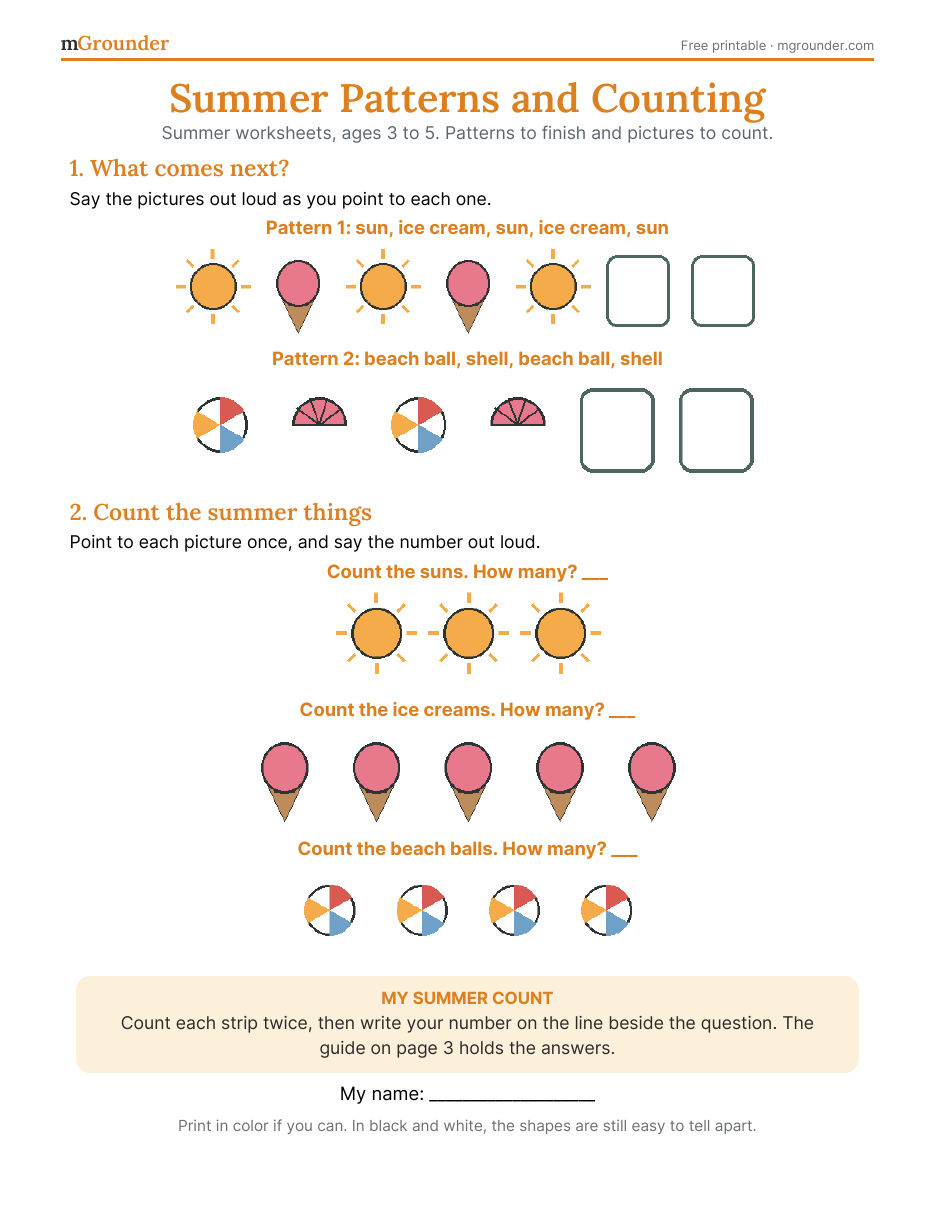
Ages 3 to 5: patterns, counting, and letters
Two summer patterns, three counting strips, circle the summer word, a letter hunt, a drawing box, and a grown-ups guide.
Download the ages 3 to 5 summer worksheets (PDF, 3 pages)Print in color if you can, and keep each sheet to ten minutes.
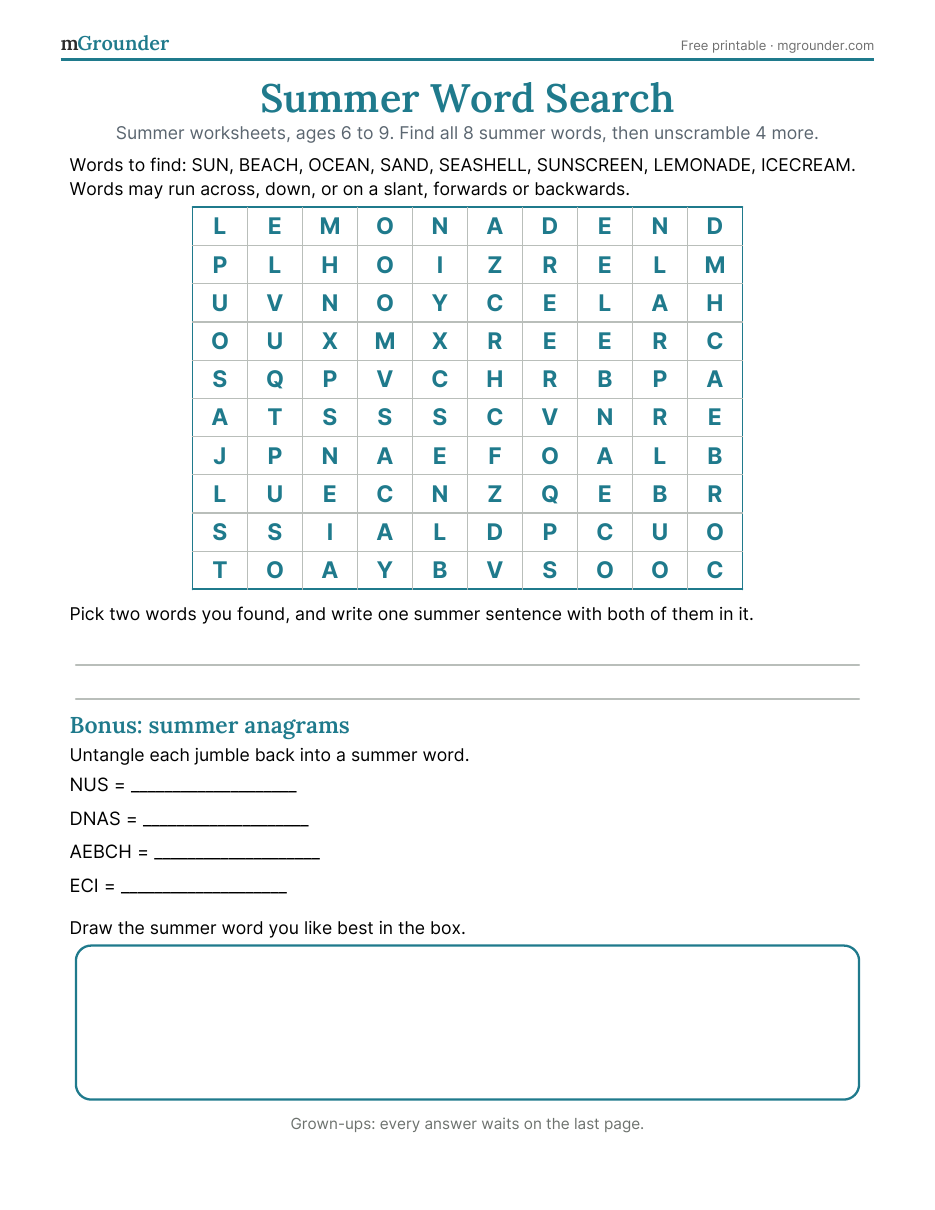
Ages 6 to 9: word search, sums, codes, and science
A summer word search, anagrams, six shop sums, four secret codes, a science quiz, writing prompts, and a grown-ups guide.
Download the ages 6 to 9 summer worksheets (PDF, 4 pages)Cut nothing out, and keep the guide closed until the work is done.
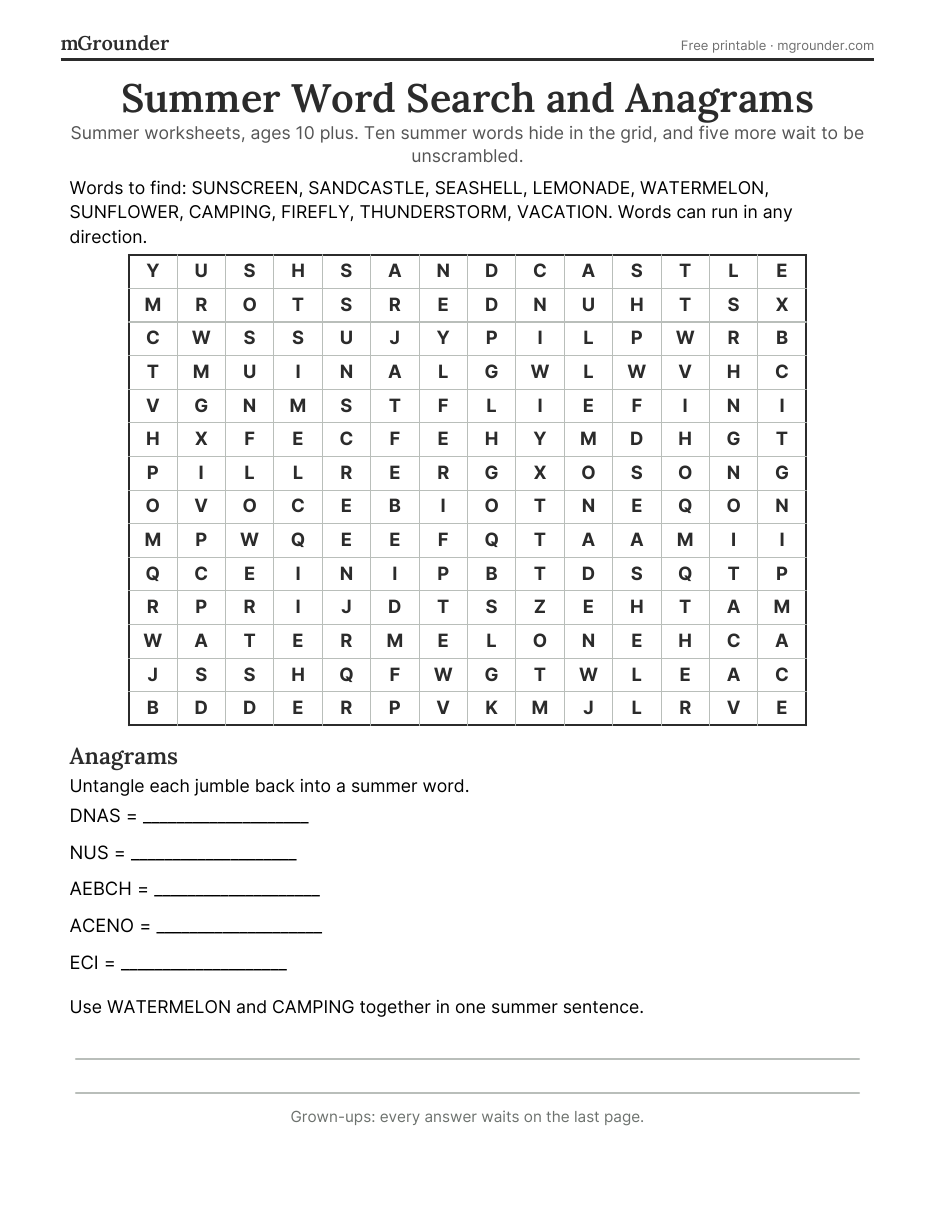
Ages 10 plus: the ink-friendly summer challenge
A ten word search, five anagrams, four math problems, summer science, a secret message, writing lines, and a grown-ups guide.
Download the ages 10 plus summer worksheets (PDF, 3 pages)It prints cleanly in black and white, and the secret message is the part older children keep coming back to.
Print the one version that fits, tonight.
Put the pack on the table beside the beach bag, hand over a pencil, and let the first morning of the break start with a small win.
September will come soon enough, and by then the skills will still be warm.