You are at the park and it happens again.
Another toddler, about the same age as yours, points at the slide and says a whole sentence.
“I want to go down the slide.”
Your child points too. He says one word.
“Dat.”
You smile and help him up the steps.
But the sentence stays in your head all the way home.
That night, while he sleeps, you count.
How many words does he actually have?
Mama. Dada. Ball. Dog. More. No. Maybe twelve in total. You remember a leaflet from the health visitor.
It mentioned fifty words by two. Your child turns two in fifteen days.
Twelve is not fifty. You open your phone at midnight and type the question you have been avoiding.
Is something wrong with my child? Every parent who has typed that question knows the feeling behind it.
It is not really about the number.
It is about the fear that you have missed something.
That everyone else can see it and you cannot.
That your child is falling behind while you stood there smiling at the park.
This guide is for that midnight question.
It will show you what is actually happening inside a quiet toddler, what helps words come, and the one line that tells you when to ask your doctor.
Talking Is the Last Step, Not the First
Here is the reframe that changes everything: talking is the last step of language, not the first.
Long before a child says a word, they are building language underground.
They learn that sounds mean things. They learn that pointing gets a response.
They learn that a face, a voice, and a gesture all go together.
Words sit on top of all of that, like the roof on a house.
You cannot see the foundations from the street.
But they are there, holding everything up.
That is why two toddlers can look so different and both be fine.
One is building the roof early.
The other is still pouring the foundations.
Both are building the same house.
Your child understands far more than he says.
He follows instructions, finds the shoes, points at the dog when you ask where it is.
That understanding is language. It just does not sound like it yet.
Think of it as a system you can copy: the Talk Loop.
Three steps, in order, five times a day.
Name it, wait, answer. Name what he is looking at, in one or two words.
Wait ten seconds, which feels like forever.
Then answer whatever sound he makes, with one more word added on.
He points at a bird and says “buh”.
You say, “Bird. Big bird.” That is the Talk Loop, all of it.
Five loops a day, every day, and the words have somewhere to grow.
1. He Understands Far More Than He Says
Start with the simplest test, and it is one you can do at breakfast.
Ask your child to fetch his shoes.
Not while pointing at them. Just the words. “Can you get your shoes?”
Watch what happens. If he toddles off and comes back with a shoe, he understood every word.
He just did not need to say any of them back.
Here is a distinction that helps: understanding and speaking are two different jobs.
Understanding comes first, always. A child who follows instructions, finds the right toy, and points at the dog when you ask is a child whose language is working.
Speaking is the second job, and it arrives on its own timetable.
One is not a substitute for the other.
They are two halves of the same skill.
Try it in the kitchen too.
“Put the cup on the table.”
“Give the book to Daddy.”
Two step instructions, no pointing, no acting it out.
Every time he gets it right, that is a word understood.
Count those, not just the words he says.
You can say to him, “You found the shoes. You knew just what I meant.”
That sentence tells him his understanding counts.
It does, and it is the ground the words will stand on.
2. Gestures Are Words Too
Your child points at the biscuit tin and looks at you.
He waves goodbye at the door.
He brings you a book and puts it in your lap.
None of those are spoken words.
All of them are communication. A gesture is a child saying something with his hands because his mouth is not ready yet.
Pointing is one of the most important gestures there is.
It means, “I see that, I want you to see it too, and I want you to tell me about it.”
That is a conversation, just without the words.
Watch for the full set. Pointing, waving, nodding, shaking his head, reaching up to be held, bringing you things.
Each one is a sentence in gesture form.
Answer them like sentences. He points at a dog.
You say, “Dog. Yes, a big dog.”
He brings you his shoes. You say, “Shoes. We are going out.”
You are not just chatting. You are showing him that his message landed, and that words are how you answer back.
For more on the words that help toddlers, see Talking to Toddlers: What to Say and What to Avoid.
3. He Talks More When You Talk Less
This one feels backwards, and it is the hardest to believe.
The less you fill the silence, the more space your child has to fill it.
Most of us talk over our toddlers without noticing.
We ask a question and answer it ourselves a second later.
“Do you want the red cup or the blue cup? The blue one, right? Here you go.”
There was no gap for him to step into.
The fix is one number: ten seconds.
Ask, then wait ten slow seconds. Count them in your head if you have to.
One, two, three, four, five. It will feel like a very long time.
It is not. It is the time a small child needs to find a word and push it out.
Try it at snack time tomorrow.
Hold up two pieces of fruit and ask, “Apple or banana?”
Then close your mouth and wait.
He may point. He may say “nana”.
He may say nothing at all.
Whatever he does, answer it like it was a full sentence.
“Banana. You want the banana.”
You can say, “I am waiting. Take your time. I am right here.”
That sentence is a gift. It tells him there is no rush, and that his words are worth waiting for.
4. One Word, Many Jobs
Listen to the words your child already has, and notice how hard each one works.
“Mama” can mean five different things before lunch.
It can mean Mum, milk, more, help, or I am tired.
Same word, five jobs. That is not a small vocabulary.
That is a child stretching one tool to cover his whole world.
Watch how he changes his voice to make the same word mean something new.
“Mama” said flat is a statement. “Mama?” said high is a question.
“Mama!” said loud is a call for help.
He is already doing the work of sentences.
He is just doing it with one word and a lot of tone.
Your job is to catch the meaning and hand the word back, slightly longer.
He says “mama” and points at his cup.
You say, “Mama, more milk.” He says “mama” at the door.
You say, “Mama is here.” You are not correcting him.
You are showing him the next word, attached to the one he already owns.
Keep a small note on your phone for a week.
Write down each new word the day it appears.
Most parents are surprised. The list grows faster than the midnight counting suggested, because midnight counting always forgets the words that arrived quietly.
5. The Nursery Chatterbox and the Home Quiet One
Some toddlers talk all day at nursery and go quiet at home.
Others are silent with strangers and chatter nonstop with you.
Both are normal, and both tell you the same thing.
Talking depends on feeling safe. A child talks most where the pressure is lowest.
At nursery, the other children do the talking and your child joins in, like singing along to a song someone else started.
At home, you are the audience, and the audience is harder.
All eyes are on him.
Or it works the other way around.
Home is where he can relax, and nursery is where he watches and listens instead.
Watching is not failing. A child who watches other children play is learning how the game works before he joins it.
Ask the nursery what they see, in their words.
Not “is he talking?” but “what does he do when he wants something?”
The answer will tell you more than any number.
If he points, gestures, and joins in, he is communicating.
He is just doing it in the place where it feels easiest.
You can say at home, “You told your teacher about the train today. Tell me too.”
Then wait. No audience, no test, just an invitation.
For more on the small daily moments that build language, see Toddler Routines.
6. The Comparison Trap
Here is the part nobody warns you about.
The comparison starts the day your child is born, and it never really stops.
The cousin who talked at fourteen months.
The neighbour’s daughter who knows her colours.
The group chat where someone posts a video of their toddler counting to ten.
Every comparison has the same hidden message.
Your child is behind. That message is wrong, and here is why.
Milestone charts show averages, not deadlines. An average is the middle of a wide spread, and the spread is the point.
Some children say fifty words at eighteen months.
Some say them at twenty-six months. Both are inside the normal range.
The chart cannot see your child.
It cannot see that he understood every instruction at breakfast, that he points, that he waves, that he brings you books.
It sees one number, and it calls that number the whole story.
It is not. When the comparison starts in your head, answer it with one fact.
“He understands everything I say, and his words are coming.”
That fact is yours. Nobody in the group chat can take it away from you.
What Not to Do, Even When You Are Worried
The most common instinct is to quiz him.
“Say ball. Say ball. Can you say ball?”
It feels like teaching. To a toddler, it feels like a test he keeps failing.
Quizzing makes talking stressful, and stressful talking stops altogether.
Replace the quiz with the Talk Loop.
Name it, wait, answer. Another instinct is to finish his sentences for him.
He points and starts a sound, and you jump in with the whole word before he gets there.
It is kind, and it is fast.
But it teaches him that someone else will always do the talking for him.
Wait the ten seconds instead. Let him reach the word himself, even if he only gets halfway there.
Now the objection every parent raises: but if I just wait, will I not miss the window to help him?
Here is the truth of it. Waiting is not doing nothing.
The talking you do, the naming, the answering, the ten seconds of silence, that is the work.
It is how words grow.
And asking your pediatrician early is never wasted.
A check that finds nothing is not a wasted visit.
It is peace of mind, and peace of mind is worth the appointment.
One more boundary to name plainly: talk to your pediatrician if your child does not respond to his name, does not point or wave, has lost words he once had, or does not seem to understand what you say.
Also talk to them if your gut says something is off, even if you cannot name what it is.
Parents are usually right about that feeling.
A doctor can check what a midnight search cannot.
For help when the worry itself is the loudest thing in the room, see How Children Act When They Don’t Feel Safe Emotionally.
In the Moment: The Talk Loop
When he points at something and you want words to follow, hold this sequence in mind.
Three steps, nothing new, just the pieces from this guide in order.
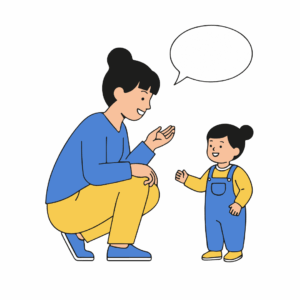
Step one: get down to his level.
Kneel, make eye contact, and look at what he is looking at.
Step two: name it, in one or two words.
“Bird. Big bird.”
Step three: wait ten seconds, then answer his sound with one more word.
He says “buh”. You say, “Bird. Big bird.”
Three steps: down, name, answer. Do it five times a day.
At breakfast, at the park, in the bath, at the bookshelf, at bedtime.
Five small loops, and the day does the teaching for you.
Do not turn it into a lesson.
There is no test at the end.
There is just a child, a parent, and a bird, and the words arriving in their own time.
You can hold the loop in your head even when the day is busy and the house is loud.
Words Come in Their Own Time
Your child will talk. Not on the chart’s timetable, and not on the cousin’s timetable, but on his.
The understanding is already there.
The gestures are already there.
The one word doing five jobs is already there.
Try one thing tonight. Pick five moments for tomorrow and write them on a scrap of paper.
Breakfast, the park, the bath, the bookshelf, bedtime.
At each one, name something, wait ten seconds, and answer whatever sound he makes.
That is the whole plan.
Name it, wait, answer. For more on the words that build a child’s confidence, see Phrases That Help Kids Build Self-Regulation.
The words are coming. Your job is not to pull them out of him.
Your job is to keep talking, keep waiting, and keep answering, until one day he answers you back in a full sentence.
And when he does, you will know exactly how it happened.
One word at a time, in his own time.