The school gate opens at half past three.
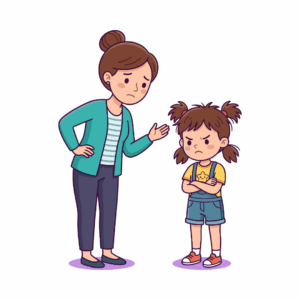
Your daughter climbs into the back seat, buckles herself in, and stares out of the window.
You ask how her day was.
She says fine.
One word, flat as a stone.
You try again at the traffic light.
What did you do today?
Nothing.
You know something happened today.
A friend, a teacher, a game that went wrong.
But the words are not there yet, and the silence grows louder with every red light.
The feeling gets there first.
The words come later, sometimes hours later, sometimes not at all.
That gap is where hard afternoons unravel.
Not because you handled it badly, and not because your child behaved badly, but because a feeling with no name has nowhere to go.
So it comes out sideways.
In slammed doors, in tears over the wrong color cup, in a child who says she is fine while her whole body says otherwise.
A chart gives that feeling a shortcut.
One face, one word, one pointed finger.
One pointed finger can say what a whole sentence cannot.
When a child can point at mad, the mad gets smaller.
When a child can point at sad, the sad gets company.
That is the entire job of this chart.
It does not track feelings, it does not teach calming moves, and it does not sort feelings by size.
Naming comes first.
Everything else can wait until naming feels easy.
This chart comes in three versions, one for each age, because a four year old and a ten year old do not need the same words.
It is free, with no email and no sign-up.
Print it tonight, hang it where your child can reach it, and start with the picker below.
Try it right now: how is your child feeling?
Before you print anything, try the chart right here.
Think of your child in this moment, or the last hard moment of the day.
Tap the face that fits.
Each face shows where that feeling lives in the body, the exact words to say, and one small thing to try.
How is your child feeling right now?
Tap a face. The words and the next step appear below.
Pick a face above, and this box turns into your next step.
Happy
WHERE IT LIVES
A light chest and bouncy legs.
SAY THIS
“You look happy. Tell me the best part.”
TRY THIS
Let them tell it twice. Happy grows when it gets heard.
Sad
WHERE IT LIVES
A heavy chest and droopy shoulders.
SAY THIS
“You feel sad. Sad is heavy. I will sit with you.”
TRY THIS
Sit close and stay quiet. No fixing, just company.
Angry
WHERE IT LIVES
Tight fists and a hot face.
SAY THIS
“Mad is allowed here. I am not going anywhere.”
TRY THIS
Squeeze a pillow together, then let go and feel your hands soften.
Scared
WHERE IT LIVES
A fast heart and a fluttery tummy.
SAY THIS
“That felt scary. I am right beside you.”
TRY THIS
Name one safe thing in this room, then one more.
Excited
WHERE IT LIVES
Buzzy hands and a wiggly body.
SAY THIS
“You are so excited. Your whole body is buzzing.”
TRY THIS
Give the excitement a job. Ten jumps, then one deep breath.
Tired
WHERE IT LIVES
Heavy eyes and a slow body.
SAY THIS
“Your body looks tired. Rest is allowed.”
TRY THIS
A quiet corner, a drink of water, and no more questions tonight.
Calm
WHERE IT LIVES
Slow breathing and soft shoulders.
SAY THIS
“You look calm. That is a good feeling to notice.”
TRY THIS
Point at the calm face together, and stay in it for a minute.
Surprised
WHERE IT LIVES
Wide eyes and one quick breath.
SAY THIS
“That surprised you. Big feelings can arrive fast.”
TRY THIS
Take one slow breath together, then ask what happened.
The picker above is a taste of the printed chart.
On the wall, the same eight faces wait all day, and your child can point without a screen, without asking, and without finding the words first.
See the three charts
Three versions, one job: naming.
Each chart is a full kit, not just a poster.
Here is what each one holds.
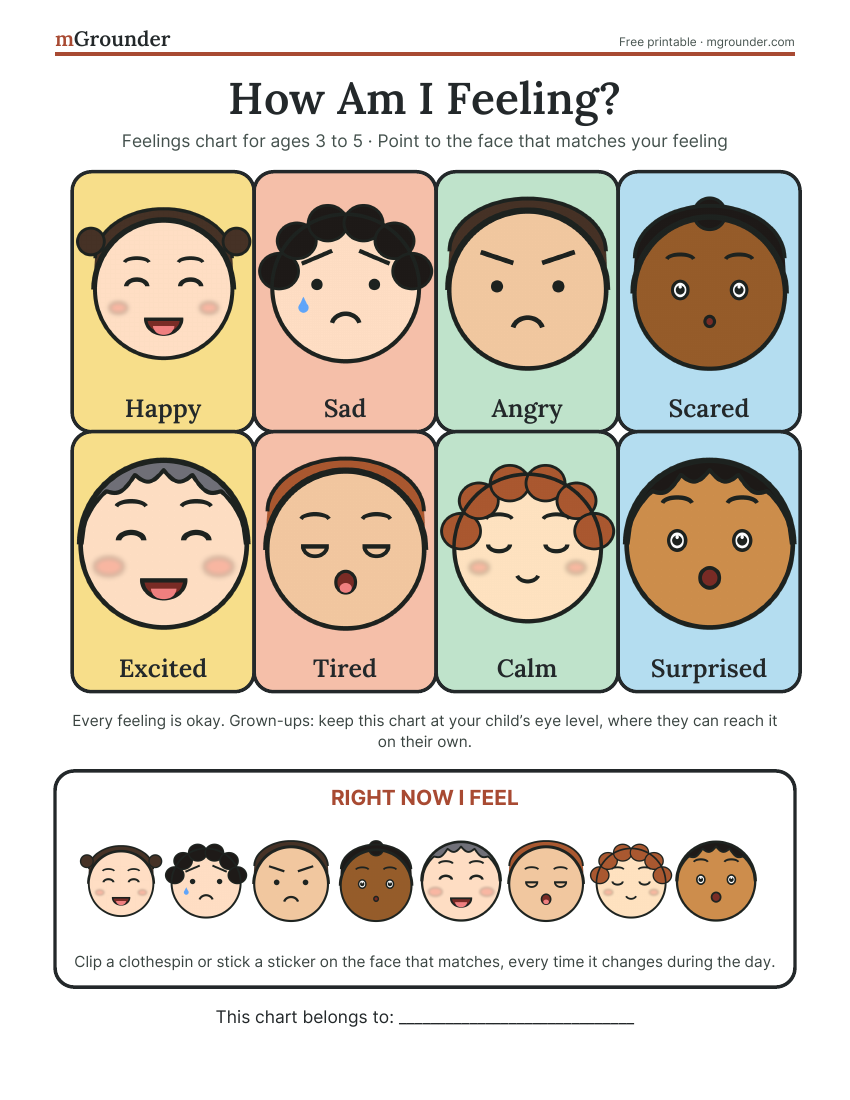
Ages 3 to 5: eight big feelings
Eight big faces a small child can read from across the room.
A daily check-in page to use again and again.
A grown-ups page with exact words to say.
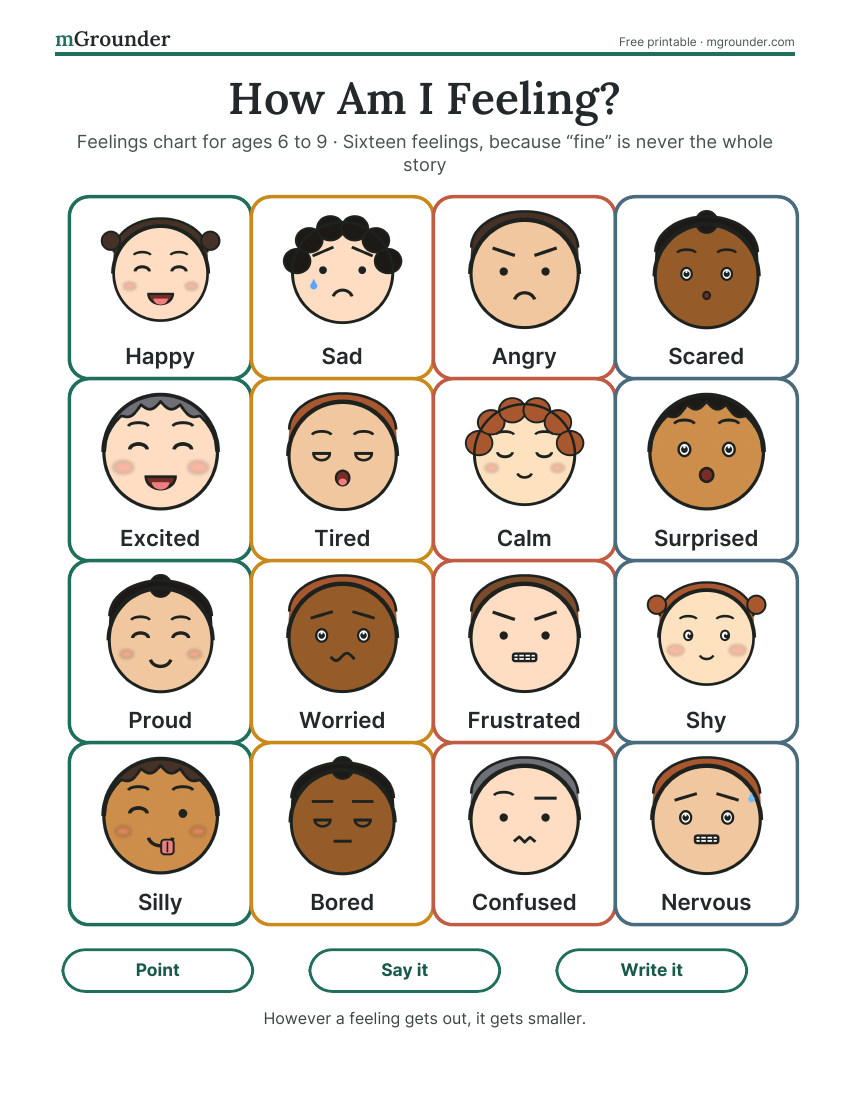
Ages 6 to 9: sixteen feelings
Sixteen feelings for the in between states, like frustrated, worried, nervous, and proud.
A feelings journal, a body clues page, and a calm down menu with six resets.
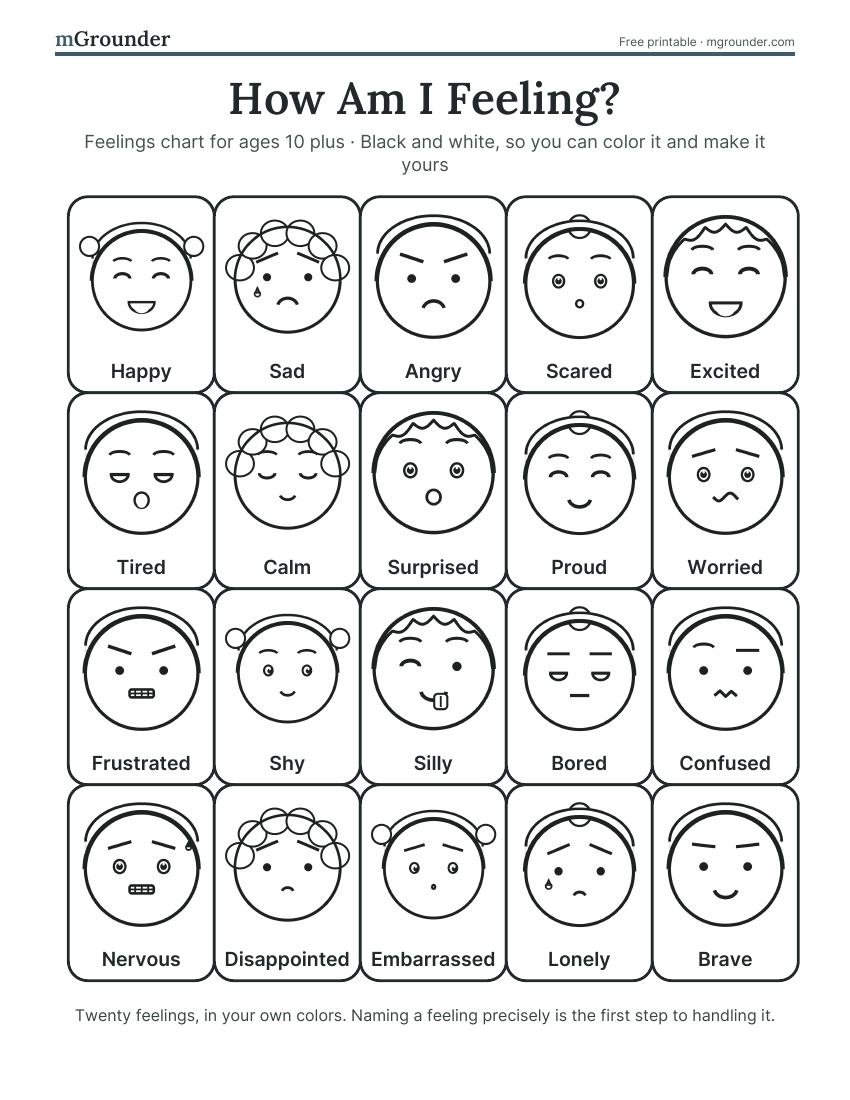
Ages 10 plus: twenty feelings, ink friendly
Twenty feelings in black and white, made to color.
A precise word bank, reflection prompts, and a weekly tracker that helps older kids spot their own patterns.
Which version is yours
Age is a starting point, not a rule.
Watch what your child needs, and pick the version that fits that need.
Ages 3 to 5. Start here if your child is still learning the first eight words for feelings. Big faces, almost no reading, and a grown-ups page that does the talking for you.
Ages 6 to 9. Move here when fine and good stop being enough. Sixteen words, a journal habit, and body clues that teach your child where feelings live before they have names for them.
Ages 10 plus. Choose this one when your child wants words that fit precisely. Twenty feelings to color, a word bank, and a tracker for spotting patterns across a week.
If two versions both seem right, take the simpler one.
A chart that feels easy gets used.
A chart that feels like schoolwork gets ignored.
Three small habits that make it work
A chart only works if it gets used.
Three small habits make that happen.
Point first yourself.
At breakfast, walk past the chart, tap your own face, and say the word out loud.
“I feel glad we are eating together.”
One sentence teaches three things.
Feelings have names, grown-ups feel them too, and naming belongs in ordinary days.
Answer with the same word.
When your child points, say the word back and stop there.
“You feel mad.”
Then pause.
The pause tells your child the feeling was heard, and being heard is enough for now.
Once a child feels heard, the words often keep coming.
Some will just wander off to play, and that ending is fine too.
Use it after the storm.
Once everyone is calm, walk back to the wall together and ask which face matched the hard part of the day.
Looking back from a calm place builds the same skill without the pressure of tears.
Bedtime suits this kind of looking back.
Ask which face matched the brightest moment, and which one matched the hardest.
Two faces, two short answers, and the day ends with feelings spoken instead of carried quietly into sleep.
If shouting has become the pattern when feelings run high, the words in What to Say Instead of Yelling are worth keeping beside the chart.
Download your chart
All three versions are free.
Free means free. No sign-up, no payment, nothing to join.
Print what you need.
Print the chart page at full size, on plain paper or card.
Hang it low, at your child’s height, not at yours.
Versions A and B look best in color, and one print lasts for months on a wall.
Version C prints in black and white, so it costs very little in ink.
Slip the chart into a page protector if it will live on the fridge.
Print the journal and tracker pages fresh each week.
A child who can name frustrated does not need to shout it.
Start there.
Begin on a calm day, copy some faces together, and let naming turn into the easiest part of a hard feeling.
When the tears are aimed at you, and your child tells you they do not love you, it stings in a way a chart cannot fix. Toddler Says I Don’t Love You walks through that exact moment.