It is Saturday morning, and the cereal is already going cold.
Your son sits at the table with his spoon in his fist.
You ask what is wrong.
He says he does not know.
You ask again, slower this time.
He says it again.
He does not know.
He is not hiding the answer from you.
He does not have the answer yet.
The feeling arrived before the words did.
That happens to grown-ups too.
You know the tight chest before you know the word for it.
You know the buzzing hands before you know you are excited.
Children feel all of that, and they have even fewer words for it.
So the feeling stays stuck in the body.
It comes out as a slammed door, or a pushed-away bowl, or a child who says he does not know while his whole body says otherwise.
This chart starts in the body, not in the word.
Every card shows a face, a body clue, and one helper to try.
Name it.
Feel it in the body.
Try one helper from the card.
That is the whole lesson.
It is the next step after naming, and it is the step that turns a poster into a skill.
If your child still needs the naming step first, the Feelings Chart for Kids is the place to start.
This chart is for the child who can name mad, and still does not know what to do with it.
It comes in three versions, one for each age, because a four year old and a ten year old do not need the same words.
It costs nothing, and there is no email gate.
Print it tonight, and start with the picker below.
Try it right now: what is the body saying?
Before you print a page, give the chart a try right here.
Picture your child right now, or at the hardest moment of the day.
Tap the body clue that fits.
Each clue shows the feeling it might be, the words to say, and one helper to try.
What is your child’s body saying right now?
Tap a clue. The feeling, the words, and the helper appear below.
Pick a clue above, and this box turns into your next step.
Tight fists
IT MIGHT BE
Angry, or frustrated. The hands squeeze when the feeling has nowhere to go.
SAY THIS
“Your hands are tight. That is angry in the body.”
TRY THIS
Squeeze a pillow, then let go and feel your hands soften.
Fluttery tummy
IT MIGHT BE
Worried, or nervous. The tummy flutters when the thoughts start racing.
SAY THIS
“Your tummy is fluttering. That is worried.”
TRY THIS
Write the worry down, then ask for help together.
Heavy shoulders
IT MIGHT BE
Sad, or tired. The shoulders droop when the day has been too much.
SAY THIS
“Your shoulders look heavy. That is sad.”
TRY THIS
Ask for a cuddle and sit close for a minute.
Hot face
IT MIGHT BE
Embarrassed, or angry. The face heats up when a feeling arrives fast.
SAY THIS
“Your face feels hot. That happens when we feel embarrassed.”
TRY THIS
Take one slow breath, then move on. Everyone has awkward moments.
Wiggly body
IT MIGHT BE
Excited, or silly. The body wiggles when the feeling is too big to sit still.
SAY THIS
“Your whole body wants to wiggle. That is excited.”
TRY THIS
Jump three times, then take one slow breath.
Heavy eyes
IT MIGHT BE
Tired. The eyes go heavy when the body has run out of fuel.
SAY THIS
“Your eyes feel heavy. That is tired.”
TRY THIS
Rest with a book and a blanket, and no more questions tonight.
That is the whole chart in miniature.
On the wall, the same clues wait all day, and your child can point without a screen and without finding the words first.
The three steps on every card
Every card on this chart carries three things.
A face, a body clue, and one helper.
Three steps, in order.
Name it. Point at the face together and say the word.
A named feeling can be talked about.
An unnamed one can only be acted out.
Feel it. Read the body clue out loud.
“Your fists are tight. That is what angry feels like in the body.”
The clue tells the child where to look.
A tight fist is easier to notice than a feeling.
Try it. Pick one helper from the card and do it together.
One helper is enough.
A child who is already upset cannot choose from a list.
Afterward, ask one question.
“Did that help?”
The answer tells you what to try next time.
The helper is the part most charts skip.
Naming is step one.
This chart is step two.
That is why it sits beside the Feelings Chart for Kids, not instead of it.
The three charts, side by side
Three versions, one lesson.
Each version is a complete kit, with practice pages and a grown-ups guide inside.
Here is what sits inside each one.
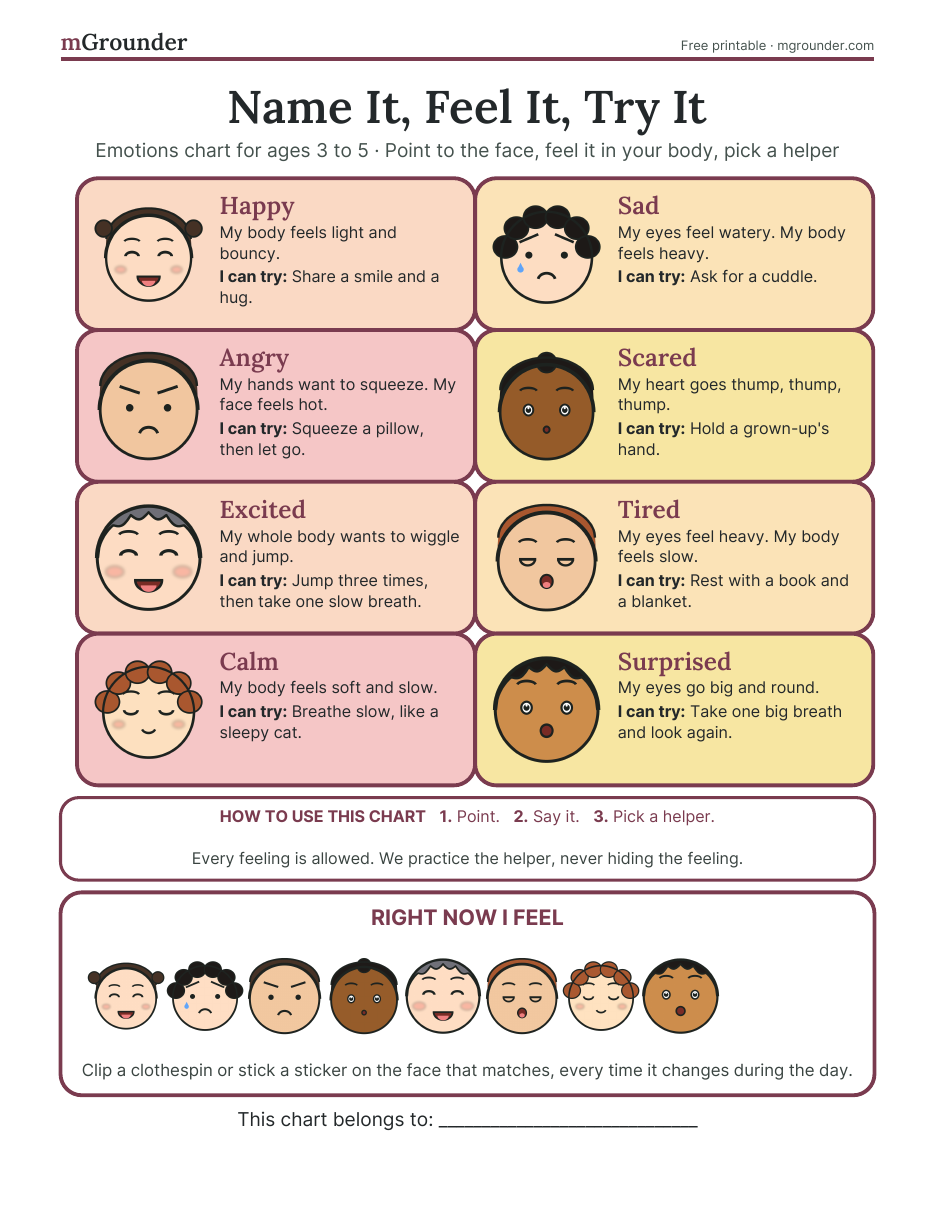
Ages 3 to 5: eight big feelings
Eight large faces, clear enough for a small child to read from the doorway.
Each card ends with one helper a little child can actually do.
A practice page to use again and again, and a grown-ups page with exact words to say.
Pick this one if your child is still learning the first eight words for feelings.
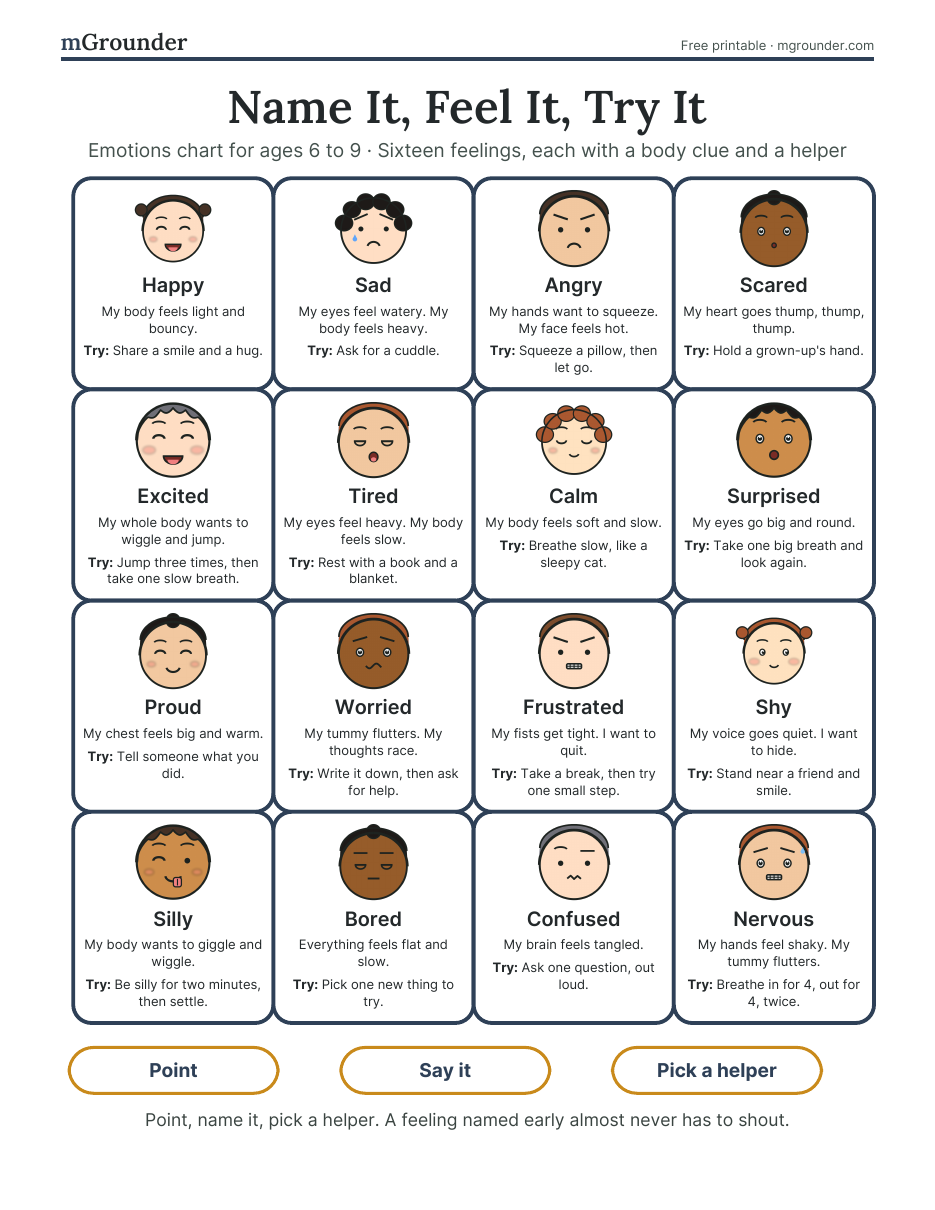
Ages 6 to 9: sixteen feelings
Sixteen feelings, with room for the ones between happy and sad: frustrated, worried, nervous, proud.
A detective game that matches stories to feelings and helpers.
A calm-down menu your child builds and owns.
Pick this one when “fine” stops telling you anything.
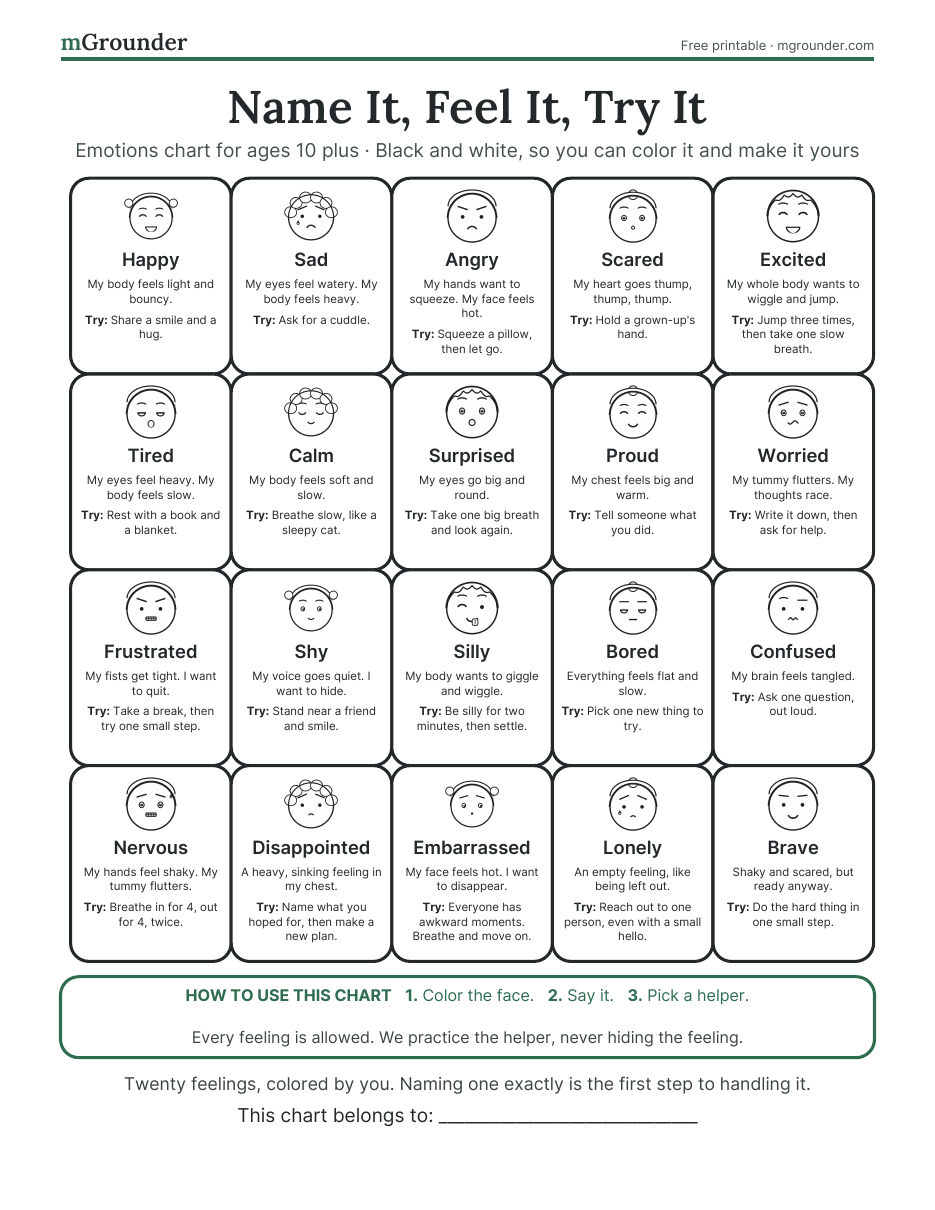
Ages 10 plus: twenty feelings, ink friendly
Twenty feelings in black and white, ready to color in.
A reset plan your child writes for themselves: their feelings, their body signs, their best helpers.
A weekly tracker that pairs each feeling with the helper tried, so the pattern shows up on paper.
Pick this one when your child wants words that fit precisely, and helpers they chose themselves.
When two versions both fit, start with the easier one.
The easy one is the one your child will actually reach for.
Where the chart earns its keep
At breakfast, the check-in takes one minute.
Each child points to a face on the way to the table.
No discussion, no fixing.
Just a finger on a face, and the day starts named.
After school, the whole day arrives at once.
A snack first, then one question.
“Point to the face that matches your afternoon.”
A pointed finger answers faster than “how was school.”
In a calm corner, the chart is the wall that talks.
Hang it low, beside the pillow and the paper and the cold water.
Three moves, no lectures.
Point, say it, try one helper.
Teachers use the same chart as a morning check-in for the whole room.
One pointed finger per child, and the room is read at a glance.
The detective page runs as a circle-time game.
One story a day, and the class votes on the feeling.
When feelings end in shouting, the chart alone will not fix it.
The words in What to Say Instead of Yelling are worth keeping beside it.
Download the chart
All three are free, with no sign-up and nothing to join.
Print the one that fits your child.
Print the chart at full size.
Plain paper works, and card lasts longer.
Hang it where your child can reach it without asking.
Print A and B in color.
Print C in black and white. The faces are made to color in.
A page protector keeps the chart safe on the fridge, and the practice page works with a dry-erase marker inside one.
Fresh practice and tracker pages each week keep the habit alive.
A child who can point at frustrated and pick a helper does not need to shout to be heard.
Start there.
Begin on a calm day, point at faces together, and let the body clues do the teaching.
Some moments need words, not a chart.
When your child says they do not love you, Toddler Says I Don’t Love You walks through that exact moment, word by word.