The phone is wedged between your ear and your shoulder, and your tea has gone cold on the counter.
Then small hands land on your leg.
“Mom.”
“Mom.”
“MOM.”
Your child is climbing you mid-sentence, one knee on your thigh and one sticky hand on your chin.
You try to keep listening, and you try to nod at the right places, but your voice goes thin.
Your child pulls at your sleeve again, harder this time.
It is not a big moment.
It is a Tuesday, the washing is still in the machine, and someone on the phone is waiting for an answer.
Waiting has no shape for a small child.
To an adult, waiting means standing still and staying quiet for a bit.
To a child, waiting means the words are already in the mouth and there is nowhere for them to go.
So the child climbs, and tugs, and repeats your name until the sound fills the room.
That is not rudeness. That is a child with no job to do while the grown-ups talk.
A Hand on the Arm
Give waiting a job, a job the child can feel.
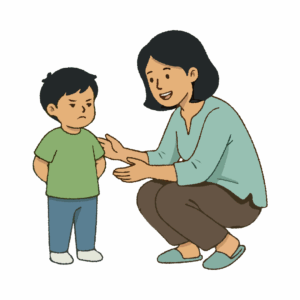
When your child comes to you mid-sentence, put your hand over theirs and keep talking.
Do not stop the call, and do not wave the child away.
Just let your hand rest there, warm and steady, on top of that small hand.
Then say it plainly, while you are still listening to the other person.
“Hold my hand while I finish, then it is your turn.”
That is the whole ritual. Hand on the arm, hand held, and a turn promised.
The child is no longer outside the conversation, pushing at the door. The child has a place in it.
A hand to hold, a job to do, and a turn coming next.
At the front door, it looks the same.
Your neighbor is holding a parcel, and your child is holding a toy car and a question about the car.
You take the small hand, and you keep it in yours while you say thank you.
“Hold my hand while I finish, then it is your turn.”
At the shop, the belt is moving and the beeping is loud.
Your child wants the chocolate by the till.
You do not need a long explanation. You need one hand and one sentence.
“Hold my hand while I finish, then it is your turn.”
The Turn Back
The ritual only works if the second half happens. You have to turn back.
Finish the call, put the phone down, and turn your whole face toward your child.
Then say it.
“I am finished. It is your turn now.”
Listen like the next thing matters, because to your child, it does.
Sometimes it is a dream about a dog with wings. Hear it all the way through.
Do not glance back at the phone.
Do not start the next job with your hands while your ears are still with your child.
That turn back is the lesson. Waiting ends, your turn comes, and grown-ups keep their word.
If you forget to turn back, say so straight away.
“I said it was your turn and then I walked off. I am sorry. Tell me now.”
Practice When Nothing Is Urgent
Do not teach waiting only in the middle of a phone call. Teach it when the house is calm.
Sit on the floor, and put a cushion between you.
Hold up your hand like a stop sign, soft and low.
“When I hold my hand up like this, it means hold my hand and wait a little.”
“Then I turn to you.”
Try it together.
Your child puts a hand on your arm, and you put your hand over theirs.
You finish your pretend sentence, and then you turn.
“I am finished. It is your turn now.”
Waiting feels different when it is a game first.
It feels possible, and it feels like something a body can do.
On the Phone, at the Door, in the Queue
Each place needs the same words, said in the same calm voice.
On the phone, you cannot kneel, and you cannot make eye contact, but you can still take the hand.
“Hold my hand while I finish, then it is your turn.”
If your child keeps talking over you, do not raise your voice to win the room back. Lower it.
“I hear you. Hold my hand. I will turn to you in a minute.”
“Hold my hand while I finish, then it is your turn.”
When the shopping is packed, turn.
“I am finished. It is your turn now. What did you want to tell me?”
When the Waiting Falls Apart
Some days it will fall apart.
Your child will be tired, and hungry, and will have held the words for too long already.
The hand will slip off your arm, and the voice will rise.
The tears will come, fast and loud, in the middle of the shop.
Do not lecture in that moment. Do not explain waiting while your child is already past waiting.
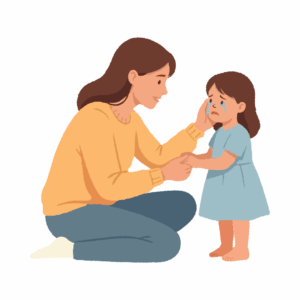
Get low, get close, and put a hand on their back.
“You waited and it felt too long. I am here. Tell me now.”
That is not giving in. That is noticing that the waiting stretched past what a small body could hold.
Later, say it plainly.
“Waiting was hard in the shop today. Next time we will hold hands at the till.”
If your child shouts your name again tomorrow, it does not mean the ritual failed.
It means the ritual is still new.
What Waiting Is Not
This is not the moment when your child stands on the sofa and calls out for you to watch a jump.
That moment is different. That child wants an audience.
This child wants a turn in a conversation that is already happening.
One wants eyes, and the other wants a pause, and then a listening ear.
Keep the two moments apart in your head. The words stay different because the need is different.
For the jump, you watch. For the interruption, you hold the hand, finish, and turn back.
Waiting is also not silence for the sake of silence.
It is not a child standing still while the adults talk for a long time.
It is a short pause with a hand to hold and a turn that really comes.
Give the turn before the waiting wears thin.
A short wait, kept well, builds trust faster than a long wait endured.
The Next Time the Phone Rings
Tomorrow the phone will ring again.
The tea will go cold again, and small hands will land on your leg again.
You will know what to do with them. Take the hand, say the sentence, finish, and turn back.
“Hold my hand while I finish, then it is your turn.”
Then, when you finish, turn your whole face toward your child.
“I am finished. It is your turn now.”