December arrives, and suddenly every parent needs the same thing.
Something to print, right now, that keeps a child happily busy.
Not a shopping trip.
Not another app.
A piece of paper, a crayon, and twenty quiet minutes.
That is what this kit is.
It is a Christmas activity pack, not a single coloring page.
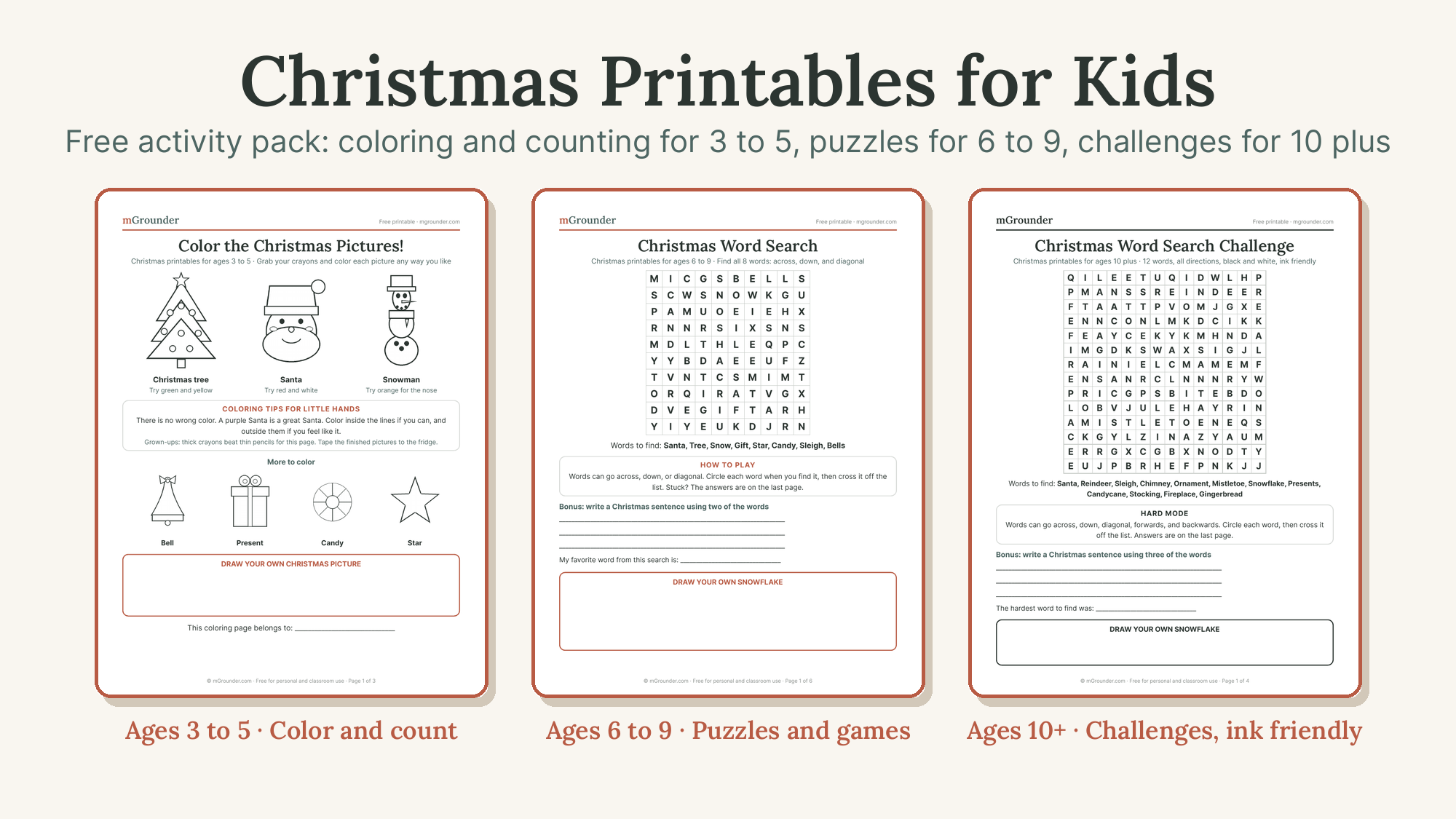
Three versions, one for each age, each one a different set of activities.
The little ones color and count.
The middle ones solve puzzles and hunt for differences.
The oldest ones take on a real word search challenge, trivia, a secret code, and a planner of their own.
No sign-up, no email gate, and no cost.
Just download the version that fits your child, print it, and let Christmas begin.
Which pack fits your child?
Tap an age. We will highlight the right version for you.
What is inside this kit
Every version is built around one idea: Christmas fun that works on paper.
No screens, no batteries, and nothing to buy.
Version A is for ages 3 to 5, and it starts with crayons.
It opens with a coloring page: a tree, Santa, and a snowman to color, plus a bell, a present, a candy, and a star.
A counting game follows, with rows of stars, presents, candies, bells, and trees to count and write in the box.
A matching game comes next, where your child draws a line from each picture to its name.
A wish list closes the version, with space for three wishes and one favorite Christmas food.
Version B is for ages 6 to 9, and it is where the puzzles start.
It opens with a word search: eight Christmas words hidden across, down, and diagonal.
A maze follows, where Santa must find his way from the green dot to the presents at the red dot.
A spot the difference game comes next, with two Christmas scenes and five changes to find.
A scavenger hunt follows, with eight things to find around the house.
A wish list and a full answers page close the version, so nobody stays stuck.
Version C is for ages 10 plus, and it is ink friendly black and white on purpose.
It opens with a word search challenge: twelve words, all directions, forwards and backwards.
A trivia quiz follows, with twelve questions every Christmas fan should know.
A code breaker comes next, where numbers turn into letters and spell a secret message.
A Christmas planner closes the main pages, with a gift planner, a meal planner, and a countdown checklist.
An answers page finishes the version, with the word search solution, every trivia answer, and the secret message.
All three versions are free for personal and classroom use.
Download the Christmas pack for your child’s age
Version A: Ages 3 to 5
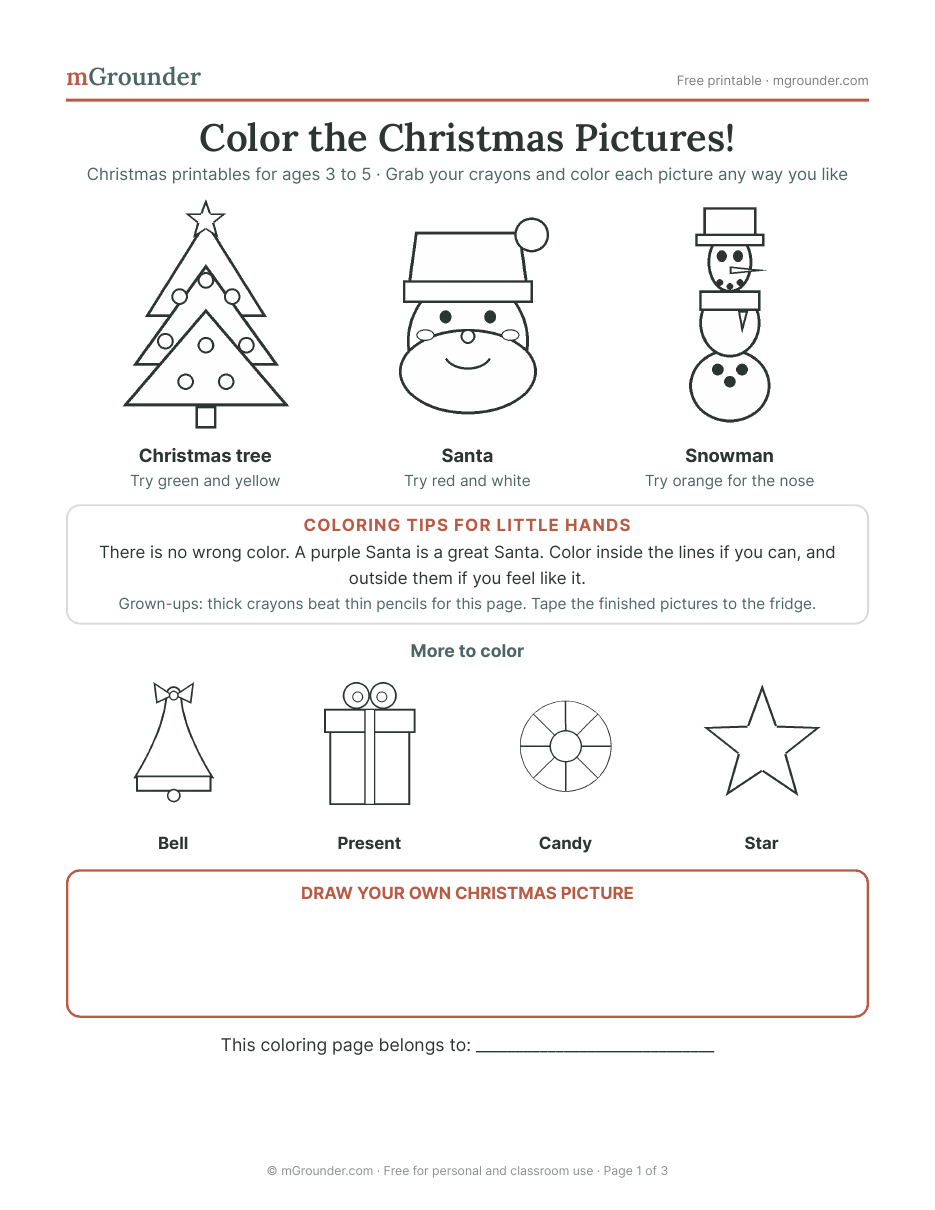
This version has 3 pages: the coloring page, the counting game, and the matching game with the wish list.
Print the coloring page first, because every small child wants to start with crayons.
Thick crayons work better than thin pencils for this age, and the finished pictures belong on the fridge.
Version B: Ages 6 to 9
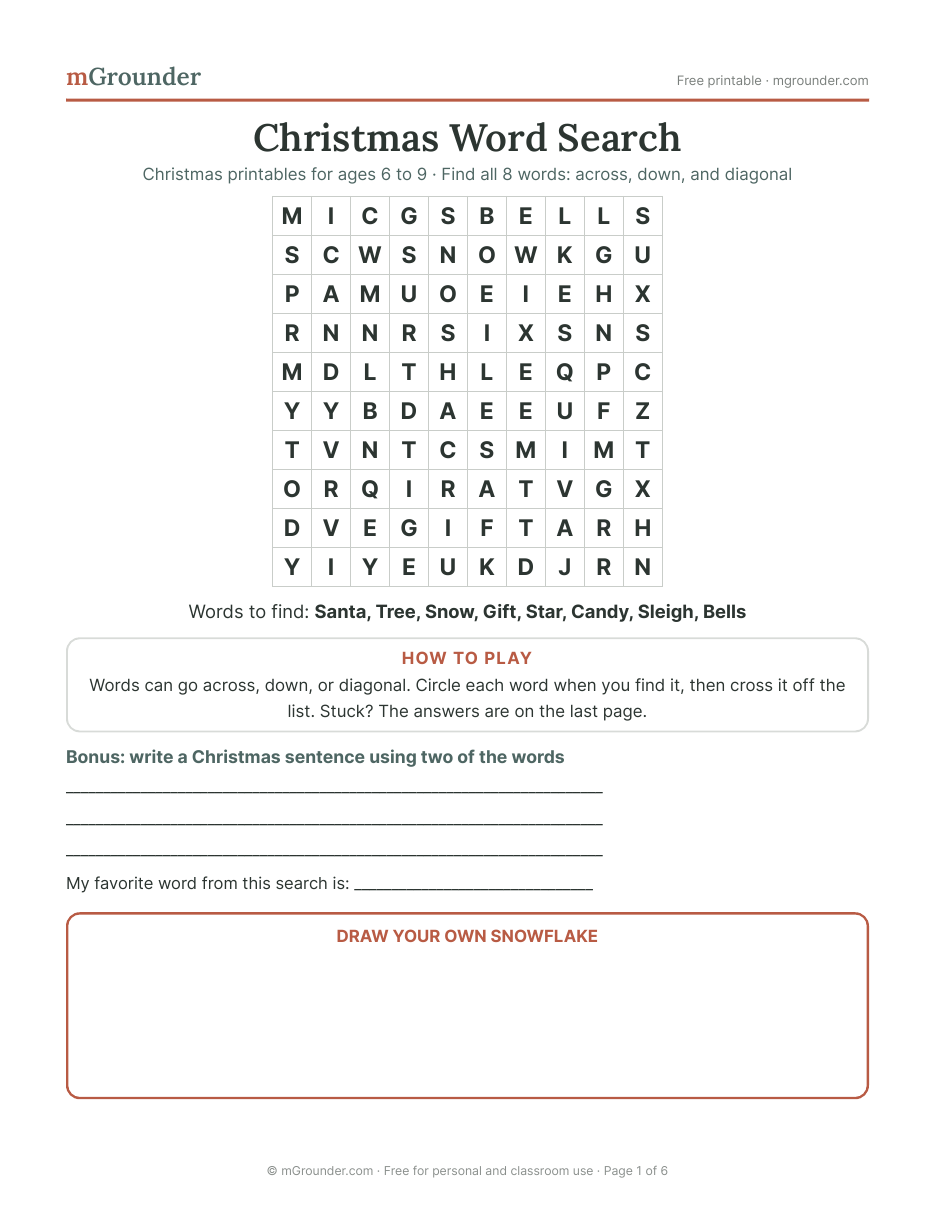
This version has 6 pages: the word search, the maze, the two spot the difference scenes, the scavenger hunt, the wish list, and the answers.
Print the whole pack double sided if you like, and let your child pick which puzzle to start with.
The answers page is at the back on purpose, so peeking takes real effort.
Version C: Ages 10 plus
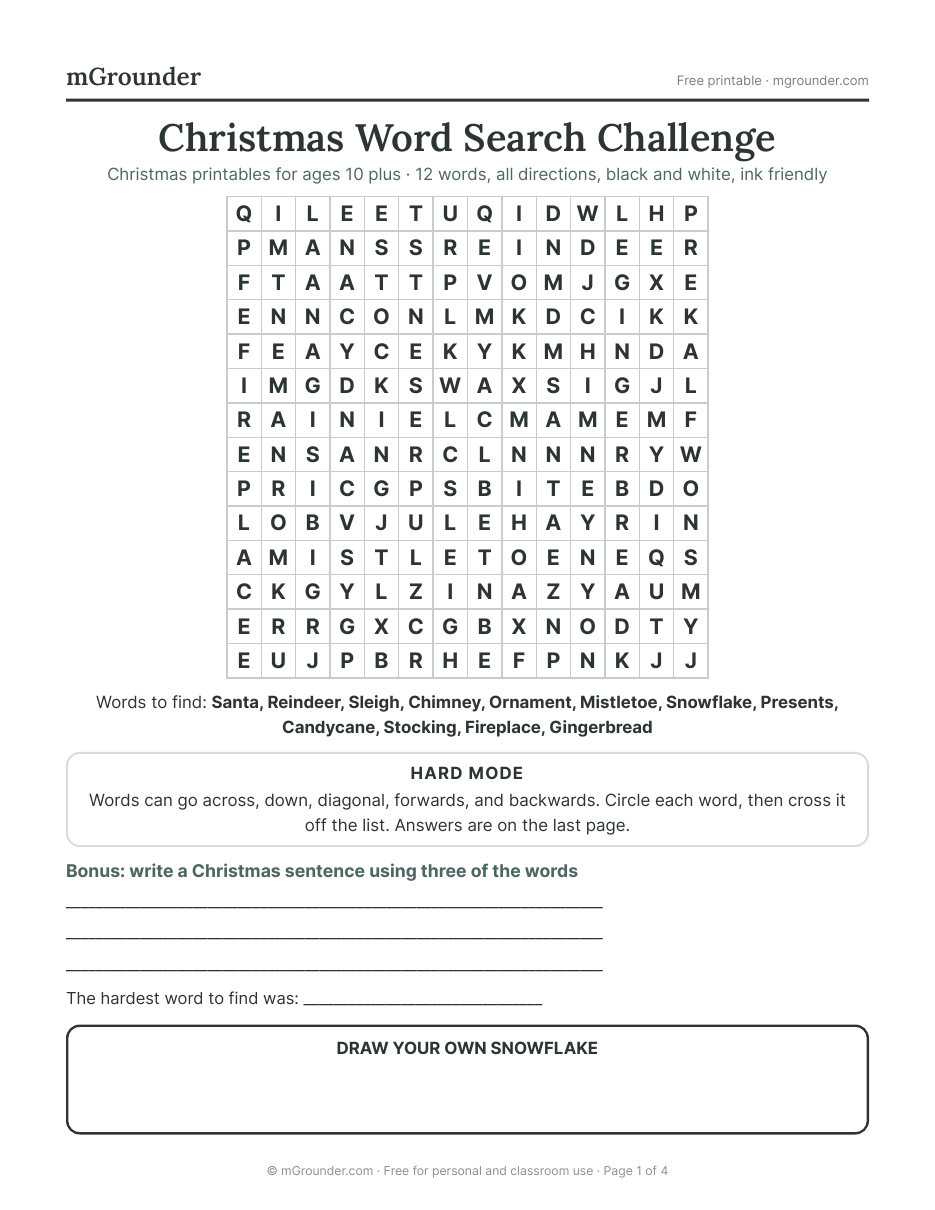
This version has 4 pages: the word search challenge, the trivia and code breaker, the planner, and the answers.
It prints beautifully in black and white, and costs almost nothing in ink.
The planner page is the secret star here: a child who plans Christmas feels like Christmas belongs to them.
How to run Christmas activity time
Pick the moment first, and then protect it.
After school, on a rainy Saturday, or on Christmas Eve morning all work.
One pack, one table, and no screens for twenty minutes.
Let your child choose which page to start with.
Choice is what turns a worksheet into play.
Sit nearby, but do not hover.
Help only when asked, and praise effort, not speed.
“That maze took real patience” beats “You finished fast” every time.
When a puzzle gets hard, offer a break, not the answer.
A walk to the window and back solves more mazes than staring does.
Finish with the wish list, always.
A child who ends on wishes ends on excitement, and excitement is the whole point of December.
Keep finished packs in a folder.
Next December, last year’s wish list is the best Christmas memory you own.
For teachers and counselors
This pack works as a classroom Christmas week, not just a single lesson.
Run Version A as a morning table activity, with crayons shared and counting done out loud.
Run Version B as a puzzle rotation: one table for the word search, one for the maze, one for spot the difference.
Run the scavenger hunt as a whole class game, with teams and a time limit.
Run Version C as independent work for fast finishers, or as a holiday homework pack that children actually want.
The planner page doubles as a writing exercise: planning is real writing, with a real purpose.
Print Version C in black and white for the whole class, because the ink bill stays tiny.
Never grade a Christmas pack, and never make it a race.
The child who colors slowly is still having Christmas.
Mistakes that quietly ruin a printable pack
Printing only one copy is the first mistake.
Siblings need their own pack, because sharing a word search ends in tears.
Printing at the wrong size is the second mistake.
Print at full page size, never “fit to page” twice, or the word search letters shrink past reading.
Skipping the answers page is the third mistake.
Print the answers too, even if you hide them, because a stuck child needs a way out.
Turning play into homework is the fourth mistake.
“Finish all six pages before dinner” turns Christmas into school.
“Pick your favorite page” turns school into Christmas.
Do the second one, always.
Printing tips
Print Version A in color if you can, because the coloring page deserves it.
Print Versions B and C in black and white without guilt, because both are designed for it.
Use plain paper for everything, and card stock only if a page will live on the fridge.
Print the scavenger hunt once per team, not once per child, because hunting works better together.
Keep a spare blank pack in the car for restaurant waits and long drives to grandparents.
A printed pack in the glove box has saved more December afternoons than any app.
Questions parents ask
What age is this pack for?
There is a version for ages 3 to 5, one for 6 to 9, and one for 10 plus.
Pick by reading level, not just by birthday, and move up a version when the puzzles feel too easy.
Is this pack really free?
Yes, completely free, with no sign-up and no email gate.
It is free for personal and classroom use, and you can print as many copies as you need.
How is this different from a single coloring page?
A single page lasts ten minutes, and this pack lasts a whole afternoon.
Coloring, counting, puzzles, games, and planning live in one download, so you print once and relax.
Can I use this pack in my classroom?
Yes, and teachers are exactly who it was made for.
Print Version C in black and white for the whole class, and run Version B as a puzzle rotation.
My child finishes everything in ten minutes. What then?
Hand them the planner page and ask them to plan a real Christmas task.
Planning the meal or the gift list is a second activity hiding inside the first one.
My child gets stuck on the word search. What then?
Let them peek at the answers page, then cover it and try again.
Peeking once and retrying teaches more than staring for an hour.
Do you have other free printables?
Yes, and this pack is part of a growing series.
Our Feelings Chart for Kids is the first in the series, and more printables are coming every week.
Keep going
Christmas is only the start of the printable series.
If your child loves naming and talking about feelings, our Feelings Chart for Kids is the place to start.
The Emotions Chart for Kids, the Emotion Chart for Kids, and the Feeling Chart for Kids are coming in the same series, each one free and each one for a different age.
Emotion cards, breathing exercises for kids, and a calm down corner kit are coming next in this series.
For the hard moments themselves, our post on What to Say Instead of Yelling and our post Toddler Says “I Don’t Love You”: Scripts for the Rejection Phase will help you stay calm and connected.
Print the pack tonight.
Put it on the table tomorrow morning, with crayons beside it.
Then watch what happens, because a child with a Christmas pack and twenty quiet minutes is December at its best.